
Marriott has a new feature in its app to let you tip hotel employees. A third party service processes the tips, and presumably passing a portion onto the hotel for staff. This isn’t about guest convenience, except to the extent that more convenient means more tips – and more tips means the hotel can hire workers at lower wages.
Digital tipping update on Marriott app
byu/Bored_Millenial- inEndTipping
This is a new escalation in hotel tipping, going a step beyond QR codes which finally found a use case during the pandemic. We started seeing QR codes for menus and various other applications. Hotels started using them to encourage tipping.
Tipping via QR code has spread in hospitality so that you now may find QR codes for tipping the front desk staff who checks you in, not just housekeeping. There are also now airport hotels that encourage tipping the shuttle driver via QR code, too.
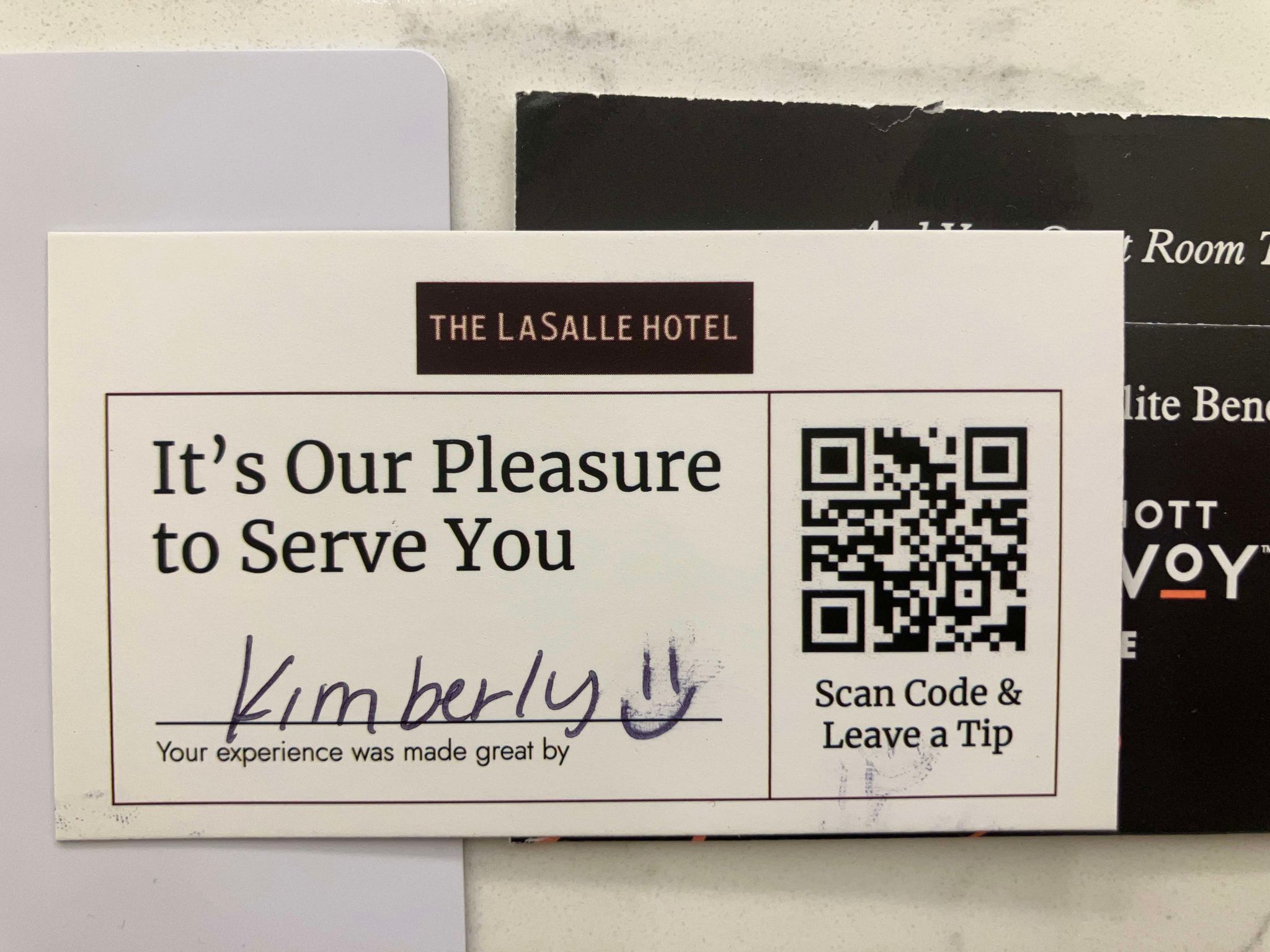
QR code tipping is often a service provided by a third party. There isn’t just a credit card processing cost to the hotel there’s also a service charge from the provider. That can be as high as 11%! The Fair Labor Standards Act allows deducting credit card processing costs from amounts passed on to employees. Auditing whether a hotel is passing through the full tip minus card processing fee, versus deducting the entire transaction fee charged, seems like fertile ground.
From The Tray Table is “torn” because he’s not confident tips make it to specific employees. One Mile at a Time “can’t decide whether to be annoyed…[or] making it easy [to tip] is good.”
So allow me to explain. This is all about reducing hotel wage costs. That’s why Marriott invested in building this out in the app. It’s about owner expenses.
- If an employee demands $25, it doesn’t really matter whether it all comes from their employer, or $15 comes from the hotel and $10 comes from the guest.
- When the wage comes directly from the hotel, that comes out of their bottom line.
- When the guest tips, that’s incremental revenue. So the hotel gets the employees they need, without spending more money and cutting into profit.
The CEO of HEI Hotels, which owns and manages more than 100 properties in the U.S. across Marriott, Hilton, Hyatt, IHG, and others including the Westin Grand Central, The Gwen in Chicago, and Revere Hotel in Boston as well as Liberty Hotel Boston and Claremont Resort & Club in Berkeley, explained that,
- He was having a difficult time recruiting employees
- Because they were demanding to be paid more
- So he needed to encourage guests to pay them more via tipping
- If he raised wages, other hotels would match that – but doing a better job getting guests to pay the wages via tipping was a sustainable advantage.
My reaction to hotels expecting me to pay their employees, as well as pay for their services, is this:
Comment
byu/Bored_Millenial- from discussion
inEndTipping
Any given employee is part of this structure and I don’t want to penalize them, but I still don’t like the structure. The employer should pay their wages, and not create awkwardness and uncertainty for the guest with variable costs separate from advertised prices. Building out technology to reinforce and extend the burden on guests to figure out what to pay each person they interact with is a terrible experience, and Marriott should be shamed for it – even if it is something their owners prefer and helps the chain advance its primary goal of ‘net rooms growth.’



Just say no to Marriott. Been doing so for over 7 years now. Best travel decision EVER.
That’s why, if I decide to tip a housekeeper, I leave cash, or hand it to the housekeeper personally.
And if there’s no daily service, there’s no tip.
Just avoid Marriott. Period.
When the only employee I interact with in a 3 day stay is the desk clerk at check-in, who am I tipping for what. I leave a $5 bill on the bed each morning when I leave the hotel, These days it is always there, because there has been no one entering the room to even take the trash out. It is not unusual to see pizza boxes still in the halls from yesterday in the evenings when I return. Housekeeping is better at Motel 6 than Marriott!
” and more tips means the hotel can hire workers at lower wages.”
Not necessarily. It depends on how the hotel hires workers. Does it say “You will be paid ___/hour and tips, which are guaranteed to be ___/day”? How much do the workers actually receive in tips?
Of course, if tipping is a large amount and completely reliable, that’s different.
The tipping culture and Marriott have reached new levels of insanity.
Marriott is unrecognizable since JW Marriott Jr’s retirement, and Anrne Sorenson’s untimely death.
Again, I speculate that this tipping insanity is a move by hotel owners, that Marriott bowed their head to. Marriott is no longer in the driver’s seat, the hotel owners are.
We have shifted an inordinate amount of our lodging and hospitality business, both pleasure and business travel, to Hyatt. I suspect that these, evil, Modern Day practices, will eventually circle around to Hyatt.
The continued demise of customer service in America.
@Gary: “So allow me to explain. This is all about reducing hotel wage costs. That’s why Marriott invested in building this out in the app. It’s about owner expenses.”
An ‘explanation’ that must be wrong, or at least incomplete. It doesn’t explain why customers would prefer tipping, nor why empoyees might.
The valuable thing about the institution of tipping is that it incentivizes and rewards service, and in a way that wages cannot, since tipping can be tied closely and inextricably to the performance of the service. Wages cannot.
Recall that, in a fit of woke hypocrisy, morality-washing restaurants announced they would replace tipping with a fixed customer fee. They virtually all went back to tipping. Why? Who does the best waiter work for? What customer wants to pay 18%-25% to service employees apparently trained by the DMV?
Separately, what has happened recently is that there has been an explosion in tipping to non-service related categories. This is mainly fueled by POS systems making it easy to stick a request in the customer’s face. The same technological change explains why the default and minimum precalculated amounts have risen to 18%. An amount that will kill the restaurant trade at a time when pre-prepared supermarket meals and the like are getting better and better.
simple. why would I tip?
No never
@ L3 — Tipping is no longer an incentive to do a good job. Instead, tipping is taken for granted and a lack of tipping is now a reason to provide poor or slow service (see Instacart, where your tip is displayed to the delivery driver BEFORE the service is provided. WTH is that?) Soultion = save your money and don’t tip.
Anyone wanna bet Instacart goes bankrupt if they dont chnage this dumb policy?
There’s rarely a reason to tip a hotel employee. The room attendant, sure, if there was one. The people doing the free breakfast service get a tip, as does anyone who carries my bags for me.
The biggest tips went to the people who could successfully hail a cab for me in Vegas in the 90s.
Do I understand from this article that tipping directly reduces the amount Marriott pays the staff member? For example, say an employee gets a $1000/week paycheck. If he/she receives $200 that week in tips, does that mean the Marriott hotel only pays the employee $800 that week?
@ WearyWatchdog — There’s rarely a reason to tip a hotel employee, yet you tip everyone it seems.
“Do I understand from this article that tipping directly reduces the amount Marriott pays the staff member? For example, say an employee gets a $1000/week paycheck. If he/she receives $200 that week in tips, does that mean the Marriott hotel only pays the employee $800 that week?”
Unless Marriott owns or manages the property, Marriott isn’t directly paying any staff nor do they have a clue what individual franchisees pay their staffs, what’s in their handbooks or if they do/do not offer any benefits because it’s the franchisee’s hotel, not Marriott’s.
Greater or lesser tipping does not reduce anyone’s paycheck at any hotel. The hourly rate is the hourly rate. The issue is that the hourly rates are basically the same as they were pre-pandemic.
MSM and Gary will spin these yarns about increased labor costs and yes, there are unicorn scenarios out there where hotels have upped their wages over the past five years but that is not the norm. What is the norm is that if you did get an increase, the property now has fewer FTEs so you’re working harder for that money or the property has clawed back any increases by hiring new staff at rates that scream 2018/2019.
Most of the QR code tipping stuff is very greasy and impossible to track from the outside in. The companies I’m aware of charge both annual fees to administer the program and they also take a monthly fee as well which the property is not going to eat so you can guess where that money comes from.
Then, IME, the property is usually taking a piece and the tips are a lot of times pooled and distributed in some type of property by property formula versus each person getting exactly X dollars.
@Paul in OC
Depends on the state the employers can get around minimum wages by taking credit for the tips.
“Greater or lesser tipping does not reduce anyone’s paycheck at any hotel. ”
Greater expectation of tips = willingness to take jobs at lower wages
Higher tip jobs attract more workers, and hotels don’t need to pay as high a wage to do so.
I will not tip on an APP cash if they do a god job
I will never participate in this. At most I would do what I do in Vegas..last night of stay I leave some cash maybe 10 bucks per day put it on a piece of paper where I have written “Tip” and thanks!. I do the same on Cruises. I will never prepay cruising. I talk to housekeeping do they want the tip daily or end of the cruise. I tip for drinks, good service at a restaurant, housekeeping, bell hop, valet services.
I never would tip at non standard places or when buying Subway for instance.
I have no issue leaving the tip in the app, as long as there is no expectation for a higher tip to take into account credit card fees.
There is another incremental change too–Courtyards in random suburbs charging for parking. I have complained about it and categorically refuse to pay this (by not staying there). If you search for a hotel with free parking ON BONVOY it will still filter in hotels with (now) parking fees. What a racket.
“Higher tip jobs attract more workers, and hotels don’t need to pay as high a wage to do so.”
The part you keep missing is, the hotel is normally not going to pay a higher wage one way or the other. When the owner/management company decides that wages for a particular time will be X, that’s what will stay in place regardless of operational need.
If you pay attention to Indeed for a long enough period of time, you will see the same properties running the same job(s) over and over and over and over. The natural assumption would be that if they paid more, they could find more/better employees and stop running the job posting.
The problem, is that is not how the industry works. If you’re short X people at whatever job, you just run short for perpetuity and grind the existing staff into the ground until eventually someone dumb enough to apply at the hotel’s hiring rate comes along and hopefully they’ll stick for a while and then a warm body can be thrown out there. But at the end of the day, the industry mantra is always, If You Can’t Rock Me, Somebody Will.
Yes, there are unicorn situations out there but the overall North American hospitality franchise model and the companies that employ that model, is designed for least common denominatior and the lowest cost possible to the FTEs.
It’s basically a ponzi scheme designed to enrich the parent company with fees that get paid first, the managment companies with their contractually guaranteed fees and the owners trying to squeeze everything else in the middle to increase whatever is left that goes into their pocket. The rank and file in the middle always, always, always get screwed.
Allowing tipping is just putting lipstick on a pig of a situation.
The analysis of the tip to wage idea in this article seems to be written for a very narrow set of regions. Spending a great deal of time in Europe this year and knowing that tipping is either 1) not permitted, 2) frowned upon or 3) exceptional for those times of truely exceptional experience amd that regional legislation often deals with many of these issues. You may have wanted to start with “In North America”.
Some of the other comments here i do agree with, service overall is way down at most of the Marriot properties i have stayed at (there are some exceptions). On the other hand, again a regional issue, is there are many places where cash is simply not really used any more, and inwould say in many locations having that option to be able to give that tip (recognising it may be negatively affected by fees and corporate policy) can often be better than nothing. Even a volunteer outside a grocery store trying ro collect donations for a charity is far less capable today of generating those funds due to less “cash”…. Tap to donate is very successful (and proven to increase intake).
So i think the article sees all of the bad and from a narrow point of view, not even considering the global reduction in the use of cash.
When I am paying 400-500 a night for a room, I expect the hotel could pay their employees reasonably. So, no tip from me to housekeeping.
Tipping culture is out of control. I am not going to enable business subsidization through my tips when they should be investing in their own people.
Bellman, waters/waitress, housekeeping, valet parker. That’s it. I didn’t to to go orders either. Too those who deserve it.
I’m done with this tipping bs. Corporations, pay your damn employees. Enough.
Sure wish companies would properly pay their workers so that tipping weren’t necessary. And if one must tip, cash is king; preferably, directly to the person you wish to thank, in-hand, with a smile, eye contact, and ‘thank you.’ This is the way. Not silly apps which steal from the intended recipient.
I’m not tipping at a hotel for less and less service. Anybody I choose to tip gets cash so I know who is getting it. Take that Marriott!
*IF* we accept that we should tip housekeeping, then we should accept QR codes, as there’s a whole generation or two that carries no cash at all.
@Doug Williamson: A service charge is itemized on the bill. It is not (1) or (2) in your list.
Well said.
So what you’re saying is, there’s finally a path to securing those elusive space available upgrades!
Thank you for making all of us aware if this shameful practice by Marriott and the broken model of tipping in the hospitality and restaurant industries. Tipping simply transfers the cost to pay employees to the customers, and only makes large hotel owners more money. And those here that use restaurants in America as an example if why tipping is useful to incentive employees, don’t know what they are are talking. I have another example of why our way of tipping makes no sense: every developed country outside the U.S. LOL
Have you looked at who owns many of the Marriott hotels these days? “Cheap” doesn’t begin to cover it.
Silliest post ever…
Also hyatt and others also have or codes for tipping.
With less people carrying cash it seems to be a good convenience.
At same time if it costs me a convenience fee thrn I won’t use it.