
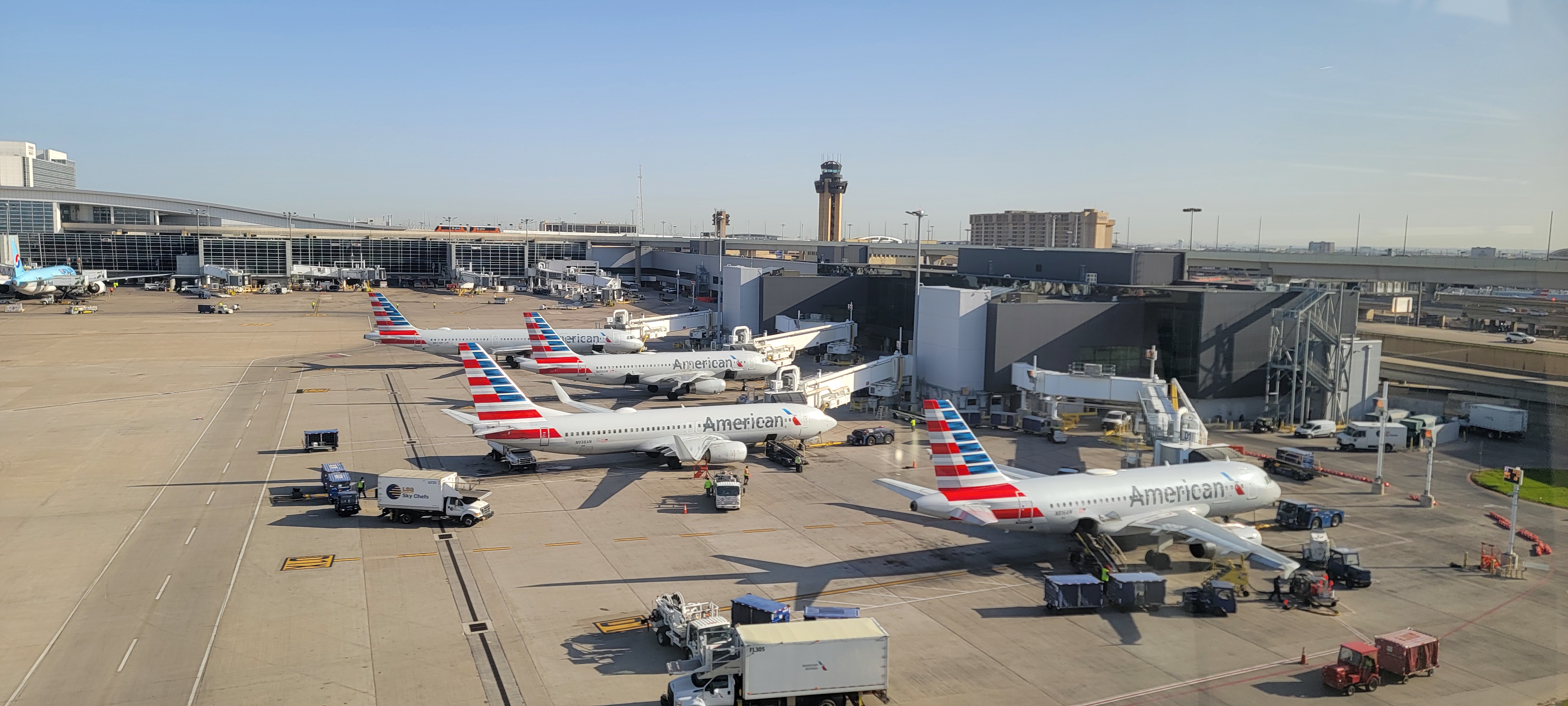
American Airlines is re-timing flights in and out of Dallas – Fort Worth to go from 9 ‘banks’ of flights a day to 13 banks of flights starting in April (with new schedules slated to appear with Saturday night’s update). This is intended to spread demand across the day, reduce the number of ultra-tight connections, and improve “trip certainty” at its biggest hub.
They’re pairing that with:
- more scheduled time for flights systemwide (including to and from Dallas)
- more “remote deplaning” capability to avoid diversions away from Dallas in bad weather when gates are gridlocked,
- continued airport capital investment, from additional gates on the A and C concourses to the new terminal F that American will fully occupy – with premium facilities, check-in and security as well as customs. (I expect a premium security path and Flagship lounge as well, though these haven’t been announced. )
Spreading the American operation at Dallas – Fort Worth out from 9 to 13 flight banks should reduce stress on the opreation – fewer times that a single flight delay means a gate is unavailable for an incoming flight, cascading the effects of the delay onto more passengers (who miss their connectin) and more flights (because the crew on the flight without a gate can’t make it to the next flights they’re working).
This is best understood as partial de-peaking: DFW will still be a banked hub, but with smaller waves and less extreme peaks. With ~930 peak daily departures:
- 9-bank average ≈ 103 departures/bank
- 13-bank average ≈ 72 departures/bank
That’s a ~30% reduction in bank “size” if the day were distributed evenly across banks.
In addition to de-peaking, American is increasing block times. Some would call it schedule padding. They’re going to have better on-time performance, because on-time is measured against the schedule. More often you’ll see flights arrive early or at least not be late, because additional buffer gets built in.
American is making a bold and unprecedented investment in block time for flights to and from DFW and across the airline’s network. Block time — the total scheduled time between pushback from the departure gate to arrival at the destination gate — determines how long a customer’s trip feels.
With this investment in American’s customers, the airline is ensuring more on-time departures that lead to more on-time arrivals and fewer delays, all creating an overall smoother and improved travel experience.
Fewer late arriving flights, and more time between many connections, means they should also reduce the number of connecting bags that don’t make their next flight – ultimately helping the airline’s mishandled bag numbers which have been worst in the industry for years.
They’re also going to have more flights arriving at remote stands when needed – bussing passengers from planes to the terminal when they don’t have gates, which is better than leaving them stuck on the tarmac (or diverting away from Dallas, frequently to Austin).
American is investing millions of dollars in additional remote deplaning capability (everything from equipment and bussing to staffing) that allows the airline to most importantly, divert fewer flights away from DFW.
This should all mean more connecting opportunities, and the opportunity to opt for longer connections without those longer connections being several hours in the future in many cases. And, they think it’ll mean less congested airspace so fewer air traffic control delays.
But this is all expensive. On the other hand, 13 banks means fewer periods of inactivity in the airport.
- Banked hubs are efficient for selling connections. A bunch of planes arrive, passengers get off and transfer, and then leave right away. That means very little time for passengers on the ground, and shorter overall trip times.
- That’s historically meant more ticket sales, since shorter trips have been displayed first to customers and customers prefer to buy those shorter trips (until they start digging in and asking whether their connection is realistic).
- But it also means high costs because there are periods of huge activity, and then everyone sits around and waits for the next period of high activity. More banks means less inactivity.
American risks increasing connection times and losing ticket sales as a result. But this sounds like a big effort in making the operation more reliable.
Increasing block times, too, makes flights look like they take longer, but it’ll mean more control over the operation and fewer missed connections. It also sets them up to successfully hold flights for connections so they don’t misconnect.
That’s something American has been doing, years after United rolled out their ‘ConnectionSaver’ program. Longer block times means that flights will often be projected to land early and thus holding a flight for passengers won’t make them late – an easy choice to hold the plane, then.
United Airlines began schedule padding a decade ago as a first step to improving its reliability. If they weren’t hitting their published schedules, the schedules weren’t realistic. They needed to add time to how long flights were projected to take. Those revised schedules were in some sense more true and honest. They let United hit easier targets, and they began doing a better job hitting those targets (as well as giving them room to hold flights for delayed customers at times).
American operates at peak over 930 flights a day from DFW airport to over 230 destinations. In late June they actually publish as many as 975 flights today (before the schedule load), according to data from aviation analytics company Cirium, though that’s far enough out that they may not actually fly that many. The changes American is making here aren’t really adding flights. It’s spreading out those flights.
Spreading out the flights is expensive but on-time reliability is an investment in delivering to expectation, which is table stakes but a first step before premium investment and giving customers a buy up ladder to spend more on better experiences really starts to matter.
In other words, first we need to be reliable and lose fewer bags. That was actually part of the Delta formula.
Given how significant this seems to be, I’m only a little bit puzzled that they’re announcing this during the dead news period between Christmas and New Year’s. The only thing I can figure out is that they decided that’s when they were going to do the schedule load, and so that forced the announcement timing. And that means they’re still a bit behind with driving the narrative and telling their story, to customers and employees, about what each piece of what they’re trying to accomplish fits together into a bigger direction. They’re leaving it to people like me to do it for them!



Hooray for AA. So glad they recognize that their operation is not sustainable and it costs them more to fix the messes that are created than just to run it more reliably from the start.
DFW is simply subject to alot more bad weather than alot of people think. Having remote gates available is smart. It costs enormous amounts of money to hold flights at outstations or divert them because DFW can’t handle extra flights.
The real question will be whether AA can improve its baggage handling to beat UA; even though UA’s schedule is much more reliable, their baggage handling runs right at the bottom with AA’s.
Improving their operation will make AA more likely to win high value business traffic, something they have undoubtedly been told by their former most loyal passengers.
I’m not sure how they fix CLT but getting DFW under control is a huge step forward for AA.
and, yes, they undoubtedly are loading schedules this week when booking activity is slower.
Whether AA pads schedules or extends turn times it’s surely needed. The airline constantly has a turn time of 50 minutes for 738s, 320s and 321s. That is not possible. CLT is for now unfixable.
As with all things AA I will believe it when I see it. Ineptitude and poor service are among their core competencies.
Just to pile on. That neither Parker nor Isom was fired for their ineffective leadership, let alone earning $30mm packages, is an indication of the utter useless of the Board. They are clearly there for the comp and flight benefits that come with a Board seat.
American Airlines has been fairly reliable to me when I’ve been based in SoFla and NYC. (@Tim Dunn will likely suggest this is merely anecdotal, so, therefore, it doesn’t matter, but…) earlier this year (June 2025), when Delta’s subsidiary Endeavor had a mini-meltdown, it was ironically AA that saved the day. All airlines experience IROPS. Glad to read AA is at least trying to improve here. Whether it’s a real improvement or just PR, we’ll see…
This is excellent news.
If this is a resumption of the rolling hub concept abandoned by the US management, the operation should markedly improve.
1990
I very much can appreciate that you or anyone can experience good events.
AA, like all other major US airlines, operate hundreds of thousands of flights/year which is more than enough for statistics to be more accurate than anecdotal experiences.
Statistics do show that AA has underperformed DL, UA and WN in operational reliability and it is very good that they are addressing it.
I am as much if not more encouraged by this pivot than I am about their investment in lounges and aircraft as Gary has covered.
I genuinely think that AA is serious about fixing what is broken which also begs the question as to what it took for the lightbulb to finally illuminate.
I like this–and I know why they are announcing this. Because they accidentally leaked the AAdvantage changes then pulled them. And while you noted that there did not “appear” to be changed in thresholds, the AA Twitter team all-but-implied there WERE going to be higher thresholds, and moments later when I refreshed the page, it was gone, reverted back to the old page. So brace yourself. I expect that Monday or Tuesday, when it is deader than deadski and they hope that the news can die in a 4-hour holiday news cycle, the bombs will drop in between their improvement news.
We are paying for our improvements. I am not saying it’s not our turn for some increases, since UA (whom I detest with all my heart, soul, mind, and strength) and DL, have raised theirs in the two years or more AA has not, but it’s still sort of a crap move in their Centennial year, as they couch it all in “we continue to evaluate customer experiences and ways to make the Advantage program better…” as they invest a bazillion dollars they don’t have. I own their stock, so I know what they don’t have. I also don’t dare sell.
I also am busy requalifying for EP since I am pretty sure I will not be there in a year since I barely made it last year! But at least we can see the improvements and at least I will earn some more SWUs which I have a 100% use rate on transatlantic flights–at booking–using–so I’ll enjoy the long flight while it lasts.
@Tim Dunn — Perhaps, AAL kept looking at its stock price, going, ‘huh, why is DAL and UAL better?’ Then, eventually said to itself, ‘fine, let’s get the XLR before the others, open some new Flagship lounges, try not to offer flights we know won’t happen, and eventually offer free WiFi.’ And yet, still, they’re also like, ‘oh, still BYOD on most flights. Yeah, we’re not Delta or jetBlue.’
Waving around a few pleasant personal experiences as proof that AA does not have a reliability problem is analytically worthless and frankly embarrassing for anyone doing so. Airlines are not judged by how they treated you on a couple of flights out of South Florida or New York, they are judged by aggregate performance across millions of segments, and on that score AA has objectively underperformed its peers for years on on time arrivals, missed connections, and baggage handling. This schedule overhaul exists precisely because the data is so bad that management can no longer ignore it. DFW’s hyper-compressed banks created predictable, cascading failures, and pretending otherwise because you once got re-protected during IROPs is willful blindness. Tim Dunn is talking about network math, hub physics, and operational resilience, things that actually determine outcomes at scale. 1990 is talking about vibes, because feelings matter FAR more to him than facts. One of these perspectives explains why AA is changing its entire schedule structure, while the other explains why comment sections are full of confident nonsense from morons who ought to get out of their mother’s basement and touch grass.
@Mike Hunt — Whenever you go on a multi-paragraph retort, it’s not your faux-intellectualism that stands out; it’s the high likelihood that you copy-and-paste my comments into a LLM and ask it to provide a high-brow retort, then edit lightly to add your own personal flourishes. Enjoy a taste…
While Mike Hunt, who shall hence be referred to as, ‘My Kant,’ relies on the authority of ‘network math’ and ‘hub physics,’ it creates a false dichotomy by suggesting that personal experience is analytically worthless. In a service-oriented industry like commercial aviation, aggregate data is often a lagging indicator; sure, it tells you what went wrong after the fact; whereas, the consistent feedback of high-tier frequent flyers acts as a leading indicator of an airline’s actual recovery capabilities and regional strengths.
To dismiss “vibes” is to dismiss the qualitative reality of the product; an airline that achieves an 80% on-time rate but fails catastrophically during the remaining 20% (the “IROPs” mentioned) is often less valuable to a business traveler than one that manages disruptions with high-touch service. My Kant ignores that data points are not just numbers, but individual customer outcomes that dictate future revenue.
Further, the characterization of the “schedule overhaul” as a surrender to “bad data” oversimplifies the strategic trade-offs inherent in airline management. American’s move toward a 13-bank structure (up from 9) at DFW, often called ‘de-peaking,’ is not just a fix for ‘cascading failures,’ but a calculated pivot away from revenue maximization toward operational resilience.
Historically, ‘hyper-compressed banks’ were a deliberate feature designed to maximize connectivity and capture market share by offering the shortest possible layovers, even at the cost of operational ‘slack.’ Spreading these flights out improves reliability, but it also increases layover times and potentially reduces the number of viable city-pair connections. By framing this shift as an objective victory for ‘math,’ the My Kant fails to recognize that AA is actually making a difficult business trade-off: they are sacrificing some of their competitive edge in connectivity to lower the costs associated with delays.
Finally, My Kant falls into the trap of over-generalization by using national aggregate performance to invalidate regional success. While it is true that AA has trailed peers like Delta in national on-time metrics for 2024 and 2025, those ‘millions of segments’ include operations in the most weather-sensitive and ATC-congested corridors in the U.S. (like the Northeast and Florida). A traveler reporting high reliability on specific routes is not ‘willfully blind,’ they are observing the performance of a specific sub-network that may be functioning perfectly well despite the ‘noise’ of the national average. To call this perspective ‘nonsense’ ignores the fact that airline networks are not monoliths, and a ‘math-heavy’ analysis that cannot account for regional variation is just as flawed as one based entirely on feelings.
Two can play this game, My Kant.
More banks won’t fix DFW’s notorious issues around weather, which are a winter, spring, and summer problem. Glad to see American invest in running more on time though. It’s operations in that regard, system-wide are abysmal. United pads schedules at EWR because it has to. Between the airport’s unforgiving delays, its layout and the need to park planes on aprons for servicing has been a a major contributor to UA’s past operational issues there. It can take 3 hours to move a jet parked near A to C.
1990
just ahead Mike is right about anecdotes vs. big data no matter how much you want to argue about it.
AA, just like every other company, changes when they realize the status quo is no longer working.
DFW has been become so unreliable that smart money doesn’t want to fly there
and talking about what happened to you or anyone else in MIA misses the point that this schedule overhaul is about DFW.
and AA is still smaller in delay-prone NYC than DL or UA. in terms of passengers boarded, AA and B6 are about the same size in NYC. AA, like DL, spreads its NYC operations over 5 effective runways at 2 airports while UA runs most of its NYC operation from 2 effective runways at 1 airport.
this is a costly but necessary move which is why AA is doing it. They have decided that being more reliable and gaining higher revenue passengers is worth more than trying to connect passengers in a massive operation in a short period of time.
Wow. Your response is nothing but a wordy attempt to intellectualize a losing position, and it still collapses under basic scrutiny. First, the lazy “you used an LLM” accusation is not an argument, it is a tell that you truly *CANNOT EVER* engage with true substance.
But more importantly, you fundamentally misunderstand both data and airline economics. Aggregate performance is not a “lagging indicator” in this context, it is the product customers actually experience over time, and it is exactly what drives corporate contracts, network planning, and fleet utilization. High tier frequent flyers are not a statistically meaningful proxy for system resilience, they are a tiny, biased sample that is often insulated from the very failures that crush network performance, because they get priority rebooking and handholding when things go wrong. That is not evidence of operational excellence, it is evidence of preferential treatment masking underlying fragility.
Your IROPs argument also backfires. Airlines with stronger baseline reliability have fewer catastrophic disruption events in the first place, which is why Delta consistently outperforms in both completion factor and recovery metrics. You are defending an airline that routinely creates self inflicted IROPs through overbanking and unrealistic schedules, then congratulating it for being nice to elites when the damage is already done. That’s not resilience, it is damage control.
As for depeaking, you accidentally prove Tim Dunn’s point. Yes, hyper compressed banks were a revenue maximizing choice, and they failed because the operational costs, customer dissatisfaction, and downstream disruption overwhelmed the theoretical connectivity advantage. AA is not making a bold strategic trade, it is retreating from an unsustainable model after years of denial. Calling this a “pivot” instead of a correction does not change the math. And your regional defense is irrelevant. An airline is a single balance sheet and a single brand. National averages matter because failures in the Northeast and Florida propagate aircraft, crew, and passenger disruptions across the entire system, including the routes you personally fly. That you did not feel it does not mean it did not happen.
In short, you are confusing subjective experience with analytical insight, and dressing it up in philosophy quotes does not change the fact that AA is restructuring its schedule precisely because the data, not the vibes, forced its hand.
“My Kant” is not particularly funny or clever, but then again, none of your inane word vomit ever really is. Best of luck using AI to come up with more banal retorts while I continue to spank you with my original content and cold hard facts. You’re gonna need it.
Now with some fresh blood coming into AA and “can’t beat the join them” with DL secret sauce will help create a much more reliable airline long term. Future 100 is looking brighter in 2026 for AA.