
An elite frequent flyer was traveling on American Airlines as a ‘nonrev’ family member of a retired employee, got into an altercation with flight attendants over his need to use the bathroom, forcing the captain to divert the aircraft. He was banned by the airline, and now he’s suing to get his ban lifted saying the whole thing was a misunderstanding.

John Nunez was a passenger on American Airlines 1124from Barranquilla to Miami on June 3, 2022. He was seated in 17C in the main cabin and was traveling as a non-rev (“D3”) passenger via his father’s American Airlines employment.
He was suffering from an enlarged prostate and kidney stones, causing urgent, frequent needs to urinate. After takeoff, he tried to use the business class lavatory. The purser told him he could not because he was seated in coach.
He went to the rear and – according to an administrative law judge – yelled at the two main-cabin flight attendants while they were seated in the jumpseats, including saying “nobody treats me like shit.”
Later, when he went back again, the judge found that a flight attendant placed a beverage cart across the aisle to block him, denying him access to the rear lavatory, after which he yelled again, calling one crewmember a “f’ing idiot” and “stupid.”
The judge also found that he requested an alcoholic beverage and the crew refused because they suspected he “may have been intoxicated due to his level of agitation,” and that the denial contributed to further conflict. Flight attendants opted not to complete beverage service due to the issues with this passenger. The captain diverted the aircraft back to Barranquilla.
The passenger deplaned with an American employee, said to the captain “I’m a non-rev who wanted a coke,” and requested a breathalyzer. He was not intoxicated when he deplaned.
The Washington Operations Center notification described the flight as returning after a “LVL 2 DISTURBANCE” due to a “DISRUPTIVE INTOXICATED PSGR,” with law enforcement to meet the flight at the gate. American’s ground-side account said that:
- Crew reported the passenger in 17C was verbally assaulting flight attendants, refused to remain seated, and threatened a formal complaint “due to his advantage status.”
- Police boarding to remove him was requested, but “there was no need” because he deplaned on request. He was “not displaying any sign of intoxication” and no airport personnel identified intoxication.
American opened an investigation. The FAA sent a request for information via American Airlines Regulator Affairs. American returned a package and sent a letter of investigation. The passenger, though, told the FAA:
The passenger was given a proposed civil penalty of $10,500 for crew interference. He requested a hearing, and the judge found that he wasn’t intoxicated and also that statements by one of three crewmembers were not credible. And the judge determined that the passenger did interfere with crewmembers duties (through loud, profane, distracting conduct and underscored by the cancelled beverage service). However, the FAA failed to prove he threatened any crewmember.
According to the Administrative Law Judge,
- crew could have de-escalated better,
- crew “made matters worse,” including denying lavatory access despite urgent need, and
- the passenger was in excruciating pain when denied the lavatory
As a result, the judget ordered a smaller civil penalty of $4,500.
The passenger wanted American to lift their ban. The judge made clear this was outside their jurisdiction. According to the passenger,
I was not profane. Period. That allegation was fabricated, and the record contains no contemporaneous documentation—no incident report notation, no witness statement specifying what was allegedly said. It was a post-hoc embellishment to justify their actions.
Second, the “loudness” characterization is misleading. We were on an aircraft—ambient noise requires elevated speech just to be heard. I wasn’t yelling or causing a disturbance; I was speaking at a volume necessary to communicate on a plane.
Here’s what’s critical: the flight attendants only called the captain after I informed them I intended to report their conduct to personnel. That’s not a safety response—that’s retaliation. They escalated precisely because I asserted my right to file a complaint.
American Airlines Customer Relations followed up on the case, stating that crew followed policies on lavatory access and beverage service for non-revenue passengers, acknowledged the breathalyzer-confirmed sobriety, denied compensation, and closed with: “look forward to welcoming you on board your next American Airlines flight.”
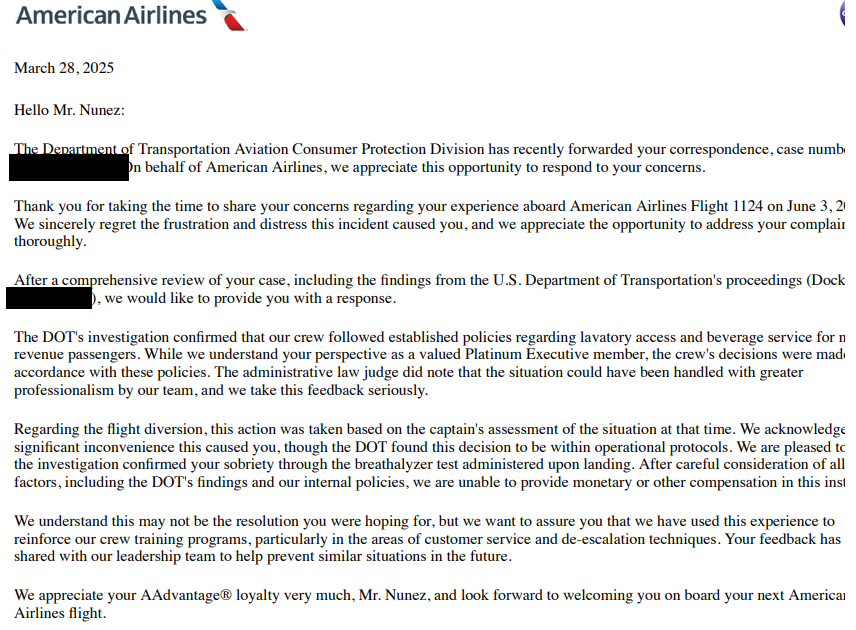
Oops. The passenger thought their ban was lifted! They bought a ticket on American Airlines, but they were denied travel.
The passenger is still suing in federal court, seeking full disclosure of the administrative record in his case – some of which has been withheld as privileged deliberative material, and redacted for privacy. The most recent complaint was filed last week.
So as of late 2025, the nonrev passenger’s fight has shifted to (1) American’s ongoing ban status and (2) a FOIA suit seeking unredacted FAA investigative records.



Oh, cool, a story from 2022… what a wild time that was then… still sorta during the pandemic recovery… yeah, a non-rev really should be on ‘best behavior’… that said, I know what the ‘frequent bathroom visits’ can feel like, regardless of drinking, alcohol or otherwise (mere water/juice can do it). Like, forget enlarged prostate, how about just light anxiety over a tight connection. $4,500 fine (and everyone’s time, effort, fees, etc.) *sigh* C’mon AA, it is retaliatory at this point; lift his ban, give the guy another chance. There’s been enough due process and time here.
What a moron. Number one if you have prostrate issues and you’re not home where you can simply use the bathroom at will, don’t drink. It will only cause a greater need to urinate. Number two, you’re on a D3 pass. The golden rule of any Non rever is never, ever make a stink about ANYTHING. Shut up and don’t confront the gate agent or crew.
Crew are usually very entuned to whose a non rev and the last thing they want is any kind of grief from a non rever. Again, what an idiot.
This is related yet slightly off topic from the article.
As a passenger, I’m in favor of complete restroom freedom. Passengers should be allowed to use the restrooms at ANY TIME. This means during take-off, landings, and high turbulence. Do we want some flight attendant saying we cannot go just because the Fasten Seat Belts sign is on???? Airlines should just amend the Contract of Carriage saying they’re not liable if the passenger injures themselves or others by not following the Fasten Seat Belt sign.
@1990:
Honestly, I’d like to see this go a step further and AA be told “Sorry, you told him you were looking forward to welcoming him on his next flight – congrats, you’ve lifted his ban”.
Given consolidation in the industry (you have about four major carriers, and not all are at all airports), permanent/long-term flight bans should probably require companies to get some sort of approval – especially given that this one seems to be a messy he-said/she-said.
(We also probably need to have a serious conversation about some crew member instructions not being considered valid for regulatory purposes, especially given the ability of aisles to get blocked. As an almost-always-F passenger, I’d be fine with a passenger with no other way to the lav who is at risk of things going horribly wrong otherwise using the front lav as long as it was clear we had some element of priority.)
@OnePatriot77
I sort of agree except during takeoffs and landings. Some pilots never turn the seat belt sign off
I’m curious why a customer would demand to do future business with a company that made it clear they don’t want his business? I’d never beg any company to take my money….
@Gray — That’s not an unreasonable interpretation. And, yeah, I wonder how much sharing of ‘ban’ lists the airlines do; like, is there so much faux-competition and regulatory capture that they do, in-fact, have a ‘secret’ list that they share? Or, is it all kept closer to themselves. As far as forward-lavs are concerned, on most narrow-body aircraft, I’d tend to agree that it’s ‘fine’ that those in the middle go to the front, even if not in F or J. For wide-body, especially 3+ class aircraft, like, Air France 773, La Premiere, no, stick to the middle of the aircraft J and back of the aircraft lavs.
@OnePatriot77 — LOL. No, not ‘any’ time, and it’s not just about passengers harming themselves, it’s about them harming the crew and other passengers when they’re ‘up’ when they shouldn’t be.
Banish him to Spirit/Spit Airlines where this pax behavior is more the norm
@OnePatriot77 – I completely agree. There are loads of U.S. pilots who either just leave the seatbelt sign on the whole time or turn it on at even the slightest vibration. Unfortunately, it seems likely that some people would still try and sue the airline if they were injured.
Passenger seems severely entitled.AA did the right thing.
I guarantee you this passenger’s father (the airline employee or retiree who gave him the D3 pass) likely had his travel privileges revoked or at least received a stern talking to.
I’d sue pointing out that he had a medical issue that they ignored.
I will never understand why people travel when they have known medical issues. Just stay home and support your local businesses. Everyone seems to think, if you are not travelling, you are some king of loser. It’s okay to not have pictures to show on social media.
Yes, the FAs could be exaggerating, but there is little doubt that a situation that causes a diversion was the pax’s fault. Good news, he can still fly Avianca (3 flights a week?) and connect to there Star partners. That gives him six U.S. cities he can fly to nonstop out of MIA.
Oh, and BTW, please, please, US pilots. Turn the darn light off sooner. I’ve never been told to sit down when using the lav when the seatbelt light is on, though that’s always been at times when they really wasn’t a need for the light to be on. I’m always prepared with my comeback line: “you won’t like the consequences of that (i.e., returning to my seat)” I’m clearer a senior citizen, so I suspect they’ll drop it.
He looks like a clown with that stupid headcovering/scarf. Is he bald?
With his medical condition, he should have been wearing adult diapers so he could deal with the situation if he couldn’t use the bathroom in a timely manner. On the other hand, the story of at least some of the cabin crew lying about what happened seems consistent with airlines, where lying is part of the job. Unfortunately for him, the airline has the right to ban him even if he can get free flights. Why do people insist on escalating when the crews hold all of the cards?
@George Romney: If you have prostrate issues,” you should remain standing up!
I’m betting you don’t understand this comment.
First, thank you to Gary Leff for covering this story fairly and linking to the actual ALJ decision and transcript. In a world where passengers are often convicted in the court of public opinion before the facts come out, I appreciate a journalist who lets the record speak.
My name is John Nunez. I’m the passenger in this story, and I want to speak directly to anyone reading this.
That flight on June 3, 2022 wasn’t just a “bathroom clash.” It was the day I lost something my father spent 33 years earning — the wings he passed down to our family. He worked his entire career at American Airlines so his children and grandchildren could see the world. Travel wasn’t a perk. It was his legacy to us.
I have a son in Barranquilla, Colombia. I fly to see him every month. That’s not tourism. That’s fatherhood.
I didn’t choose to have an enlarged prostate and kidney stones. I didn’t choose to be in excruciating pain at 35,000 feet while a flight attendant blocked the aisle with a beverage cart. I didn’t choose to have crew members fabricate claims that I was intoxicated.
So let me address the critics directly.
**”He was drunk and disruptive.”**
Then why did I *request* a breathalyzer the moment I stepped off that plane? Why did I blow 0.00? Why did police release me without charges? Why did the Administrative Law Judge find I was “not intoxicated”?
Drunk people don’t ask for breathalyzers. I did. Because I knew the truth.
**”The crew said he was a problem.”**
The ALJ reviewed the evidence — all of it. He found the crew’s testimony “lacked credibility.” He found my testimony “credible.” He found the FAA “failed to prove” I threatened anyone. He found the crew “made matters worse” and “could have de-escalated.”
And then there’s Flight Attendant Celi. On the stand, she admitted she couldn’t actually hear what I said. She testified she was “Democrats” — her word for guessing. She acknowledged the noise on the aircraft made it difficult to hear. Yet her statement to the FAA contained specific quotes attributed to me. How do you quote someone you admitted you couldn’t hear?
The ALJ saw through it. That’s why he reduced the civil penalty from $10,500 to $4,500 — a 57% reduction. That’s not a slap on the wrist for a guilty man. That’s a federal judge saying the government’s case was built on sand.
**”The investigation was thorough.”**
It wasn’t. FAA Inspector Ronny Moon conducted what can only be described as a one-sided investigation. He admitted on the stand that he never interviewed the two passengers who witnessed the events and were prepared to corroborate my account — Enrique De La Hoz and Edwin Pineda. He didn’t review the complete video evidence. He didn’t verify the crew’s claims against objective evidence.
And here’s what’s remarkable: Inspector Moon testified at the hearing, “I believe you.” The FAA’s own investigator looked at me and said he believed me. Yet the enforcement action proceeded anyway.
The case was classified as a Level 2 disturbance — “DISRUPTIVE INTOXICATED PSGR” according to American’s Washington Operations Center notification. But I wasn’t intoxicated. The breathalyzer proved it. The police confirmed it. The ALJ found it. So why was I classified as intoxicated? Because the crew said so — the same crew the ALJ found “lacked credibility.”
Level 2 protocols require specific procedures. They weren’t followed. The investigation was built on assumptions that collapsed the moment they were tested in a hearing.
**”He should have behaved better as a non-rev.”**
This is where the contradiction gets interesting.
Yes, I was traveling on a D3 pass that day — my father’s benefits. But I’m also an AAdvantage Executive Platinum member. I earned that status. Miles I flew. Money I spent. According to American’s own policies, elite members are entitled to certain considerations.
So which am I? A non-rev who should grovel in silence? Or an elite member entitled to the treatment I earned? American wants it both ways. When it’s convenient, I’m a non-rev who should know my place. When I cite my status, suddenly that doesn’t matter.
The crew didn’t know my status when they blocked my access to the lavatory. They didn’t care about my medical condition. They only called the captain *after* I said I intended to file a complaint about their conduct. That’s not a safety decision. That’s retaliation.
**”American has the right to ban whoever they want.”**
Then explain this: After their internal review, American Airlines Customer Relations sent me a letter stating they “look forward to welcoming you on board your next American Airlines flight.”
I believed them. I bought a ticket. I was denied boarding.
So which is it? Was the ban lifted when they welcomed me back? Or did they sell me a ticket knowing they would deny me boarding? Either they lied in the letter, or they committed fraud at the gate. Pick one.
**”Just move on.”**
My father gave 33 years to American Airlines. Thirty-three years of early mornings, late nights, holidays away from family — so that his children could have wings. Those weren’t just travel benefits. They were his life’s work handed down to us.
My son lives in Barranquilla. Every month I fly to be his father. That’s not a vacation. That’s my responsibility.
An independent judge reviewed every piece of evidence and concluded I was telling the truth. The FAA’s own investigator said he believed me. The government’s case fell apart on the stand. Why should I accept punishment for something I didn’t do? Why should my family lose what my father earned because crew members lied and an inspector couldn’t be bothered to do his job?
To the person mocking my head covering: I’m a 50-year-old man from Miami with roots in Barranquilla. That’s my culture. That’s who I am. It has nothing to do with this case, but it tells me everything I need to know about you.
**Here’s what the record actually shows:**
– Blood alcohol: 0.00 ✓
– Police assessment: sober, released without charges ✓
– ALJ finding: crew testimony “lacked credibility” ✓
– ALJ finding: my testimony “credible” ✓
– ALJ finding: FAA “failed to prove” threats ✓
– ALJ finding: crew “made matters worse” ✓
– ALJ finding: crew “could have de-escalated” ✓
– FAA Inspector Moon: “I believe you” ✓
– Corroborating witnesses: never interviewed by FAA ✓
– Civil penalty: reduced from $10,500 to $4,500 (57% reduction) ✓
– FAA enforcement case: dismissed with prejudice (December 2024) ✓
Every neutral fact-finder sided with me. The FAA’s own investigator believed me. The only people who still claim I was wrong are the ones who lied about me in the first place — and the airline protecting them.
This isn’t about winning a lawsuit. This is about my family’s name. My father’s name. What I pass down to my son.
The ALJ saw the truth. The record reflects the truth. Now the world can see it too.
I didn’t ask for this fight. But I won’t walk away from it.
— John Nunez
Miami, Florida
The comments by Mr. Nuñez are more compelling than any others written in this post. It sounds like after the crew lied about Mr. Nuñez, AA figured it could cut some liability and save themselves some costs, so it did.
I appreciate the thoughtful comments—both supportive and critical.
Two clarifications for those saying “just comply” or “don’t fly if you have a medical issue”:
First, I did comply. I deplaned when asked, cooperated fully with police, requested a breathalyzer, and was cleared with a 0.00 BAC. The FAA judge later rejected the intoxication and threat allegations and found the crew could have de-escalated. Compliance was never the issue.
Second, D3 (non-rev) status does not eliminate medical dignity or basic passenger protections once boarded. I was also an Executive Platinum customer at the time—status earned through years of paid flying. That doesn’t mean special treatment; it means the airline knows your history and is expected to exercise judgment and de-escalation, not default escalation.
This wasn’t about entitlement. It was about a medical urgency handled poorly, followed by an investigation that didn’t hold up under oath.
Reasonable people can disagree—but an independent judge reviewed the evidence and the record is what it is.
I’ll leave it there.
— John17c
Let me explain this plainly, because this is where a lot of assumptions collapse.
The diversion was not triggered by something the captain personally observed. It was triggered by information relayed up the chain, much of it hearsay, during a fast-moving situation.
Here’s the critical part:
• Flight Attendant Maria Quiroz testified under oath that she did not believe I was intoxicated and did not believe other crew genuinely perceived intoxication.
• She was the only flight attendant the FAA Administrative Law Judge found credible.
• Quiroz also testified that the captain was monitoring the situation via interphone during the alleged “threatening” conduct — and took no action at that time.
That matters.
If there had been an actual safety threat, escalation would have happened then, not later.
Instead, escalation occurred after I was issued a disturbance paper and objected to the write-up. Quiroz stated the captain diverted “before escalate more,” which reflects preempting further disagreement, not responding to imminent danger.
Now contrast that with what came later:
• Other crew debriefs escalated the language after the fact (threats, intoxication, interference).
• Those later accounts were not contemporaneous observations and contradicted each other.
• One key flight attendant never testified at all and was never cross-examined.
That is how hearsay hardens into narrative.
The captain made a decision based on what he was told, not on firsthand observation. Later, that relayed information was memorialized more harshly than the contemporaneous reality, even though:
• Police administered a breathalyzer: 0.00% BAC
• Law enforcement testified I was calm, cooperative, and sober
• No restraint, no arrest, no charges
The ALJ recognized this disconnect. That’s why:
• Quiroz was credited
• Other testimony was discounted
• The FAA failed to prove threats or intoxication
So when people say, “a diversion means the passenger must be at fault,” that’s simply not true.
A diversion means a decision was made based on information available at the time.
This case is about whether that information was accurate, exaggerated, or post-hoc inflated — and why records explaining that evolution are missing.
That’s not opinion.
That’s how the record reads.
John Nunez-17C