Rhetorically JetBlue, United, Delta and Southwest are tying increased checked bag fees to the high cost of jet fuel. That’s not really true, but it opens them up to this charge: they’re jacking up fees but won’t commit to reduce them when the price of fuel falls.
It’s a simple misunderstanding of how tickets are priced, but it’s rhetorically compelling.
The Delta CEO won't commit to lowering ticket prices if jet fuel prices go down.
When asked if his company would lower prices if fuel costs dropped, he instead said that lower fuel costs would "certainly help us boost our margins this year and clearly into next year as well.”
— More Perfect Union (@MorePerfectUS) April 8, 2026
First, this is going to be controversial, but big airlines don’t actually make very much money flying passengers. That suggests they aren’t ‘taking advantage of passengers’ with their fees.
Much of their profit comes from selling miles to banks. When you strip that out, you get passengers barely providing enough money to cover the cost of flying. Put another way, airline tickets plus fees for things like checked bags are closer to break-even or even a loss leader to get passengers to take their credit cards.
In simplest terms, we can look at airline financials and back out profits from their bank partnerships using self-disclosed margins of 53% for American Airlines, 39% for Delta, and 44% for United. That way we avoid the common mistake most commentators make of using revenue figures from the banks and treating that as profit.
- American Airlines: 2025 revenue was $54.6 billion, operating income $1.47 billion, and net income $111 million. Card-linked loyalty marketing services revenue was $3.51 billion (this is a more conservative number to use than $6.2 billion in cash payments from co-brand and other partners – I am intentionally using the lower number because the higher one would make their margin from flying much worse).
Backing out profit on the marketing services figure, American’s operating margin (from flying) was 0.8%. And in fact marketing services is mostly profit, stripping out the actual cost. Arguably the total remuneration figure would be better to use, and backing out the margin on that number gets you to – 3.4%. Either way, the point is that American Airlines actually loses money flying passengers and cargo.
- Delta Air Lines: discloses $8.2 billion from American Express in 2025 out of $63.36 billion in revenue, operating income of $5.82 billion, and net income of $5 billion. They had a 4.8% operating margin excluding American Express payment, and a 3.3% net margin.
United’s figures are a bit more obscured in their financials. However they’re profitable without Chase revenue, but with a net margin of around 0.7% – 1.2%.
Airlines Chase Profits By Lowering Prices!
Since the marginal cost of an additional passenger is almost zero (just a bit of extra fuel to carry their weight) and a seat that goes out empty earns zero and can never be re-sold, if one airline started taking advantage of passengers with higher prices that generated high margin revenue, in most markets other airlines would just lower their prices to attract the passenger. They would make more money.
They’re going to charge more for non-stop flights in markets they dominate, and less in markets where there’s one-stop competition. But overall this model holds with actual airline behavior.
Higher Costs Adjust Supply Which Affects Price
Ultimately, in competitive markets, prices are set by supply and demand not cost of production. Cost of production – in this case jet fuel – affects supply. Since flights aren’t very profitable, as fuel rises, airlines lose money on those flights. They might still operate many of them to make sure they’re relevant to passengers with credit cards (they don’t want to lose credit card spend to a competitor still flying). But they scale back supply. That leads to higher prices, at any set level of demand, helping to cover the higher price of fuel.
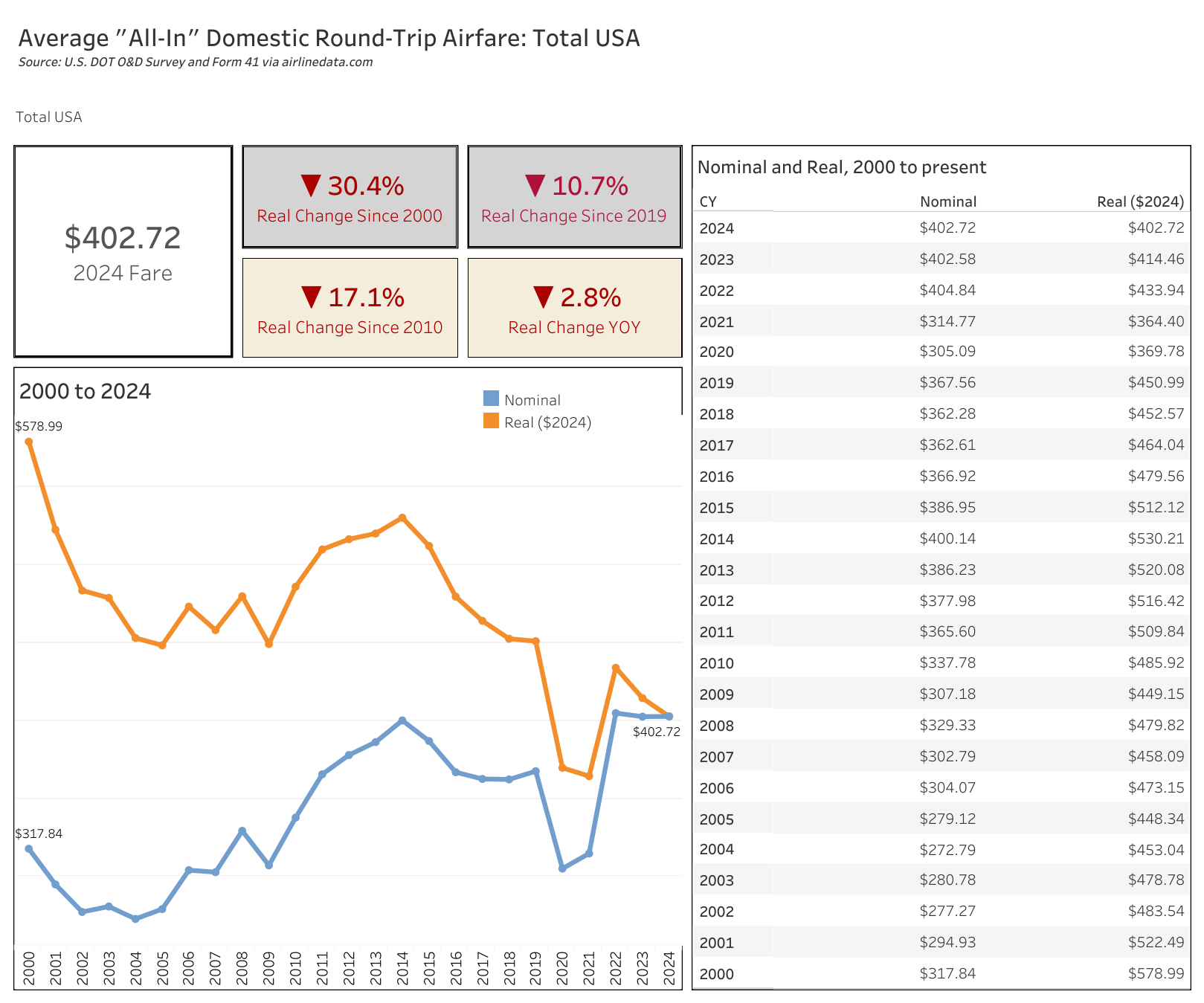
And, in fact, including fees the price of air travel has fallen significantly in inflation-adjusted terms:
Checked Bag Fees Are A Price Increase Subsidized By The Government
Checked bag fees are one way to raise price. It’s also tax-advantaged (encouraged by Congress). Domestic airline tickets are subject to a 7.5% excise tax, but ‘optional fees’ are not. So moving money out of the fare and into fees is tax arbitrage.
- U.S. airlines generated $7.3 billion in checked bag fees in 2024. $5.8 billion of that was domestic bag fees.
- This saved airlines $435 million in taxes.
If you don’t like checked bag fees, understand that Congress is providing airlines with a half billion dollar a year incentive to charge them. And they use those bag fees as an incentive to get their credit card (which waives many of those fees), in turn driving their profits.
Fees Are Just One Way Airlines Adjust Prices To Try To Avoid Losing Money
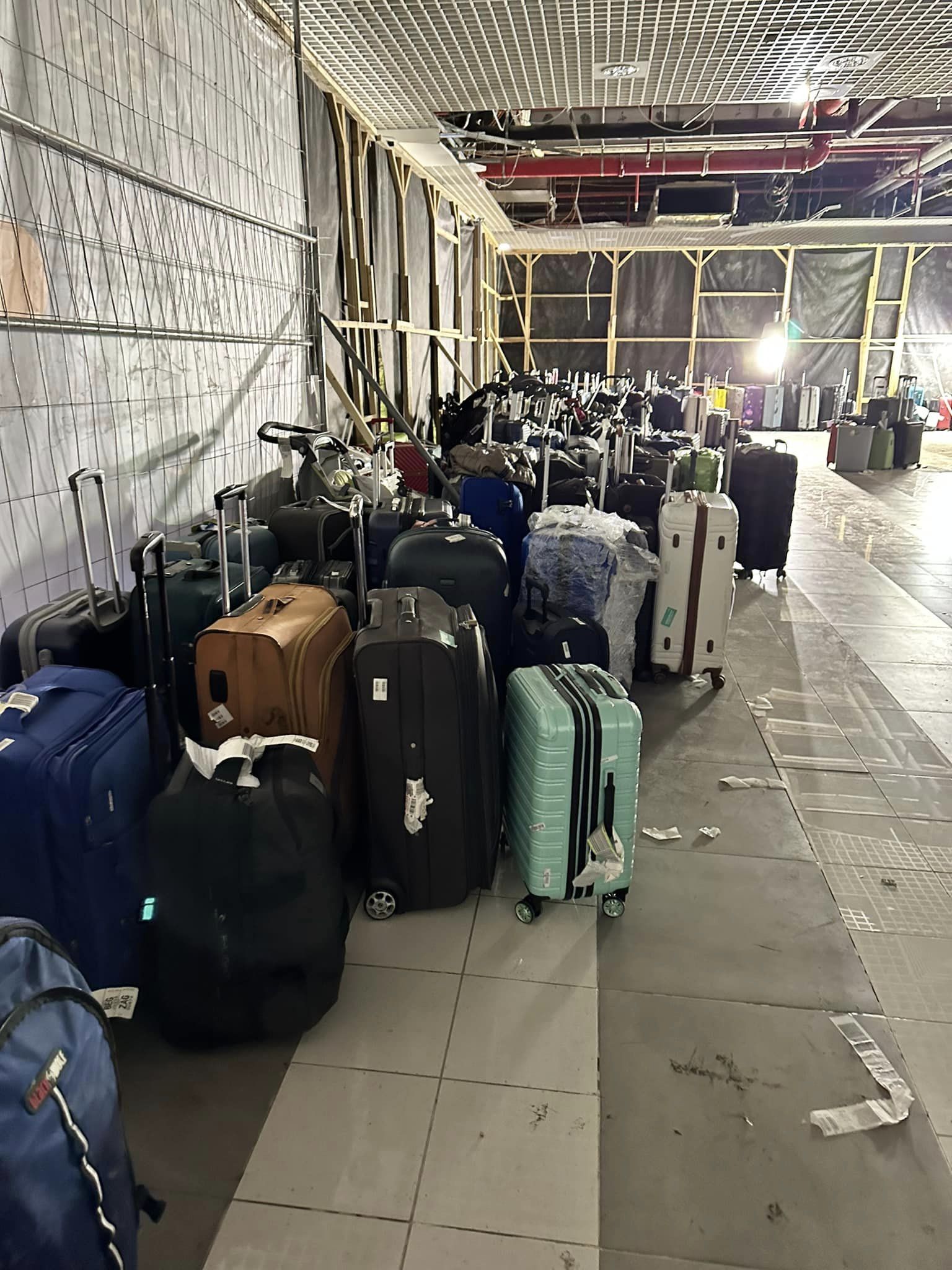
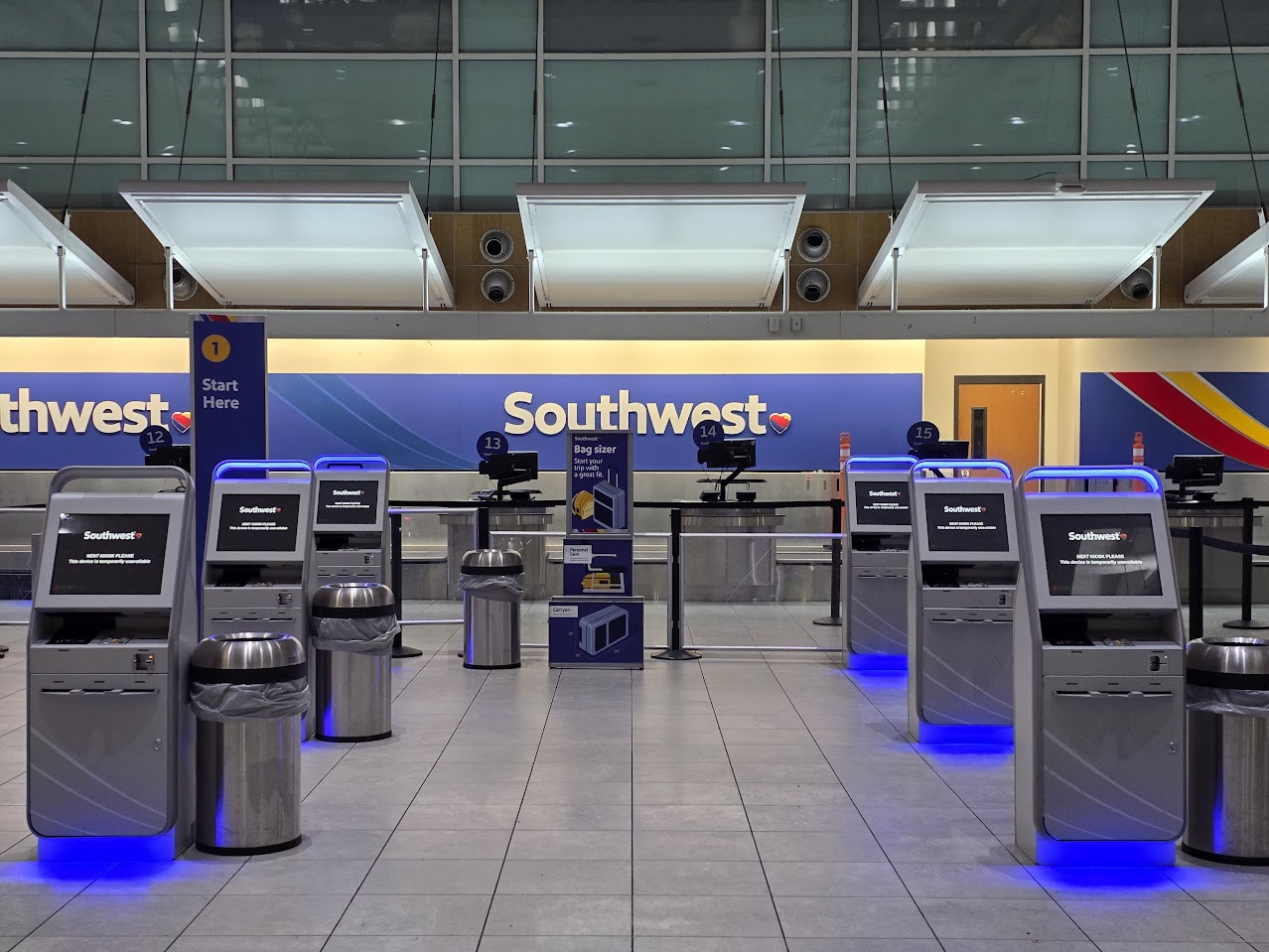
Checked bag fees aren’t all the same. JetBlue has a structure which can make their bag fees higher than competitors, with peak and off-peak seasons – when they’re able to fill planes, they charge higher bag fees, supply and demand!
But checked bag fees also do not fall when costs or demand falls, airfare adjusts, and there’s a strong legal incentive for this to be the case.
Delta’s CEO isn’t going to promise to lower bag fees. He can promise, though, that the airline will adjust the total cost of providing travel as its costs change and demand for its product changes.



The blunt truth is that airlines do not make money flying passengers. If you’re buying a domestic coach ticket you are most likely getting a fare that does not cover operating costs. There’s very few situations like that in the free market. So, the public maybe shouldn’t complain about a hike in fares.
If everyone is pinching pennies these days, why are we (i.e. Congress) incentivizing airlines with a half billion dollars so that they can charge us baggage fees? I’m not suggesting that baggage fees be eliminated (although that would be nice), but eliminate the incentives and have airline pay the 7.5% excise tax.
American could not possibly operate on such a narrow margin and stay in business!
Still shilling and licking boots, I see. @Gary Leff, @George Romey. Naw, this is corporate and individual greed. Ed has a $100 million incentive package. Crocodile tears, y’all. They’d gut their workers and us consumers for mere extra penny; maybe even for free.
They should charge carry-on luggages as well.
They promise to charge what the market will bear, and no more. In return I promise to pay what I have to, and no more.
And, @Mike Hunt, @Tim Dunn, @Mike P, and the other faux-intellectual ‘conservative’ economist libertarian types, if it makes you lot feel any better, please feel free to call me a ‘socialist, communist, liberal, leftist cuck,’ like you usually do, BUT… this is a regressive tax on consumers. You already know that the relatively well-off people with status, who already fly mostly in premium cabins, and those of us who do carry-on only are not the ones paying these fees. Rather, it’s the relative poors who are getting kicked in the balls, yet again. And, if costs go up too much for them, they’ll just stay home. Empty planes. Less travel. Less commerce. This is not a good way to run a business, much less a country. Gonna milk ’em dry. Prove me wrong, ye robber barons.
Question: If a bag was shipped as stand-alone air freight, would that cost more than $50?
Checked bag fees are very profitable for American, Delta and United Airlines.
@1990 You do realize that during the CBA days, when the government set routes and fares and determined which airline operated on that route, the average American could rarely afford to fly. So when the government controlled the airline far less of the “poor” as you say flew. In fact, they probably never flew.
And as someone that was alive during the days no one complained. No one claimed it was “systemic racism” that kept them off planes. Or greedy airlines. But the again the government wasn’t full of charlatans such as Bernie Sanders and AOC ginning up the ignorant masses.