American Airlines President Scott Kirby spoke yesterday at the Wolfe Research 9th Annual Global Transportation Conference offering mostly extemporaneous comments in response to investment analyst questions.
The theme that analysts are interested in is the revenue environment that airlines, and especially American, are facing — they’ve seen declines in passenger revenue per available seat mile (PRASM) despite huge declines in fuel costs that have driven profitability. And they want to know when that will turn around, and what American is doing to accelerate that.
American already rolled out new forecasting system as part of its improved yield management. He believes they simply didn’t have good, actionable data at the flight level about likely purchase of different kinds of fares, giving the example of ‘0.1 tickets sold at a given fare with a standard deviation of 3’. There’s some challenges in the near-term where individual managers had local knowledge about a flight, with separate spreadsheets, and made changes to flight availability based on that knowledge while there’s a learning curve for the new system. But they want to get better at tailoring availability of fares on a flight to demand for that flight.
In his narrative, it used to be that airlines would forecast demand for full fare tickets and they would forecast demand for leisure tickets, and those were treated as distinct – but in a world where there are discount fares with no advance purchase requirements that simply isn’t true anymore. People only buy more expensive tickets when less expensive tickets aren’t available.
In the past they segmented customers based on fare rules. Now they’re moving to segmenting customers based on the product those customers want to buy. Instead of treating everyone the same after their tickets are purchased, they want to give customers exactly what they are buying. That’s the Delta model, where Delta has been saying they want customers “to pick the airline and the product that works best for them.”
Kirby says he thinks customers who want premium economy aren’t willing to fly basic economy and separately notes (when talking about incremental costs of Basic Economy and Premium Economy initiatives that he sees driving revenue growth) that “[p]remium economy will probably have free drinks.”
I’m not sure that Kirby is right, that customers are either one product or another. This week I bought a United ticket and was offered discount economy and discount first class for $159 more. I wasn’t going to spend the $159. During the purchase process I was offered a buy up to Economy Plus extra legroom seating for $79. I wanted extra legroom, but I didn’t want extra legroom for $79.
Indeed Kirby’s whole model of incrementally higher pricing for better product suggests passengers make tradeoffs between product and price all the time so the notion that customers are going to buy a particular product – period – can’t be right regardless of Kirby’s stated belief that consumers are price inelastic with respect to flying.
I decided to stick with regular economy. Sure, it included a seat assignment. But it effectively didn’t offer any changes since the fare was less than the change fee. It didn’t include upgrades, since I’m not a United elite.
Once I committed to the purchase, United came back with a $99 offer for first class. I took it. I buy my tickets based on the value proposition embodied by schedule and price. There are tradeoffs, and whether or not I’ll pay more depends at what margin?
Maybe Kirby is right, of course, and I’m unique in that I’ll fly a number of different possible products — American, United, Southwest and I recently considered Frontier based on schedule and price (though I’ll pay a premium to avoid it).
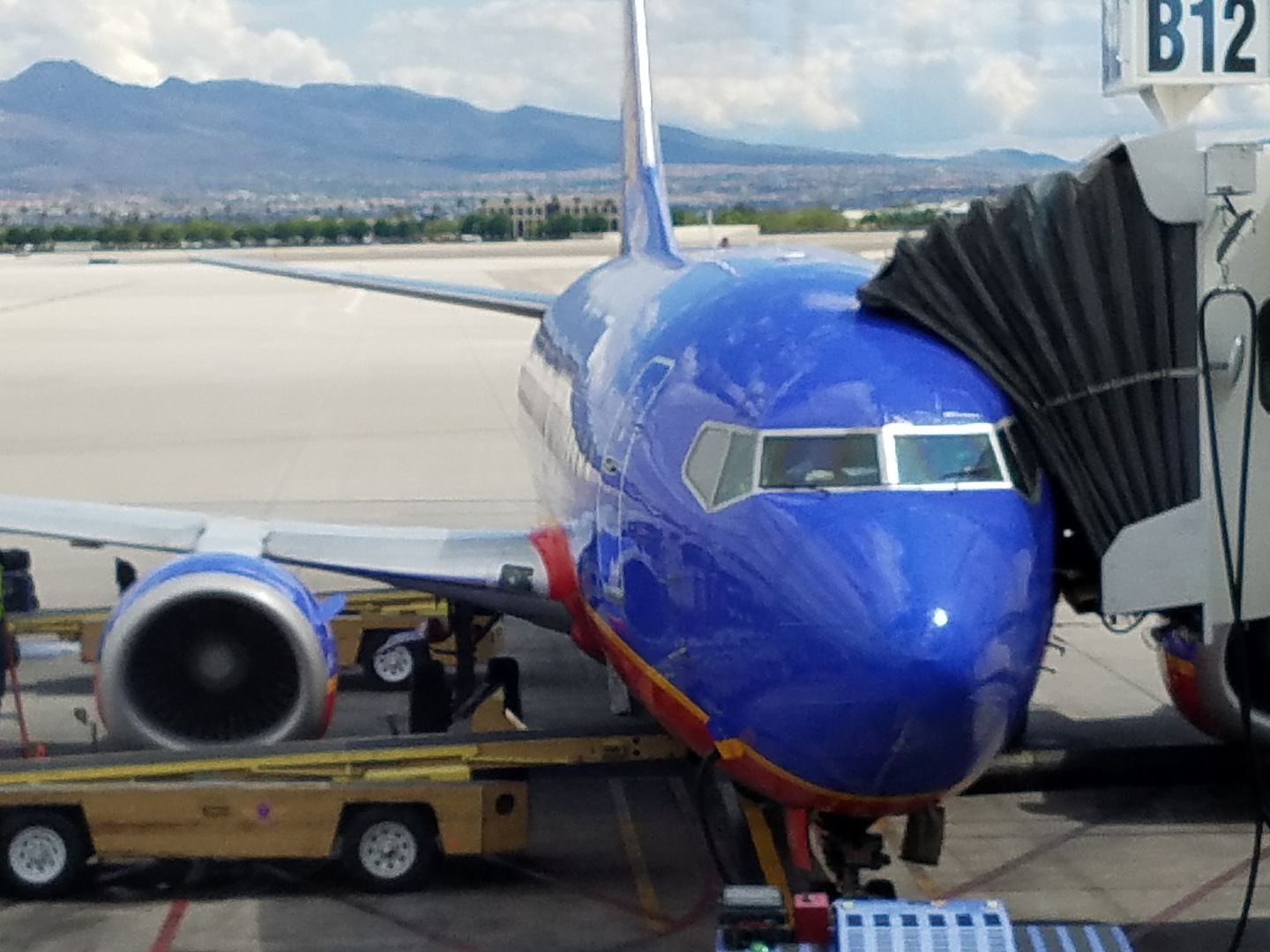
I’m not a top spender with American (I don’t qualify for Concierge Key) but I’m at least an average-spending 100,000 mile flyer, with my work trips I will easily break-even under American’s new revenue-based earn.
I continue to question the wisdom of share buybacks as a non-expert, the idea of having ‘too much cash relative to what it takes to run the company’ to paraphrase Kirby’s explanation, seems an expression of failure: a belief that management has no stronger growth opportunities, either in its current industry or elsewhere. It says that the business sees itself as in a specific industry, with constrained opportunities, rather than as a set of capabilities that can be leveraged into opportunities elsewhere. But if the highest value use of cash is buybacks, it’s not a growth company and not a growth stock.
It also seems a perverse perspective when American Airlines hasn’t managed to yet offer a consistent product across its fleet, or even power ports or in its legacy US Airways planes.
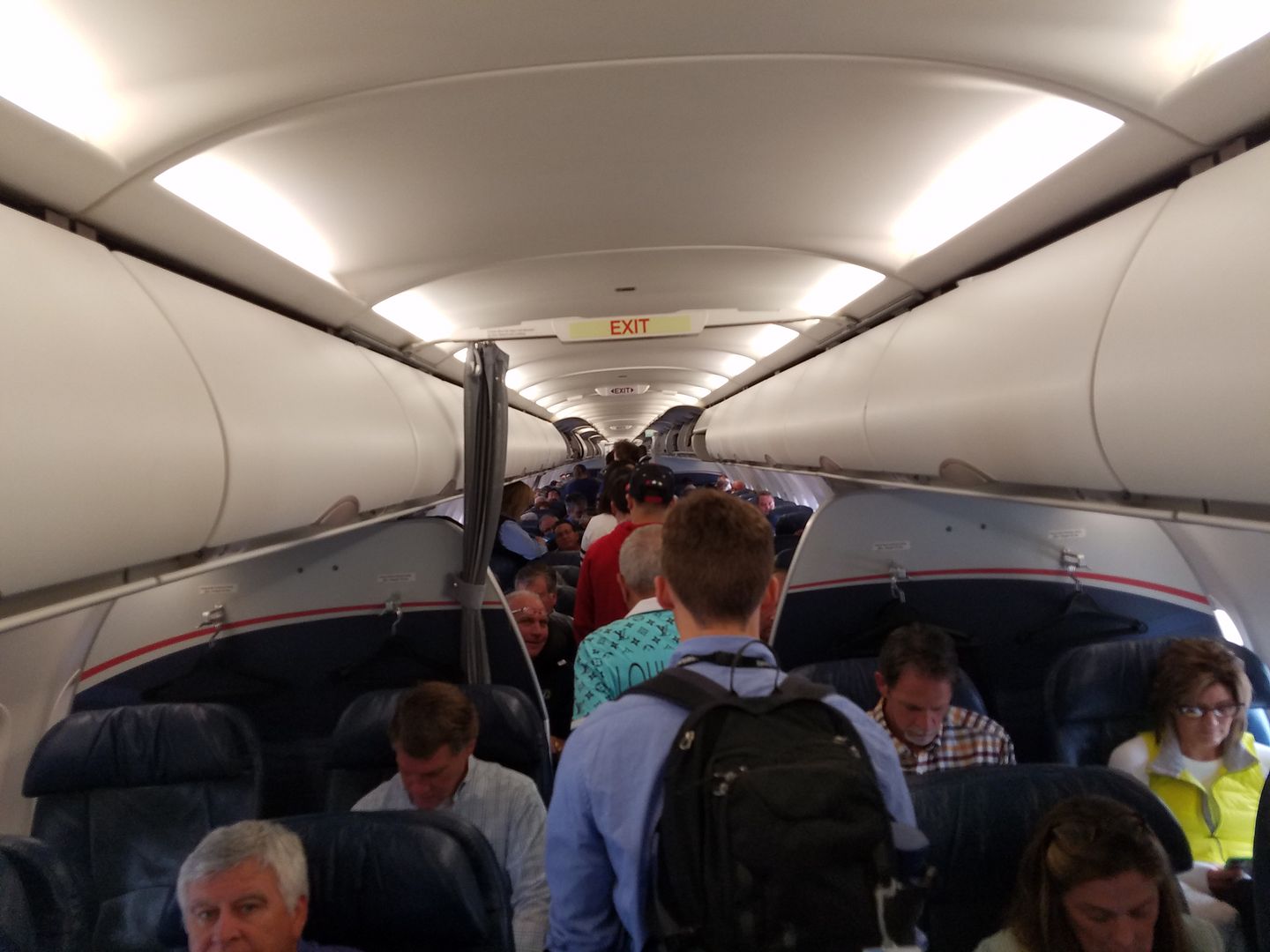
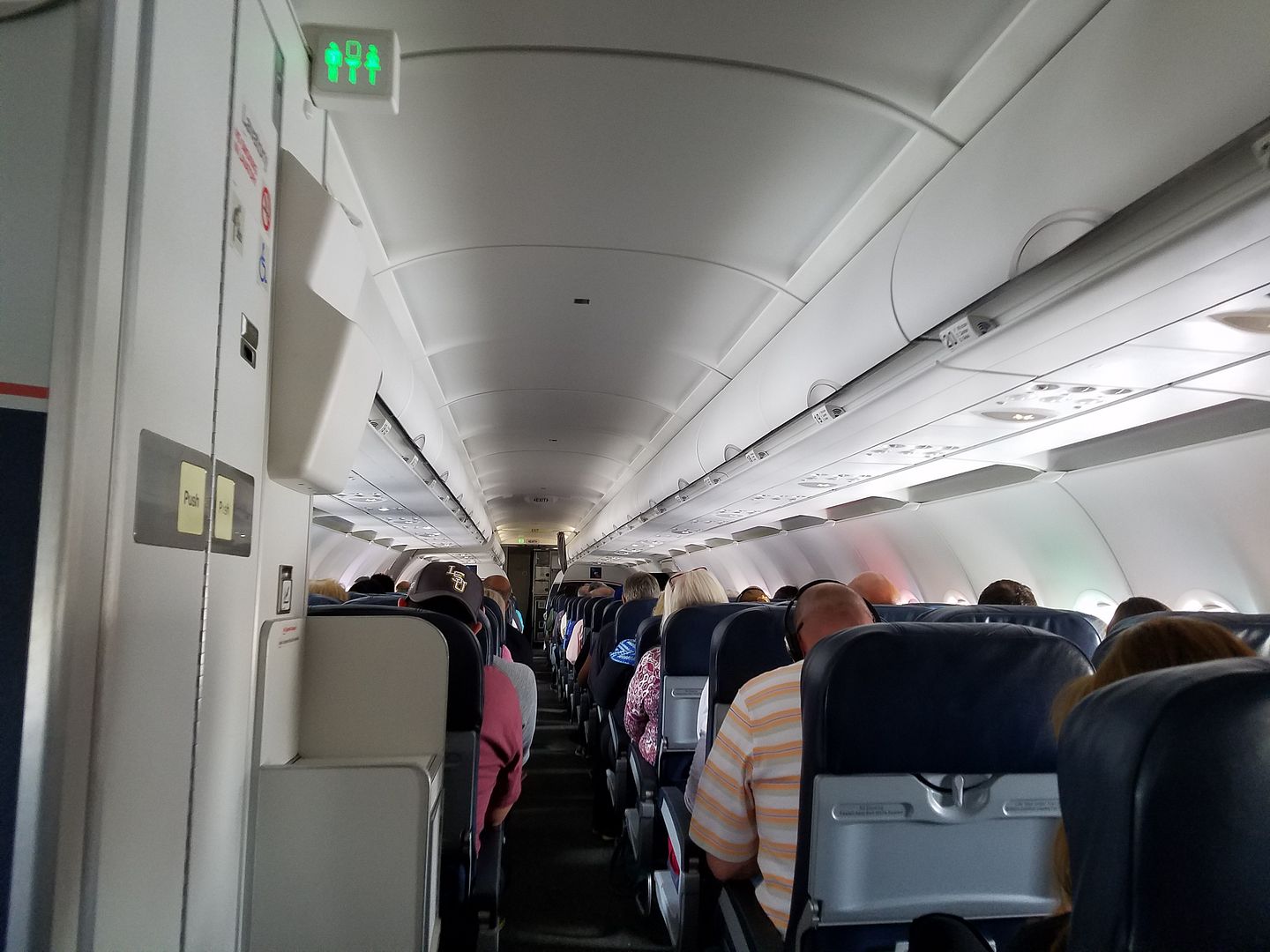



To segment your customer base, you need to offer distinct products that customers can differentiate and choose. Airlines have a very hard time doing this because the counter agents are the same, the check in process is the same, the airport experience is the same, the flight leaves at one time, (first class passengers don’t get a pass on delays). On board the aircraft, you can get a seat assignment, a bigger seat and a meal or drinks. On anything other than transcon or intercontinental, THERE IS NOT MUCH DIFFERENCE. This leaves you wit very few factors to differentiate and charge for. Throw in the the devaluation of loyalty programs, the inability of the airlines to create a similar experience (ATC, weather, lack of standard fleets, power ports on some aircraft, not on others, IFE, etc) and the quest for segmentation driving revenue growth is very hard for domestic USA travel. That is why being a free agent is he only way to go unless you fly a ton of miles on long flights.
This is what FF programs are being decimated. Airlines are competing for business travelers and doing everything possible to remove FF benefits and getting the coveted OPM flyers to pay more for upgrades, seat assignments, premium economy seats, etc. The entire game is about extracting money from and competing for biz travelers b/c no matter what they do leisure flyers are only going to spend a certain amount.
That’s a fascinating story, Gary. $159 for the upgrade, then $99 once you have demonstrated that you are a price-conscious customer. The airlines are getting closer and closer to Hotwire’s model of offering a range of products to price-conscious customers.
Next up I wonder if we will see offers to change an award booking to a paid ticket at a special price, or offers to change a paid ticket on an empty flight to an award ticket at a mid-tier miles price. Or offers to waive change fees and give you extras like premium seating if you switch from a heavily loaded flight to a lightly loaded flight. There really is no end to where the airlines can go with customized offers.
It’s really sad that this is what Kirby is talking about. AA has some serious issues such as customer service going in the tank since this merger.
How does Kirby expect AA passengers to even know what they are buying in Premium Economy? AA needs to make several updates first — Main Cabin Extra on every plane, faster Wifi, power ports.
I am not sure if the airlines appreciate how this might result in the customers segmenting them.
I fly almost exclusively for work – 100K+ miles per year, currently almost all on American.
I would (pending company policy) buy a premium economy ticket when flying to, say HKG or LHR, but I am sure as heck not going to buy anything other than basic Y for something like ORD-DFW or DEN-LAX. And if I am not going to get elite benefits on those flights, or if I am going to have to wait for an “upgrade” to an economy plus type product, I’ll just buy a ticket on Southwest, or UA, or DL, or whoever has the best schedule/price.
So my AA purchases end up getting segmented over multiple airlines. Would have to see how the revenue would sort out.
Since Kirby thinks he knows his customers and “their needs”, let him find out the hard way. The whole “Economy Comfort”, “Economy Plus”, and “Main Cabin Extra” are such minimally better products. On a TPAC or TATL the costs of these upgrades are ridiculous. $100 to $150 for 4 inches more legroom, come on, passengers are not idiots. Passengers are waking up to all the gaming the airlines do with extras. It pays to wait.
Interesting point with stock buy-backs. Problem is so many companies are doing it. Not investing in your product, service, employees, etc. can become a self fulfilling prophecy of mediocrity. How many airlines did that before and no longer exist?
JohnB, I think the airlines are trying to triage which services and benefits go to which customers. They want to stop giving away upgrades and other benefits to customers who only want them for free. There ARE people who will pay for 4 extra inches and upgrades, and AA wants to monetize the demand. Delta, as usual, is leading the pack in monetizing their Economy Comfort.
I think stock buyback are the worst possible use of cash ever unless they’re retiring shares that would otherwise be incurring substantial dividend expense. Even then it should only be after the company is debt free and has already purchased all reasonable competitors.
Bob, AA would love it if you as an AA elite spent big corporate money on a premium Y ticket LHR-HKG and took WN for your low yield leisure flights. They have no interest in providing elite benefits on cheap leisure fares. They’d rather sell the cheap leisure ticket to a kettle or free agent who pays the ancillary fees.
Gary, have you read up on IATA NDC [new distribution capabikity] and Resolution 787?
People will pay for tangible differences in hard product. But the idea that we’ll pay more for a drink and a snack is misguided.
The main flaw is if you are expecting elites to pay for what they used to get for free, they’ll just choose the more convenient flight at the best fare.
Can only communicate what I learned from personal experience.
My experience was that at every level there were people who couldn’t really care less about how much was spent with or how much somebody traveled “on an airline”. Pick one.
So my response is naturally that I could care less how much revenue I give to any airline.
I tried developing a relationship with one player and frankly it became a cluster f.
When you begin to treat your “rewards” program and the people who wish to avail themselves of it as adversaries to your business model, paying customers are not stupid.
People would like for their travel decisions and purchases to be ‘easier’ so than why all the fare buckets and phantom availability and so on.
I’ll fly anyone but for all the railing against southwest’s supposed “revenue” based program which doesn’t work either, for domestic travel it probably wins because it’s the easiest to understand.
Even now, I’m thinking well it would be nice to have status with the airline I’d like to fly but then you examine all the petty BS you’d have to go through to get it only to then not be given the best fares but instead treated like a captive bidder at a Christies auction for some old Danish guys steak knives?
Sorry I’ll pass. And the end result isn’t incrementally More revenue through your mishandled loyalty programs. It’s ZERO revenue.
@josh g – yes i am familiar with, why?
Why is United offering these status giveaways and bonus miles. I was a loyal customer once spending $20k+ a year, they upgraded me a lot and treated me well. Then things changed, they stopped upgrading me frequently and moved to revenue based earn. I switched to Southwest, earned a companion pass and flew other airlines as well. I have barely set foot on a United plane in the last 2 years except to redeem award flights. Now they have offered me gold trial status plus a spend bonus which means a total of 30 points per dollar for $2500 base spend when cc, elite and the promo are taken into account. That’s more than I earned as a 1K and I may take advantage of it but I won’t become a loyal United customer again. They broke the relationship. AA should be careful they don’t do the same.
Good post Gary, it doesn’t present a very optimistic future for AA if this is how the CEO President thinks this is how the relationship with customers works. He believes that each customers will only buy one variation of the product, but he seemingly does not see the irony in the fact that the airline does not provide a consistent version of any of those variations.
@rjb hits it right on the head, there are dozens of facets to the air travel experience, but if the only ways AA is willing to differentiate products is the cost of the drink and the range of pitch between 31 and 35 inches – they are going to have a very tough time driving revenue higher. The Revenue/Seat Mile that AA is getting from me is lower in 2016 than it was in 2015, mostly because I am buying fewer P and A fares which in turn is because of the changes to AAdvantage. So far there has not been one ticket purchase that I’ve ever made on the basis of the drink cost, but maybe Kirby is right and that’s what’s driving most passenger choices.
Earnings per share is one of the most common measures of corporate success and a huge driver of stock price. It is also a common measure for executive incentive plans. The fewer shares outstanding, the higher the EPS (and likely the larger the payout to top management) for any given amount of profit. Also, executive incentive plans (restricted stock, phantom shares, stock options, etc.) have a dilutive, although most likely small, effect on EPS. This may be part of the motivation for using corporate cash for stock buybacks.
Stock buybacks are a tax efficient way of passing earnings along to owners. Dividends are taxed as ordinary income whereas the increased share price that a buyback drives is a capital gain. Buybacks can be done to excess but some f the rhetoric here is a bit much.