American Airlines began grading its flight attendants this spring. Flight attendants have now graded management in return. Their union says that more than 8,200 responded, Inflight Management received an F, and the airline has already agreed to make changes.
Me@Work scores individual flight attendants using a year of customer survey results and operational data: passenger satisfaction, attendance, flight attendant-coded delays, door closing and predeparture work, use of Microsoft Teams, incident-report completion and electronic flight bag compliance.
I thought the idea was directionally right. American should measure performance, reward its best flight attendants, coach or retrain people who need help and eventually remove employees who remain unsuited to the job. However,
- Passenger scores cover a whole crew and reflect delays, catering, inoperative wi-fi, dirty planes and other problems an individual flight attendant doesn’t control.
- Delay codes create blame games. Door close targets can encourage employees to focus on things other than the customer.
- And American wasn’t attaching meaningful rewards to good performance.
The union challenged the transparency and accuracy of those scores. Now it has responded with Them@Work, grading American’s managers using the same basic conceit.
The union’s focus here isn’t even Me@Work. American began a restructuring in June 2025 that created specialist roles for operations, performance and attendance. American promised subject-matter expertise and managers working in terminals and at aircraft gates. APFA says it was told the purpose was support, not compliance checks and discipline.
But flight attendants say American built an efficient system for producing discipline cases and meetings while making it harder to find someone who can fix an actual problem.
Flight Attendants Turn Me@Work Back On Management
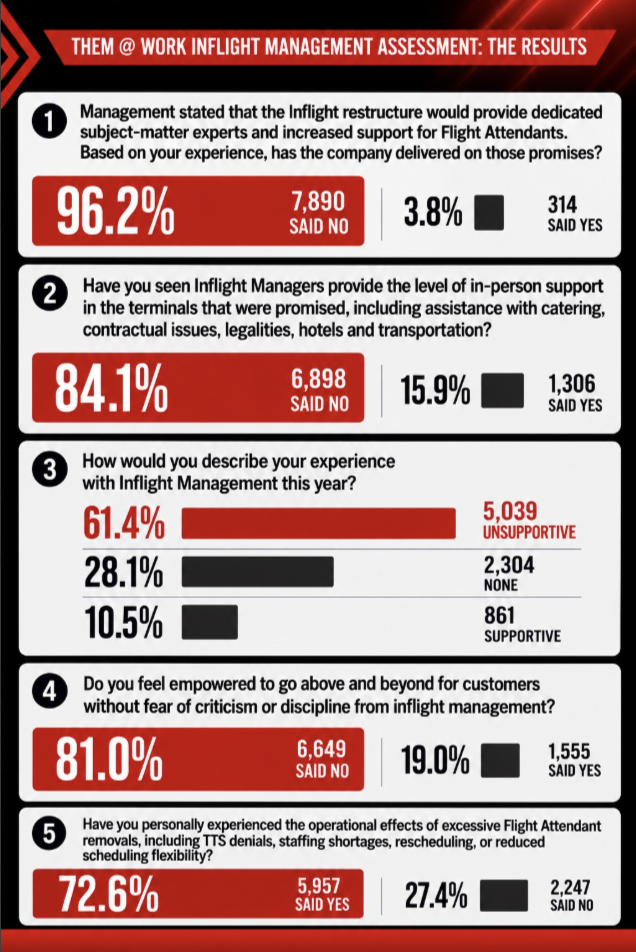
All five questions in the union’s survey received exactly 8,204 responses:
- 96.2% said the restructuring had not delivered the promised subject-matter expertise and support.
- 84.1% had not seen the promised in-person terminal help with catering, contractual issues, hotels, transportation and operational problems.
- 61.4% described management as unsupportive, 28.1% reported no experience with management and just 10.5% called it supportive.
- 81% said they didn’t feel empowered to go above and beyond for customers without fear of criticism or discipline.
- 72.6% said they had personally experienced operational effects from flight attendants being removed for management matters.
This was a union advocacy survey launched with the instruction to “hold Inflight leadership accountable”. There are no cross-tabs. There may be the same flight attendants responding multiple times. Questions are leading, especially the one that labels flight attendant removals “excessive.” Internal union politics is part of this, too. So it’s not a scientific estimate of what 96.2% (or 81%) of cabin crew believe.
Still, 8,204 responses is significant (roughly a quarter of American’s flight attendants). 5,039 people described management as unsupportive. Among responses that expressed a view, 85.4% were negative.
The 81% customer question should concern American most. Premium service requires discretion. Employees who expect a complaint, score or investigation whenever they depart from minimum procedure are going to protect themselves. They’ll follow the script rather than solve the passenger’s problem.
A 20-Minute Meeting Can Break A Multi-Day Trip
APFA reports that management blocked flight attendants from flying for 4,076 roster days during June alone with meetings to answer for complaints. DFW accounted for 1,128 days, Miami 646, New York 486, Charlotte 477 and Philadelphia 420.
That doesn’t mean flight attendants spent 4,076 full days sitting in meetings. Philadelphia had 108 meetings in June that produced 420 blocked roster days. A short meeting can conflict with an indivisible multi-day trip sequence, taking the employee off the entire trip.
Pulling a pay-protected employee from a trip is expensive at scale, since they also need to pay someone to work the trips, and this uses up reserve coverage that would otherwise protect the operation (or they need to pay a premium to get an open trip covered with volunteers). That makes for tougher recovery during irregular operations and managers spending time processing employee cases instead of helping crews at the gate.
The union says flight attendants have been removed from high-paying trips for 20-minute meetings merely to document that an electronic flight bag had been stolen. It reports meetings following emergency hospital visits, vague passenger survey comments, anonymous and uncorroborated allegations against long-serving employees, and security incidents or passenger assaults.

American Agrees To Move Some Cases Back To Phone And Email
APFA says American contacted the union after the survey and agreed that matters suitable for remote handling would no longer require the same in-person process.
Meetings that previously could have been handled by phone or email will return to those more appropriate channels.
That should mean fewer flight attendants removed from trips and more managers available in terminals and on aircraft, according to the union’s announcement of the results.
It’s a sensible correction, though shifting a meeting to email alone won’t satisfy a union concerned with whether a routine inquiry is being treated as an investigation. The airline, for its part, tells me:
We’re grateful for the care, professionalism and dedication our flight attendants bring to American every day. We share a common goal of delivering a great experience for both our team members and our customers, and we will continue working to strengthen that experience across the airline.
American is right to want accountability. It doesn’t seem like the current version of the program is getting there, and the union isn’t working to suggest ways to accomplish it either. The company needs data, it needs first-hand observation, and given its unionized workforce it needs to find a way to work collaboratively with APFA which probably means putting more money on the table to incentivize great performance not just meetings to counsel low scores and other issues.
Too often customers get flight attendants doing the minimum rather than going above and beyond. That’s a problem for an airline making huge investments in becoming a more premium carrier. When 81% of respondents in a survey say that management has produced a system that makes them wary of going above and beyond, that’s a problem, even when it’s a survey designed to elicit precisely that response.



Friends, please—instead of attacking frontline crew (as some inevitably do in these threads), we frequent fliers need to recognize that it’s bad management and greedy shareholders against both the workers and us consumers.
Dolly Parton said it best in 9 to 5:
“They let you dream just to watch ’em shatter / You’re just a step on the bossman’s ladder / But you’ve got dreams he’ll never take away / In the same boat with a lot of your friends / Waitin’ for the day your ship’ll come in…”
When an airline creates an environment where 81% of flight attendants fear discipline just for using ‘common-sense’ initiative to help passengers, corporate leadership has failed both its staff and its customers. Management squeezes crew to protect margins, leaving passengers with higher fares and downgraded service while workers get micromanaged into working in fear.
The minute we turn on each other in the cabin, the owners win (not us). True solidarity between the people in the seats and the crew in the aisles is the only way the tide actually turns for better.
“[F]ear of criticism or discipline” is doing a lot of heavy lifting these days, isn’t it?
Discipline? No, retribution by union thugs. We all know it’s true. Obviously management would have no reason to object.
AA blew their opportunity to become a competitive airline when they lacked the cajones to lock out the union. Now you overpaid them and they still hate you, your customers, their jobs, and most likely themselves.