
The largest flight attendants union is looking to the government to require airlines to staff more cabin crew on widebody planes because that means more union dues safety, which seems like a solution in search of a problem.
"This is fundamentally a safety issue. Our union is calling on Congress and the FAA to require at least one Flight Attendant per door exit on widebody aircraft.” @FlyingWithSara
— AFA-CWA (@afa_cwa) May 15, 2026
Their proposal is to require at least one flight attendant per door on widebody aircraft, so that no door is “uncovered” by a cabin crew member in an evacuation. For instance, on American’s Boeing 787-9P:
- There are eight exit doors
- FAA-certified minimum staffing is seven flight attendants
- American actually staffs more than that, but if crew got sick and called out they wouldn’t have to cancel the flight.
Generally flight attendant minimums are based on number of seats on the aircraft (one per 50 seats, for planes with more than 100 seats).
The argument is that flight attendants are supposed to assess whether an exit is usable in an evacuation, open usable doors, deploy slides, and command passengers getting off the plane. They are supposed to stop people from taking bags and coordinate with the cockpit. But without one flight attendant per door, passengers may open an exit they shouldn’t or take bags (of course, just a week ago, passengers ignored flight attendant instructions evacuating with bags, as they always do).
However, the FAA issued an evacuation report in 2022, reviewing nearly 300 real-world evacuation events, and found the overall level of safety in emergency evacuations “very high” already.
- There are about 30 evacuation events per year worldwide
- In the U.S. alone there are more than 10 million scheduled passenger flights per year
- There were no evacuation-related fatalities in the U.S. over the ten-year period reviewed.

The FAA explicity concluded that their review “did not identify current flight attendant staffing is inadequate.”
In any case, where there are evacuation issues they tend to be communication, training, passenger baggage, blocked exits, and smoke and fire, not the number of flight attendants. In other words, flight attendant staffing is among the lowest-priority items for evacuation safety.
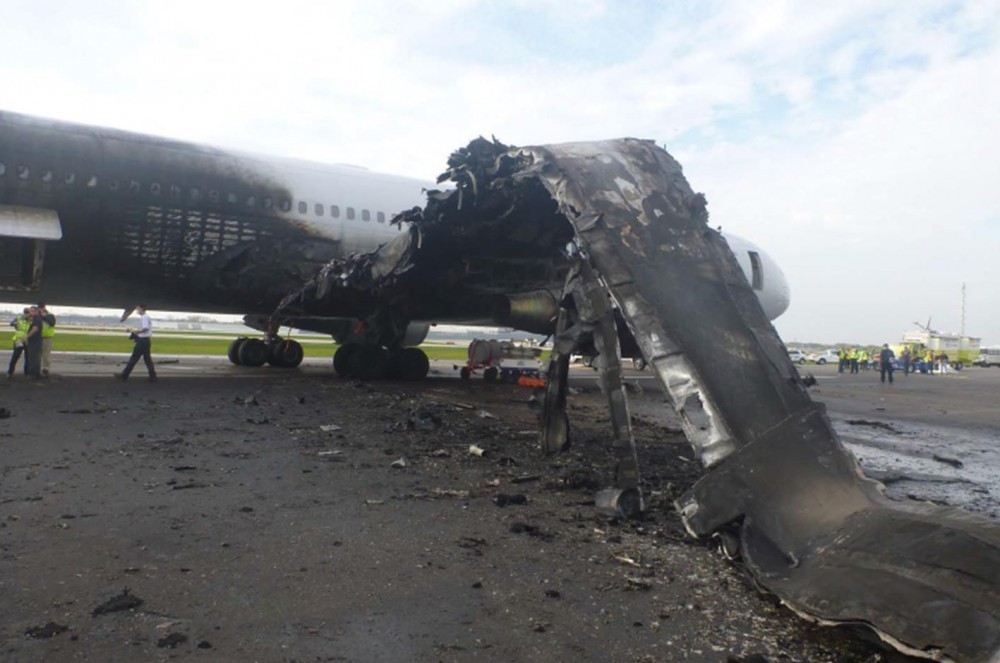
Moreover, famously in the evacuation of American Airlines Flight 383 in Chicago in 2016, one passenger was seriously injured and the NTSB attributed this to (1) delayed shutdown of the left engine and (2) a flight attendant’s deviation from procedure allowing passengers out the left overwing exit while the engine was still operating, with lack of crew communication a contributing factor.
The legislative effort by AFA-CWA is not a serious safety program. Flight attendants who consider themselves professionals should be embarrassed by this – and angry. It diminishes the significance of their role to make work, where safety is just a fig leaf, and the message is they’re only needed because the government says so – rather than because of their contribution to the airline. Sara Nelson should be ashamed.


What a garbage article. The union is 100% correct in their statement that 1 FA to cover 2 doors that are nearly 20 feet away from each other DOES reduce the safety levels to some degree.
It leaves that 1 FA with zero room for human factor or error.
out of curiosity, why have the story lead photo be of the members of the largest non-AFA Flight Attendant union?
@MaxPower — Flight attendants with Envoy, Piedmont, and PSA (each American Airlines subsidiaries) are with AFA-CWA, so maybe that’s what Gary was going for… or he didn’t think about it much and just used a go-to AI/clipart thumbnail like usual.
Ah…the AFA and the bag that is the president. What the AFA is doing is padding their bank account. Again, the gift that keeps on taking. Thankfully, I’ve not had to evacuate an aircraft BUT…from what I see, the issue is passengers taking their crap with them. The only thing I will “jump” with is my wallet, passport and medications. They are on my person.
@AirbusCFI — If you are actually an instructor, what do you think would make the difference during evacuations?
The Japanese seemed to get it (JL516), though I recall they repeatedly warn against bringing anything with you during safety video (they also warn against taking photos).
Some on here have previously expressed vigilante sentiments (violence against those who don’t comply), but that doesn’t seem helpful. Others express a brutality through excessive punishment (automatic forever bans, jail, etc.), but that also doesn’t seem like an effective deterrent. In the heat and chaos of the moment, who knows how individuals or the group reacts.
@1990
fair point
@MaxPower — What’s a FIB, again? /s
What a 100% sensical proposal.
Bet that this anti-American people administration won’t do a thing. After all they all fly private and openly disdain the plebes: let them die (air pollution, prohibit vaccines, cancel science, etc.)
Let’s face it, more flight attendants are assigned to the expensive seat areas and fewer are in the coach seat area. Therefore they could already be out of place due to the company’s assignments. Things will probably go like normal where passengers have read the safety sheet and know what they are supposed to do. What should happen is that an able bodied person should be required to sit in the row of every emergency exit that doesn’t have a flight attendant sitting there. If that requires a free upgrade, so be it.
@JD what are you imagining? The 787p, for example has 8 doors:1L, 1R, 2L, 2R, 3L, 3R, 4L, and 4R. So with 7 FAs your imaging one at each except one FA has 3L and 4L. How silly, the FA with 2 doors would have, say, 4L and 4R.
And, BTW, you’ve got 4 pilots on many international trips. What are they doing during an evacuation? Monitoring a door if necessary?
Oh good, more attendants to sit on their phones in the galley the whole flight, just what we need. How about some customer service first, you know like on every airline OUTSIDE the US has? The it might be easier to support them. Most of the domestic flying public might fall for it, but if you fly overseas much, the US domestic carriers are abysmal in every category, particularly customer service and customer experience.
1990: Yes, I am actually an Airbus instructor with about 17,000+ hours of time and 20+ years of teaching both Boeing and Airbus products. To answer your other question, I don’t know. The preflight announcements always stress keeping one’s seatbelt fastened in case of “unexpected turbulence”. Do the passengers heed that…NO! Thus, there are injuries. When I’m riding in the back, I do keep my seatbelt loosely fastened AND…it has helped numerous times. I can’t speak for all airlines but others that I have flown also have the “in the unlikely event of a loss of pressurization” and a “case of emergency evacuation” remarks. Do passengers listen…again NO!!! The Asian culture is “FOLLOW THE RULES” (Asiana in KSFO is a great example) In Western culture…”Damn the rules…run for your lives”…oh..grab my suitcase, briefcase, gift candy, etc.” One thing instructors, examiners and line check pilots stress in case of an emergency is “two out & two in” announcements. The FIRST thing is “Please remain in your seats with your seat belts fastened” (IF APPROPRIATE!!). Notify the tower of our intentions. Notify the flight attendants and notify the company. It is especially important to keep the flight attendants in the loop as, in case of an inability to hear from OR contact the flight deck, they can command an evacuation on their own. While I don’t know IF this happened to JAZZ at KLGA, I’m sure that the flight attendants commanded the evacuation since the flight deck was destroyed.
hmmm. . . .evacuations are quite rare but would an additional FA mean better service?
Jack, I don’t think so. US law requires one flight attendant for every 50 seats in the aircraft whether there’s a butt in the seat or not. Overseas flight require the same number but due to required rest, the number of flight attendants is increased. By how much…I don’t know. I doubt that adding any additional number would improve service enough to warrant the increase in staffing. Good flight attendants are, most likely, exhausted after “walking” across the country/oceans. Proper training will show them how to take proper breaks and still provide good service. If one reads between the lines of union demands (to include prior missives) they want to increase headcount which would increase the union’s bank account. The gift that keeps on taking.
@AirbusCFI — Thank you for the detailed response, and for what you do. ‘Two in, two out’ must be exceptionally challenging in situations where time does not allow for it. Yes, Air Canada Express 8646 is such a case; 4 crew, 2 pilots (heroes), 2 FA, one thrown from the aircraft, the other in the back was apparently the only crew member available to facilitate evacuation. Given that the pilots had just 6-seconds, I doubt there was any communication out/in. And, I’d imagine the confusion of the situation was wild for the FA in the back of the cabin; it is a miracle that there were only two fatalities (the pilots). I do not recall any reports of issues with carry-ons with that incident. I’d assume passengers were reunited with their items after the fact, even if it takes a while since the aircraft gets held for the investigation.
1990: There’s a rule that one “flies” the jet all the way to the gate and the parking brake set. Yes, a discontinued takeoff or a go around are very busy times and the pilots have this “beaten” into their heads…FLY THE JET! If it gets to the gate in one piece, that’s normal. IF you can use the jet for the next flight…that’s a bonus! With the passengers and crew in mind though, there are some things that we MUST DO to secure their safety and that is a fluid situation. With a “NO JEOPARDY” rule, FDR & CVR data is continually analyzed. This FOQA data is routinely monitored by each fleet and current and recurrent training is based on that data. Additionally, using the FOQA data, if a safety trend is trending in the wrong direction, flight instruction guides are immediately updated so that we preempt issues before they occur. Pilots are encouraged to “self report” things that they might have experienced or rules that they might have dorked up. For airlines that have AQP standards, the pilots may be brought to the “schoolhouse” for counseling and to train them to proficiency before they are sent back to the line. The whole training process is SAFETY FIRST. APQ is a very expensive and “tooth gnashing” process to implement but is much easier to “keep rolling” once it is approved by the FAA. Many airlines that “are AQP” for the pilots will spend the money to get the flight attendant training AQP certified, too. Thanks for the compliment. Flight training is difficult and demanding but, for me anyway, very rewarding…especially when I go out on an observation and meet one of my former students.
@AirbusCFI — That must be rewarding! Again, thank you!