
The viral effort to “buy Spirit Airlines” never actually had any money. And it wasn’t clear what the group would be buying, how it would operate an airline losing massive amounts of money any differently, or whether its public pitch was even permissible under U.S. securities laws.
It did, however, build something potentially valuable: a huge mailing list and social media audience. Now comes the grift stage where ‘Spirit 2.0’ tries to convert those people into investors and prepaid passengers for a new paper airline.
Spirit 2.0 Wants Everyone To Sign Up Again
The group sent an email Saturday evening asking members to rejoin under a new name: “Let’s Build An Airline.”
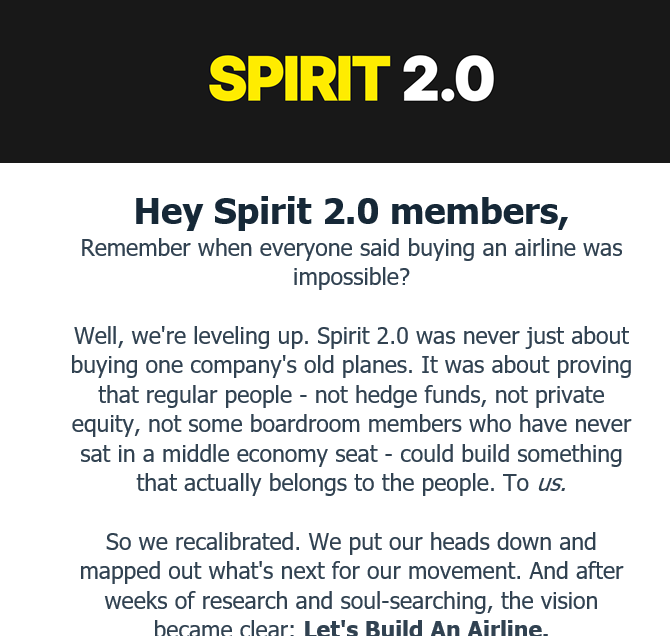
Remember when everyone said buying an airline was impossible?
Well, we’re leveling up. Spirit 2.0 was never just about buying one company’s old planes. It was about proving that regular people…could build something that actually belongs to the people. To us.
So we recalibrated. We put our heads down and mapped out what’s next for our movement…Let’s Build An Airline.
Same fight. New name. Real momentum.
The project was literally called “Let’s Buy Spirit.” Its website solicited pledges toward buying Spirit Airlines out of liquidation. It talked about ‘one member, one vote’ ownership, employee equity, profit sharing and an airline run for passengers instead of hedge funds.
I wrote at the outset that it amounted to “a pledge form and mailing list capture.” When claimed pledges later reached hundreds of millions of dollars—still without actual money—the effort mostly attracted scammers registering similar domains. It turns out the mailing list capture was the one part that worked.
There’s Almost Nothing Left Of Spirit To Buy
Spirit’s liquidation has continued while the campaign “recalibrated.” JetBlue won Spirit’s LaGuardia slots with a $58.5 million bid. The airline’s headquarters sold. Google is paying $10 million for Spirit’s internal emails, messages, documents, code and operating records, excluding the customer database.
The useful pieces of Spirit are being distributed among buyers. Spirit 2.0 didn’t obtain any aircraft, gates, slots, employees, operating certificate, headquarters, technology or brand. So now the group says this was never really about “one company’s old planes.” Spirit has been transformed retroactively from the intended acquisition into merely the inspiration for a “movement.”
They Now Want To Build The ‘Costco Of Airlines’
Founder Hunter Peterson has been posting a daily “building an airline in public” series that outlines what is supposed to come next. The proposed business would be the “Costco of airlines.” Customers would purchase memberships to receive lower fares, while nonmembers could still fly but would pay more. They want to:
- Form a public-charter operator under Department of Transportation Part 380 rules
- Contract with an existing airline holding a Part 121 operating certificate
- Add the chosen aircraft type to that partner’s certificate
- Market and sell the flights while the partner supplies the certificate and performs the actual flying
- Seek their own Part 121 certificate or acquire an existing airline or certificate (and they think they can do it in 30 months)
Peterson described that structure, but hasn’t identified an airline partner, aircraft, or routes.
To be sure, it’s possible to create an airline brand and sell scheduled-like service while outsourcing flying to someone else. A public charter operator submits a prospectus, schedule, and agreement with a direct air carrier along with passenger funds protections and other documentation to the Department of Transportation for approval.
That makes it a charter marketer. And the idea of selling subscriptions is hardly new in the airline industry.
A September 1 Retail Investment Offering Is Supposedly Coming
The group says that September 1 will bring the new airline name, management team, ownership structure and a capital raise open to accredited and non-accredited investors.
- Up to $5 million through Regulation Crowdfunding
- Up to $75 million through a Regulation A Tier 2 offering
- A claimed total capacity of $80 million every twelve months (which is the combined statutory ceiling for two different securities exemptions)
The group displayed those figures in its “building an airline” series. It has also estimated roughly $650,000 for a feasibility study and aviation legal work and $15 million to obtain a Part 121 certificate.
Regulation Crowdfunding permits raising up to $5 million in twelve months. Regulation A Tier 2 permits up to $75 million and requires an offering circular, audited financial statements, Securities and Exchange Commission qualification and continuing reports.
There was apparently already an earlier attempt to obtain money from investors. One account says Spirit 2.0 produced $2.2 million from 443 investors by a June 26 bid deadline, missing a $5 million minimum.
Why Make Everyone Opt In Again?
This new effort is to get people subscribed to the ‘let’s buy Spirit Airlines’ e-mail list to opt into this new project. There are ostensibly hundreds of thousands of names on the existing list, from joke pledges, fake commitments, and people who actually did want to rescue Spirit rather than finance a different airline entirely. So a fresh opt-in separates active prospects from the mostly useless file. And it:
- Creates clearer permission to market a new venture under a different name and domain
- Improves email deliverability by removing inactive and invalid addresses
- Addresses the communication problems that Spirit 2.0 blamed when it paused its previous investment outreach
- Identifies notionally-interested investors, membership subscription buyers and initial passengers
- Produces a more ‘real’ number to show potential venture investors, crowdfunding portals and operating partners
There’s Still No Business Plan
There’s literally no suggestion of what the market for this airline would be and how they plan to address it – with planes, routes, and types of service. There’s no home airport or budget. There’s no feasibility study, revenue forecast or even estimate about how much capital would be required after certification. And I haven’t seen offering documents, audited financials for the larger fund raise, or any real capital commitments to the project.
All they appear to have at this point is a “Costco of airlines” slogan. Costco collects predictable membership fees and sells merchandise at thin margins. A membership revenue stream is desireable, they wouldn’t be the first airline to sell one, but that alone doesn’t solve for the economics of an airline.
Maybe This All Isn’t Even Real?
The project is led by a professional voice actor and content producer who previously served as head of production for Beast Philanthropy. He’s putting out serialized entertainment, with a regular stream of episodes about lawyers, investor meetings, prospective executives and purported breakthroughs. Maybe attention is all this really is, and the project doesn’t need to ‘succeed’ to generate followers, content, and the ability to give future talks about content marketing.



I dunno about that framing. I’ve never seen hair pulling at Costco
Ah, yes, the decade of grifting continues…
Nice fantasy if you can get it!
However all I want is competition
we have airlines shooting at fish in a barrel like never before since the Trump war massive inflation and the loss of Spirit
I did a double take this summer when I saw an advance purchase rate in coach
for 400 plus dollars Las-Lax plus bags and seat assignments what happened to the 75-100I dollar fares?If only Costco or Walmart could fly lol