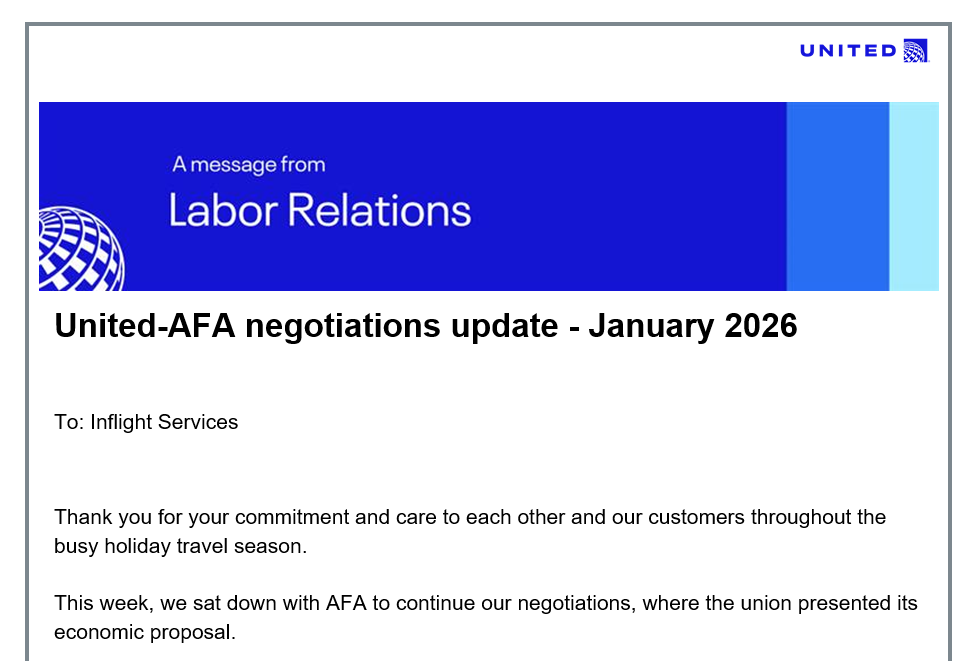
United just emailed every flight attendant to say: the union came back this week asking for more money, and the airline’s answer is fine — but cabin crew will have to pay for it in work rules.
In a blunt contract-negotiations update, the company dangles two things crews have been demanding for years, ground pay for long sits and shorter reserve availability periods, then pivots to the trade: offsets, including a controversial cut to reserve guarantees and a renewed push for preferential bidding system (PBS) scheduling.
It’s less a we’re close message than a map of what United wants next: raises and quality-of-life improvements only if the union accepts work-rule changes flight attendants have been resisting.

The union offered a new economic proposal this week. United says the proposal, “as currently presented,” would put them at a competitive disadvantage, and United delivered a counterproposal that they say hits “several of [the union’s] top issues,” explicitly calling out Sit RIG pay and Reserve Availability Periods (RAPs).
- It appears they’re offering to pay not just for boarding time in this contract but for time stuck on the ground between flight segments. A Sit RIG is a pay-protection formula that turns time into a minimum amount of credited pay, guaranteeing a certain amount of money for sit time.
Airlines can build pairings that look ‘legal’ but waste crew time. Sit RIG makes those pairings more expensive, pushing the carrir to build more efficient trips (or pay for the inefficiency). This was a union promise to members during negotiations, but that didn’t make it into the tentative agreement 71% of flight attendants rejected.
- United is also offering shorter ‘reserve availability periods’ making flight attendants less captive to the phone, a big quality-of-life improvement, but they’re hinting at looking to pay for this by changing reserve pay guarantees.
United says it also laid out ways to offset the cost of the union’s new asks. They’ll give, but they need give-backs to pay for it.
They’re suggesting that the original agreement which was rejected would have been “industry-leading pay among unionized U.S. carriers” and that they’re focused on getting raises “as soon as possible.”
It has been five years since they’ve had a raise, and inflation has eaten much of the value of their pay in that time! The union has suggested United should pay more now, even while they negotiate the contract, though that would take away the incentive for flight attendants to approve the non-pay portions of any agreement later.
Then they answer the two “most popular” questions they got from flight attendants:
- Why the company floated moving reserve guarantee from 78 to 75 hours and phasing out reserve override.
- What PBS schedule is.
They’re trying to reset the narrative after the 71% no. They’re telling crews they were already being offered something great in that first contract, the union is now asking for more, and it’s too expensive – but we’re still the adults in the room trying to get you paid quickly. That’s why they emphasize “you’ve waited too long” in their messaging while simultaneously saying AFA’s proposal isn’t “competitive.”
And they’re anchoring more money to we need offsets.” As I wrote at the outset when the contract was rejected, the union doesn’t get to just add higher pay and quality of life work rules. The contract is a bundle with a total cost. The union misread is membership and misallocated that cost in the earlier negotiation. Now they’re going to need to horse trade.
And United is highlighting exactly which trades are live:
- Ground pay and reserve availability changes are what they’re willing to talk about on the ‘give’ side.
- Reserve economics and structure and PBS scheduling is what they’re normalizing on the ‘offset’ side.
They’re confirm that rumored, controversial reduction in reserve guarantee from 78 to 75 hours is real, along with phasing out reserve override. This is being sold as the price of a popular win: AFA surveyed flight attendants who want shorter availability periods, and these “could be reduced to 12 hours” if the guarantee/override changes happen, which would “align” with American Airlines and their new contract.
Put another way, United is taking something that spooked reserves and packages it as the mechanism to get the thing people told their union they wanted.
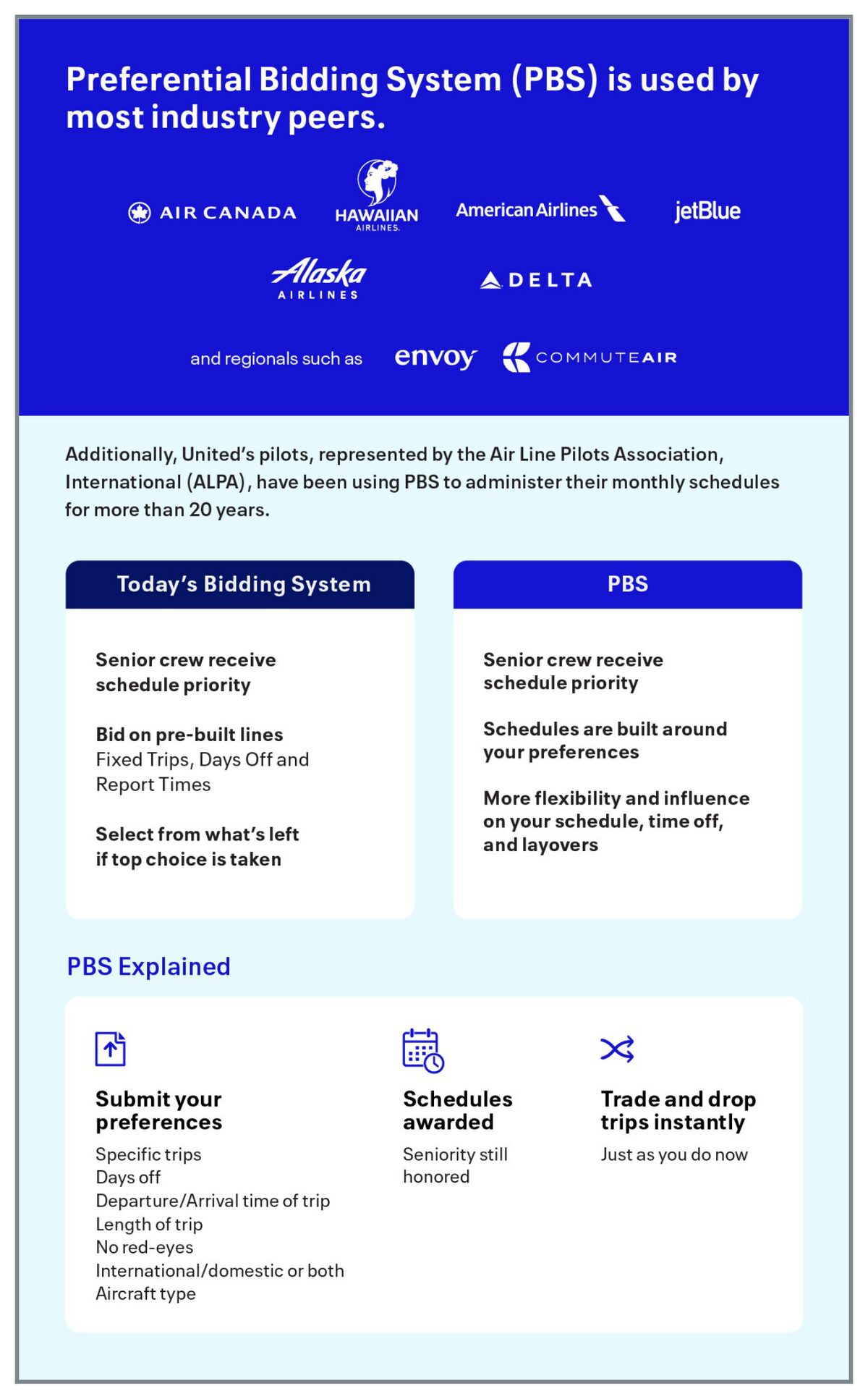
United isn’t merely mentioning PBS, they’re trying to de-fang the objections by defining PBS narrowly.
- PBS awards schedules based on individual preferences rather than bidding pre-built lines.
- It doesn’t create pairings, doesn’t eliminate open time, and doesn’t change the ability to trade/drop.
- They explicitly say it’s “just the method for awarding monthly schedules,” while other rules remain negotiable.
Flight attendants hear “PBS” and think ‘algorithm assigned schedules’ (and a broader concern that PBS is a management efficiency project).
Clearly from this message there’s not a new tentative agreement imminent. The message reads as proposal exchange and positioning, not joint problem-solving at the finish line. The union presented economics. United says it’s too expensive and countered, and they’re trying to manage employee reaction. It’s designed to (1) box in AFA’s economics as unrealistic, (2) pre-sell offsets, and (3) soften internal resistance to the two likely targets—reserve structure changes and PBS.
Bargaining is expected to happen February 10-12 and then twice in March. They aren’t close, but they’re willing to give more – if flight attendants will accept things they don’t like.



the AFA is being beyond stupid for letting PBS be the huge stumbling block that alot of UA FAs make it out to be.
Many other FAs – unionized and non-union – as well as pilots use PBS.
It is an efficiency tool but it also has guardrails. The inability of the AFA to negotiate to give the company what it wants with the appropriate guardrails – is beyond incompetent.
UA IS feeling the frustration of their FAs which should be happening but it is time for the FAs to push the AFA to create a viable proposal within economic reality – not an endless list of “me, me, me” requests.
For once I don’t disagree with you, but it is up to the F/As through their union to decide what they need in a contract. This is all part of the dance. Normally, going around the union is a no-no, but PBS is a big deal for both parties. I think making the tradeoffs clear should help them get to a deal.
Frankly what are they going to do? Can’t strike (if Biden wouldn’t allow it you know Trump won’t) so all they are doing is delaying getting a raise (and any retro pay won’t make up for all of it). Of course they could call in sick or take other measures to harm UA but, be careful, as I would expect UA to get an injunction, seek damages from the union and move to fire any FAs that participate. Again don’t look to Trump to protect you, the last president was union friendly not this one. UA would save money with new, cheaper FAs to replace the ones they fired. Also could empathize they don’t have to join the union or pay dues in most states.
Frankly I don’t see any scenario where UA loses or FAs win. The sooner that FAs and their union recognize this the sooner it will be resolved.
@Retired Gambler — Likely, cannot legally ‘strike,’ but doesn’t mean everyone can’t get sick at the same time… *cough* (awful flu going around… @Maryland, please feel better soon!)
SW FA’s don’t have PBS. UA management can’t be trusted to negotiate fair guardrails.
@1990 – if they do that expect legal recourse. Of course if people are really sick that is one thing but they likely wouldn’t want emails and text subpoenaed. If there is any collusion to harm UA expect fines and firings which is good. As a 30 year senior executive I always side with management. Workers are replaceable but leadership and company branding actually matter
@Retired Gambler — A bunch of doctors said they’re sick though, in accordance with the ‘law.’ Huh. Will you look at that…
It’s amazing how some people speak ‘authoritatively’ about things they know nothing about.
Unions are really bad with basic accounting and economics. United can afford a pie “this big.” Chop it how you like, but it is only this big. Make choices that make the pie bigger, more to cut up. Obviously, UA wants them to accept a smaller pie than they can afford, but a maximum exists. But, of course, far too many unions would happily take a deal that would bankrupt the company. Look, we got a huge percentage of nothing.
Unions have fine accountants, and the UA F/As have been more than patient and reasonable delivering great service as evidenced by the YOY NPS 2% gain. They will get the industry-leading contract the deserve.
According to their CEO, United is the best airline in the history of the world. That means that the staff that passengers see the most are flight attendants and that those flight attendants are what makes United the best in the world. Therefore, United needs to stop behaving like it’s run by an odious swine and pay those best flight attendants in the world with world-leading pay and benefits.
@Christian — Well said. Best airline should pay the best. (Unless… maybe… they aren’t the bes..) Just pay them more.
@rebel — So, are you shilling for management, trying to help workers, or just like to watch the world burn? What would @rebel do here? Solve it for us.
@1990
Where does your burning heart for the organized labor movement come from? You boast of flying business class all over the world, you certainly boast like someone living a life built off the scraps of the poor (or from your trust fund rather) while hardly working, at all, given your constant and incessant posting on every article ever written on an aviation blog incessantly during the work week.
Is this how you balance your need to feel more liberal? Posting on a comment section about your support for the labor movement while doing nothing in real life?
@MaxPower — Oh, I forgot, if you fly business class, you must hate workers. No, you can support their cause, want them to be paid not just a living wage, but a thriving wage, and uplift the entire industry and society, one step at a time. Or, sure, just gate-keep, that’ll do…
(Speaking of business class, since we’re allowed to still dream, can we just follow La Compagnie’s model, and do all lie-flat, no middle seats, for every flight? Oh, yeah, sorry, the poors aren’t supposed to enjoy nice things. Get back in the dungeon, you peasants!!)
It is incredible. It started with “industry leading, best contract for the best flight attendants”. It has dwindled down to “well we will give you what we are calling the best only in comparison to other UNIONIZED flight attendants. We aren’t going to give you anything above or beyond”. It’s corporate greed. They can absolutely afford the few things on the list while also staying competitive. They simply do not want to because their job is to suck and squeeze everything they can out of everyone. They’re vultures.
“Oh, I forgot, if you fly business class, you must hate workers.”
Not at all, but you boast of constantly flying it while clearly having no job that keeps you busy enough to afford it absent a trust fund or lies about flying business class — evidenced by the incessant posting and commenting every day.
There’s nothing wrong with having a trust fund, but never having had to work for what you buy does make you lose credibility in the eyes of many, which you seem to realize, hence the constant incessant outrage on behalf of the common man or the organized labor movement absent a rather obvious lack of realization of the various issues in play…
also called virtue signalling
I’m a UA flight attendant, and I would actually love PBS, especially if adopting it meant upgrades in other areas of our contract. Unfortunately the AFA won’t even listen to their flight attendants. This is the first time either the company or the union has seriously defined or explained what PBS even is.
My friends at American love PBS and have zero issues with it. There’s an adjustment period, clearly, but afterwards it’s supposedly great. We’re the last major airline still using paper bidding, and logically I can understand that it is costly and inefficient. I can only hope the AFA allows us to vote on a contract that includes PBS. I bet United would probably give us almost everything else we want if we agreed to adopt PBS
I’d take PBS if they put it in the TA #2, if that meant higher wages, better profit sharing, and better layover hotels. As long as they keep instant open time trading, I can make anything work
I’m a UA flight attendant (with more than 5 minutes seniority) and I would actually HATE PBS, since we dont know if adopting it meant upgrades in other areas of our contract since UA mgmt has shown how benevolent they are in the past. Fortunately the AFA won’t even listen to their flight attendants. This is NOT first time either the company or the union has seriously defined or explained what PBS even is. UA mgmt has been trying to foist PBS on the FA’s since the 1990’s.
My friends at American dislike PBS and have issues with it, especially the most junior ones. There’s an adjustment period, clearly, but afterwards it’s still not great. We’re NOT the last major airline still using paper bidding, (Southwest still uses paper bidding) & logically I can understand that it is costly and inefficient but I cant explain any details on how I came to this conclusion. I can only hope the AFA allows us to vote on a contract that includes PBS. I bet United would NOT give us the best version of PBS available & give us almost everything else we want if we agreed to adopt PBS because suddenly management would be FA labor friendly. If i’m wrong, then I’ll quit since i’ve been here a whole year & my peers at UAL will be left holding the bag.
signed
management schill maggie
UA FA as well. Every year, everyone gets a raise everywhere (except those FAs 13 years or more senior that are topped out). Some positions (within any company/industry) more significantly than many other positions combined. And Americans shoot ourselves in the foot and ask why the economy is so bad….
I do not hear anything getting close to the flexibility we had pre-covid, and then throwing PBS in it?
Ok. I’ll have demands if PBS is their reaction to everything. It clearly gives them a leg up we won’t see until it’s too late. Otherwise, why threaten it so much?
So, PBS.. Will only agree to it if contract violations come with a fine paid directly to the FAs, is added. Or. Or. If the CEO gets a raise, the lowest paid FAs cannot be paid annually less than .5% of the total of CEO. (Astonishing what that number is currently for how low of a percentage that is)
Stipends, stock options, and bonuses included in that calculation.
Runaway raises are such a burden to society and companies in general.
Get realistic. We’re not asking for the world.
Adding a couple thousand FAs a year wasn’t our choice either. Staffing a 321 would be great. Or just change the damn configuration.
Certainly there are plans to find ways to let go of senior people as well. Like, a gradual goal to make it difficult for an FA to stay long enough to hit top out pay, with years beyond that.
FA satisfaction scores anyone?
This comment will age like wine or go down as conspiracy.
“Unions have fine accountants” You can hire all the talent you want. You need to listen to them. Unions, at least union members, regularly show they don’t understand the business basics. UA can only afford so much. Of course, they don’t want to give all they can afford. Union choices will change the size of the pie available. But, once that’s locked in, we are now just talking about how it is divided. Greater pension benefits means lower pay. High seniority add-on pay means lower wages for the less senior. The biggest problem with unions in general is their unwillingness to adopt policies that would affect the bad employees, thus failing to make the pie bigger.
Obviously and unfortunately Mr. Kirby does not see a need to have Industry leading pay & quality of Life for his front line crew.
Mr. Kirby has made some great moves & accomplished a lot. We have seen him go from a horrendous painful to watch public speaker to a smooth operator. He made ALL the right moves during Covid .
He is not on the front line & he cannot hear the beat of the distant war drums of the front line crew. The anger of the flight attendants is something I’ve never seen before. I’ve been around along time . I’d like to see UNITED succeed. I wish to see us all pull together.
President “”TRUMP ,” saved United during Covid. Yes he ordered our salaries be PAID! Thank you Mr. President
I’m just a Flight Attendant. President Trump can fix this with just 2 words directed to Kirby!
FIX THIS…. Thank you Mr. President
Respect SENIORITY .
Respect SENIORITY!
I am a UA Flight Attendant and any UA flight attendant that says he or she would love PBS is out of their minds. The company will not do right by us with PBS. We will not have any flexibility at all no quality of life a hard note for me.
I am a UA Flight Attendant and any UA flight attendant that says he or she would love PBS is out of their minds. The company will not do right by us with PBS. We will not have any flexibility at all no quality of life a hard note for me.
Ooh! Now do Horizon Airs never ending contract negotiations and their unwillingness to agree to pay enough to get a chunk of their FAs off food stamps. And how being paid.by the Credit Hour means getting paid for.about 4 hours of a 12 hour shift equalling to quite a bit less than Federal Minimum Wage.
– Thank You!