
Live and Let’s Fly highlights an Alaska Airlines poster reminding employees to follow company procedures before releasing information in response to requests by law enforcement. That’s being called out online as ‘obstruction’ of justice by people who do not know what obstruction of justice means. Alaska is doing exactly what we should all want them to do (although they should really go farther).
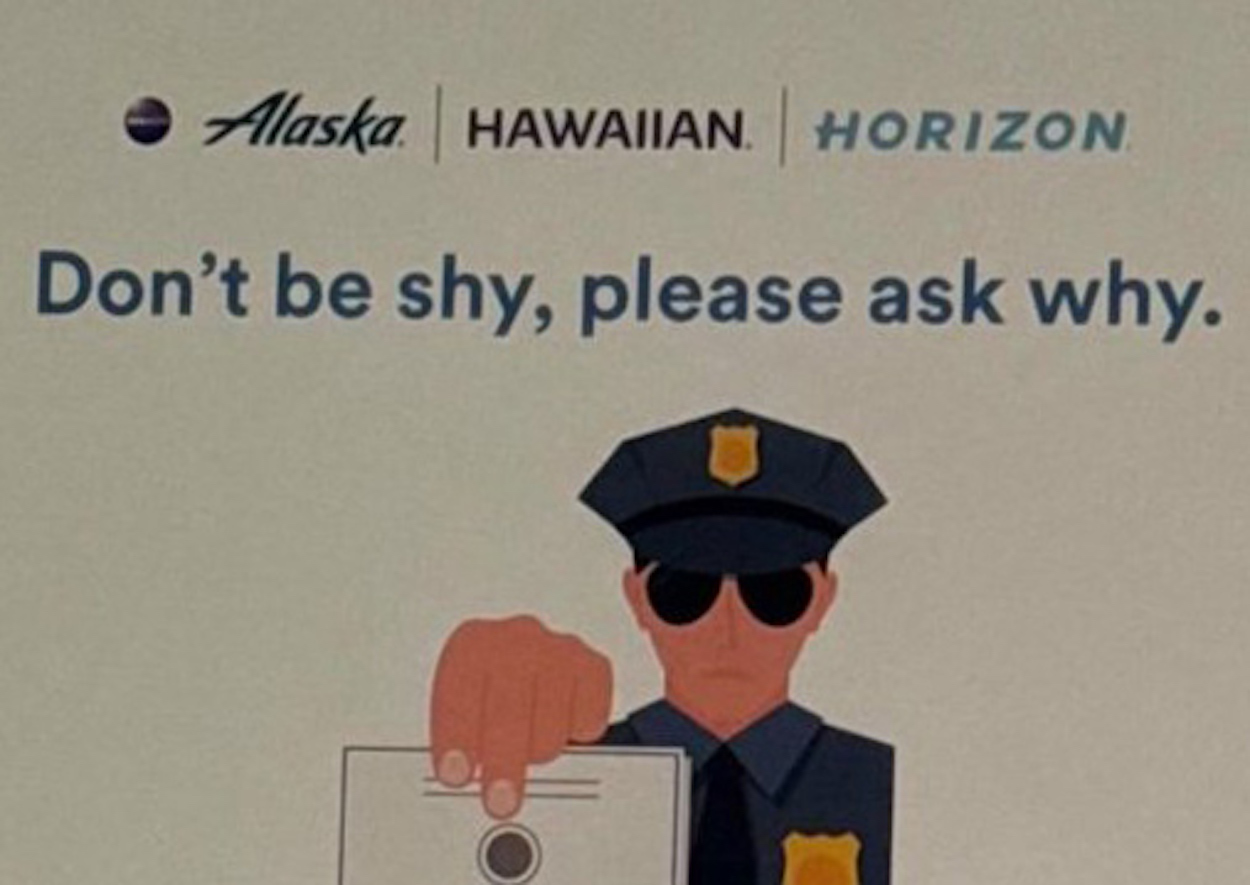
Frontline employees are reminded that they aren’t authorized to release information on their own “Notify your supervisor immediately” –
NEW: This was sent to me by an @AlaskaAir employee. A company poster instructs employees not to comply with federal authorities.
Hey @realDonaldTrump, @DHSgov Alaska Airlines is openly obstructing federal law enforcement operations. I think it’s time to see what federal funds… pic.twitter.com/lWCaAwGuVX
— David Medina (@davidmedinapdx) November 30, 2025
In fact, this poster has been in use for several months and is not in fact new. But it’s being mocked as “if you see something, say nothing” along with hysterical stuff about Alaska protecting “drug running and sex trafficking customers.”
Here’s What Obstruction Of Justice Actually Is
At the federal level, “obstruction of justice” isn’t one crime, it’s a family of statutes (18 U.S.C. ch. 73) covering things like:
- Interfering with the due administration of justice in a pending judicial proceeding
- Tampering with witnesses, victims, or informants, or otherwise corruptly obstructing an official proceeding
- Destroying or concealing evidence, or corruptly persuading others to do so.
Usually there has to be a real proceeding or formal process (court case, grand jury, agency proceeding, or at least an ‘official proceeding’ as defined in the statute). Investigations are not themselves “proceedings” for the purposes of these statutes.
There also needs to be a corrupt intent to impede, influence, or frustrate that process. That suggests violence, threats, deception, destroying evidence, pressuring witnesses, and the like.
Simply not volunteering information you’re not legally required to give is not obstruction. There has to be a legal duty plus a corrupt effort to thwart it.
Alaska Is Telling Employees To Follow Procedure, Not Subvert It
The poster says that if law enforcement or a government official asks for passenger information, don’t comply on the spot. Ask for a subpoena or warrant. Loop in a supervisor. For non-urgent requests, involve legal.
In other words, disclosure should follw valid legal process. There’s no refusal to follow valid legal process. They are directing employees to follow the law and company policy, not to lie, delete data, or hide witnesses.
Legally, a private company has no general duty to give police whatever they ask for informally. Insisting on a warrant is exactly how the process framework is supposed to work when the government wants private data.
This Is What We All Want Alaska To Do
Police and federal agencies are not entitled to everything they ask for just because they asked. That’s why we have warrants, subpoenas, and judges.
Alaska’s privacy policy says they are committed to protecting personal information and describes controlled circumstances for sharing it. A free-for-all “tell any cop whatever they want” approach would contradict what they’re telling customers.
And it protects employees from being bullied or freelancing. A gate or reservations agent shouldn’t have to decide on the fly whether some badge-flashing person is legit or whether the request is lawful. “Company policy: I need legal process, and I must call my supervisor” is a shield for front-line staff.
It also creates a clean, auditable trail. Requiring written legal process means there’s documentation of what was requested, why, and what was provided. That protects passengers (who can challenge abuses later); the airline (that it acted lawfully and consistently); as well as law enforcement (better chain of custody of evidence, lower risk of suppression).
It is 100% standard practice in industries with sensitive data. Apple says government or private entities must follow applicable laws and that Apple’s legal team reviews requests to ensure a valid legal basis. Microsoft says they require a subpoena for non-content, and a warrant for content – and that they object to improper requests. (Indeed, this is how you know if the request is valid in the first place!)
What else is Alaska supposed to do, given their legal obligations in state privacy laws and international data regimes (remember, Alaska is a global carrier now)?
I remember when conservatives – just last year when Joe Biden was president! – beleived in ‘limited government’ and ‘rule of law’ requiring a judge to sign off on searches.
- This also makes it harder for officials to use corporate databases for personal vendettas or fishing expeditions.
- Fewer uncontrolled ad hoc disclosures mean fewer copies of your data floating around in random evidence lockers.
- If Alaska (and others) simply handed over whatever a badge-holder asked for, you get informal, unlogged fishing expeditions. An officer could ask, “Print every upcoming reservation for X surname” or “Who’s booked on this flight to D.C. tomorrow?” with no paper trail and no judge.
- Journalists, activists, political opponents, or just “people who look wrong” could have their travel scrutinized. It’s mass surveillance by shortcut. And it’s easy to imagine local officers routinely querying flights for “known troublemakers,” ex-partners, or racial/religious groups during moments of local hysteria.
Honestly, I wish Alaska would go farther. Where legally permissible, I’d want them to give me notice when my data is requested so I could seek an order to quash! They’re not going to do this, but it’s the expectation that I put into every contract’s confidentiality language that I review in daily work.



Shame on people for not understanding the 4th Amendment, let alone obstruction of justice.
Love it when the same people that condone governmental actioned “obstruction” (and deflection and diversion) in order to protect a selected, person or groups of “special” people are the first to scream “obstruction”.
I applaud Alaska Airlines for protecting their line employees and protecting my data (and I too wish Alaska would go a bit further in extending these protections).
The proper comment should be
I believe they follow the law and not release information without a warrant. Unless the pax is an idiot and feels their information should be released then they can publish it
Soooooo…the people with absolutely zero respect for the rule of law, the people who openly ignore judicial ruling they don’t like, the people who tried to overthrow our country then called to hang those who uphold the law are upset about this poster.
You can’t be serious!
Good on Alaska for not snitching. Good on Gary (and Matt) for supporting civil liberties, privacy, etc. This really should not be a partisan issue. Yet, this administration would like passenger details to harass perceived enemies and brown folks. Heinous.
I’d like to understand the role of Southwest in the deportation of the 19 year old student flying home to see her family on Thanksgiving:
“Ms. López, a freshman studying business at Babson College in Wellesley, Mass., was about to board a Southwest Airlines flight to Texas early on Nov. 20.
She was told there was a problem with her ticket, so she went to customer service and was surrounded by immigration agents, Mr. Pomerleau said.” https://www.nytimes.com/2025/11/30/us/politics/college-student-deported-thanksgiving-texas.html?searchResultPosition=7#:~:text=case%20was%20pending.-,Ms,-.%20L%C3%B3pez%2C%20a%20freshman
I’m confused. Gary is standing up for following the law here, but somehow he also thinks Bundt cakes are “woke”.
As someone who has worked for AA and UA, I can tell you their policy is the same.
This has always been the rule at any airline I’ve known and those where I’ve worked. When I was managing stations, I always made it one of my first goals to form a good relationship with the law enforcement on site. They knew to come to me or one of my managers, not my front line employees. Without a subpoena or warrant, not happening. There was a 24/7 monitored/alerted box that went to whoever from corporate security was on call, who would see, then usually call and say “okay to give them x, y, and z.”
Yes, I will admit there were some situations where it was my judgement call, but only escalated to my level, to give information before paperwork in hand. But that was only for trusted airport-assigned FBI special agent or DEA agent on site who I knew had me backed up with paperwork but were after a fugitive who they had good reason to believe were trying to travel from the airport or had very recently (like someone who killed a police officer then went and bought a walk-up ticket to the other side of the country and flew – though that’s stupid because what, they didn’t figure 5 hours was enough time to figure out where they’d be and alert the locals there?). And at that, maybe just a nod, or “You’d better send that subpoena quickly” or “Maybe check another airline first…” Never any fishing expeditions, but I had the good relationships such that LEOs knew not to abuse it.
These days, it’s “If you see brown people, say something.”
I’m a Bostonian so I never fly Alaska, but props to them for doing this, and I’ll try and fly with them whenever I can.
Completely different philosophy than Delta who basically had employees assisting the DEA in illegal detentions and searches at ATL
The airline is acting properly here, as others have mentioned. The real issue is that there have been situations where airline gate crew, for example, have called for law enforcement and then refused to give said law enforcement information about the very perps that they’re calling on! A somewhat recent example of this occurred in 2024 concerning United. They called local police because a passenger stole a some safety equipment and the plane couldn’t depart without it. When the cop asked for information the gate staff wouldn’t give it to him – after they called him. As he put it, “It’s your crime.”
Glad to see that Alaska is at least acting on ethical principles. As we transition away from SWA, Alaska is high on our list for our west coast needs.
@LS — Same goes for Costco (but not for Target, or United). Take note; companies that ‘sway with the wind’ are long-term losers.
So I guess these GQP types won’t mind just letting law enforcement into their homes to root around through their belongings just because they asked. Otherwise, they’d be obstructing, right?
Good on you, Alaska.
Weird that some people would clutch their pearls over their information not being handed out freely to anyone with a badge.
Excellent article, Gary, with one exception. You seem to believe that “conservatives” writ large no longer believe in limited government or the rule of law. This is utter nonsense. Conservatives haven’t changed at all; rather, an alarming number of personality cultists are attempting to co-opt the conservative movement to suit their own ends. In fact, their claims to be conservatives would make William F. Buckley roll over in his grave. MAGA ≠ Conservatism.
Don’t be a fascist. Be like Alaskan. If you support this at all, you are a fascist. ♂️
@Joe Public – Sadly, the Republican Party has left William F. Buckley. Whatever side you’re on, principled conservatives are far better for the country than what we have now.
@Joe Public & @Gary Leff — Well said, you two. Actual conservatives should be outraged and ‘do something’ about the con-man who stole their party and message for far worse. Now, on the other side, I’d love to see a Progressive takeover of the corporate-Democratic party, which may actually be better for more people. Quite different than giving it away to a grifter.
@rdinsf
My guess is that TSA Secure Flight was involved – this automatically sends all passenger details for every flight directly to DHS who can pass it on to parts of itself (e.g. ICE), or others.
It also essentially does exactly what this part of Gary’s post mentions: “An officer could ask, “Print every upcoming reservation for X surname” or “Who’s booked on this flight to D.C. tomorrow?” with no paper trail and no judge.”
The people in the bleachers cheerleading for the expansion of the surveillance state are going to be awfully upset someday when it’s pointed at them and those they care about. And everyone that would advocate for them has already been thrown in jail. I think there’s a quote about that from some world war, or something. Ah, well.
Any company that hands over ANY customer data to any government authority without a lawful, judicially authorized warrant should be sued off the face of the planet. Full stop.
@supersonicfroot — Yup, good news is that they never come for you. Phew! Otherwise, that’d be upsetting. Like, by all means, go after my perceived enemies, but, leave me alone…. /s