
A year ago the Department of Justice ordered the DEA to stop searching passengers at airports and taking their cash – without probable cause, crimes, or charges. Over a 10-year period, the DEA had seized over $4 billion in cash, the vast majority of which was unconnected to any crime or charge.
You might think that means that law enforcement will no longer stop passengers in airports and take their money. But that would be wrong. Since they get to keep the cash there’s a strong incentive to continue the practice.
- DOJ killed DEA’s infamous “jetway robbery” program at airports.
- But the forfeiture machine didn’t stop. Homeland Security, Customs and Border Protection and local police seize cash instead.
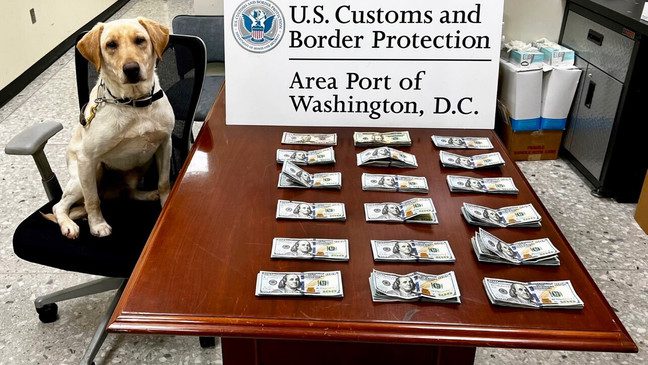
The Dallas Morning News has coverage of these efforts from a local angle. Agents are seizing large amounts of cash from passengers at DFW airport and Love Field without arresting them or charging them with a crime.
Instead of approaching passengers at gates, they’re using drug dogs. The dog sniffs, no drugs are found, but they find cash and take it. No charges are filed. Agents are focusing on:
- One-way tickets deeming these suspicious
- Travel to Los Angeles or other ‘known drug markets’
- Tickets purchsaed within 48 hours of departure (important business travel!)
- Passengers with criminal records.
- Little or no clothing or personal items in luggage, dryer sheets, sanitizing wipes, or perfume in bags.
- They also often search phones for messages or photos suggesting drug dealing or money laundering.
This works because (1) dog alerts are unreliable and easily cued by handlers, and (2) most cash is contaminated with drug residue anyway. So dogs alert, find cash not drugs, and officers get to take it.
A couple of examples in the piece are especially interesting, because they occurred with JSX passengers departing from a private terminal at Dallas Love Field.
- January 2025: Homeland Security agents say they smell marijuana from two suitcases. They don’t find any drugs, but the passenger had $800,000. They seized the money. No charges were ever filed.
- February 2025: A drug dog alerted to bags. Officers found and seized $356,880 in cash. No charges here eihter – and the passenger managed to prosecute their claim and get about half the money returned (about as strong an argument for the government being completely in the wrong as there is – they offer some money back as a settlement waiving all claims).
I don’t know that JSX and its passengers are being targeted but it’s worth knowing that the government isn’t focused on commercial terminals exclusively, and that flying out of private terminals isn’t a warkaround to protect your rights. A JSX spokesperson shared,
At JSX, we hold deep respect for the work of federal agencies such as DHS, HSI, and Border Patrol. Their commitment to traveler safety and security spans passenger terminals, private hangars, and beyond, underscoring that no one, regardless of how or where they travel, is above the law. We work closely with regulators and partners to continuously identify ways to simplify the travel experience without compromising safety or security.
I’ve written about civil asset forfeiture at airports before, and even served as an expert witness in a case against the practice.
- The government seizes cash without charging anyone with a crime.
- Then the victim has to prove the money wasn’t used in a crime to get it back. There’s a byzantine process for doing this, and usually the victim has to enter into a partial settlement to get anything back at all, which includes a promise not to sue.
- And the way this is all structured, the agency seizing the money gets to keep part of it for themselves.
Even just flying Dallas to Los Angeles or Atlanta to Chicago is enough of a predicate, because passengers are flying from ‘one known drug location’ to another. The government considers one way tickets suspicious. For years airline pricing practices changed so that it often made more sense to book one ways. (We’ve seen a return of some roundtrip pricing.)
Even though it is your right, it’s a good idea not to carry large amounts of cash with you at the airport. It’s subject to confiscation. And if you’re carrying more than $10,000 out of the United States, you need to register that with the government – not just with the country you’re carrying it into.
More on civil asset forfeiture, from Last Week Tonight:



No sympathy- in 2025 with wire transfers, nationwide bank access and digital payment methods there is no excuse to carry over maybe $10,000. Even that amount is excessive. Personally I do carry around that to Las Vegas (or maybe if going on a cruise with a casino) even though I’m set up for casino credit lines.
One time I took 27,000 USD with me in traveler’s cheques with me on a trip to Thailand. What a pain to report it to the proper office in LAX. If I hadn’t added enough extra time, I would have missed my flight. Part of the problem was that the office closed an hour for lunch. Two thirds of the money (actually a bit more) was targeted for buying a new taxi for cash that a brother-in-law was going to drive and make payments to cover the cost. That turned out to be a disaster. As far as a wire transfer, it could not be done at that time. I would have been a lot happier not carrying all of those traveler’s cheques. To do a wire transfer you have to have someway to initiate it in the USA and a bank to receive it at in another country (Thailand in this case). Some countries have restrictive laws about who can get a bank account. These day I can initiate a wire online while overseas and receive it into an account overseas.
An example of why crypto is here to stay.
This kind of shitbag behavior is exactly what you’d expect from some third world banana republic, not the supposed leader of the free world. And there I thought our whole Constitution thingie was predicated on being innocent until proven guilty.
Outrageous behavior. I would do whatever and fight this to the bitter end. I go to Vegas often and if it is a gambling trip tend to have some cash on me. If I win I tend to have cash on me returning home. As a minority in USA this is racial harassment from scum bag Cops. Pure and simple. When does it ever end in USA when? Your apologies are about as worthless as you are as well if you give me on.
The entire civil forfeteur scam has gotten out of hand. We need the Supremes to step up.
This wouldn’t be allowed in a free country.
@This comes to mind — Psh, at least 6 of them only serve one master, the current President and their own self-interest, and so long as that grifter gets his cut, corruption will continue. Sure would be nice to have adults in-charge again. No time soon, it seems.
@Retired Gambler:
No, I don’t need a reason. The government does not have a role in policing the *legal* things I do. I don’t have to give a reason at all. If they think it’s suspicious, let them prove it.
@DanTheMan — Well said. That’s why they call you ‘TheMan.’
Innocent until proven guilty used to be a thing. Besides, $10K is a pittance- even if in cash. Perhaps make the reporting limit $50k and free up the time of these keystone cops at DHS…
@JCW — Perhaps, we should take note from “Turkey Trot” (Season 28, Episode 4), and do as Detective Harris did to “War Pete” (like and subscribe): “…look for a secret button in the floor to release prisoners.” *kicks him in the ass*
@1990
With regards to SCOTUS, Thomas and Gorsuch have strongly criticized civil asset forfeiture and think it’s unconstitutional. Gorsuch wrote a great concurrence about this in Culley v. Marshall. Sotomayor probably also thinks it is unconstitutional. We’d need Kagan and Jackson to join them.
To 1990: Civil forfeiture is not a partisan issue. Democrat controlled jurisdictions are as guilty as Republican ones. It’s a money grab issue.p
In general I hate civil forfeiture, and there are lots of legitimate reasons to travel with $20,000.
$800,000 in cash: I cannot think of any legitimate reason to be carrying that much cash. AND at that value, it is obviously worth retaining a lawyer and challenging the forfeiture if you can prove the legality of your cash.
That’s fine. I’d just read the report and find the names of the people involved and make them regret their poor decisions til the day I died. Money comes and goes physical pain and fear is a reminder that will stay with you forever.
Yet another example of how we are not even remotely close to having freedom in this country. It’s a joke that people often brag about while ignoring all evidence to the contrary. The government is a legal mafia deserving of zero trust and they write their own Mala Prohibita rules/laws (as opposed to Mala In Se: inherently known by humans to be immoral and wrong by nature). Then some gov drones have the nerve to state that ignorance of the law is not an excuse. That is ludicrous because no person can know each and every “law” that is still on the books from a century ago or even from just last week. Our country is run by people from our lowest common denominator and criminals. When politics is a career and not a short term service to give back to the people, you aren’t going to get the cream of the crop talent considering a run for office. Stealing money from citizens without any evidence of a crime only makes that person a criminal with a badge.
@Michael Fitzgerald — Let’s stop the corruption everywhere then.
@ Gary
And the last principled conservative to get elected was . . . .
(and don’t tell me W or GHWB)
The $10k figure needs to be $31k to keep up with inflation since 1984. It’s ridiculously low.
@TProphet — Mhm.