
Back in the spring, American Airlines began testing a customer-friendly move to hold connecting flights for delayed passengers, when doing so won’t cause problems for the operation. This started at Dallas – Fort Worth airport, and has expanded.
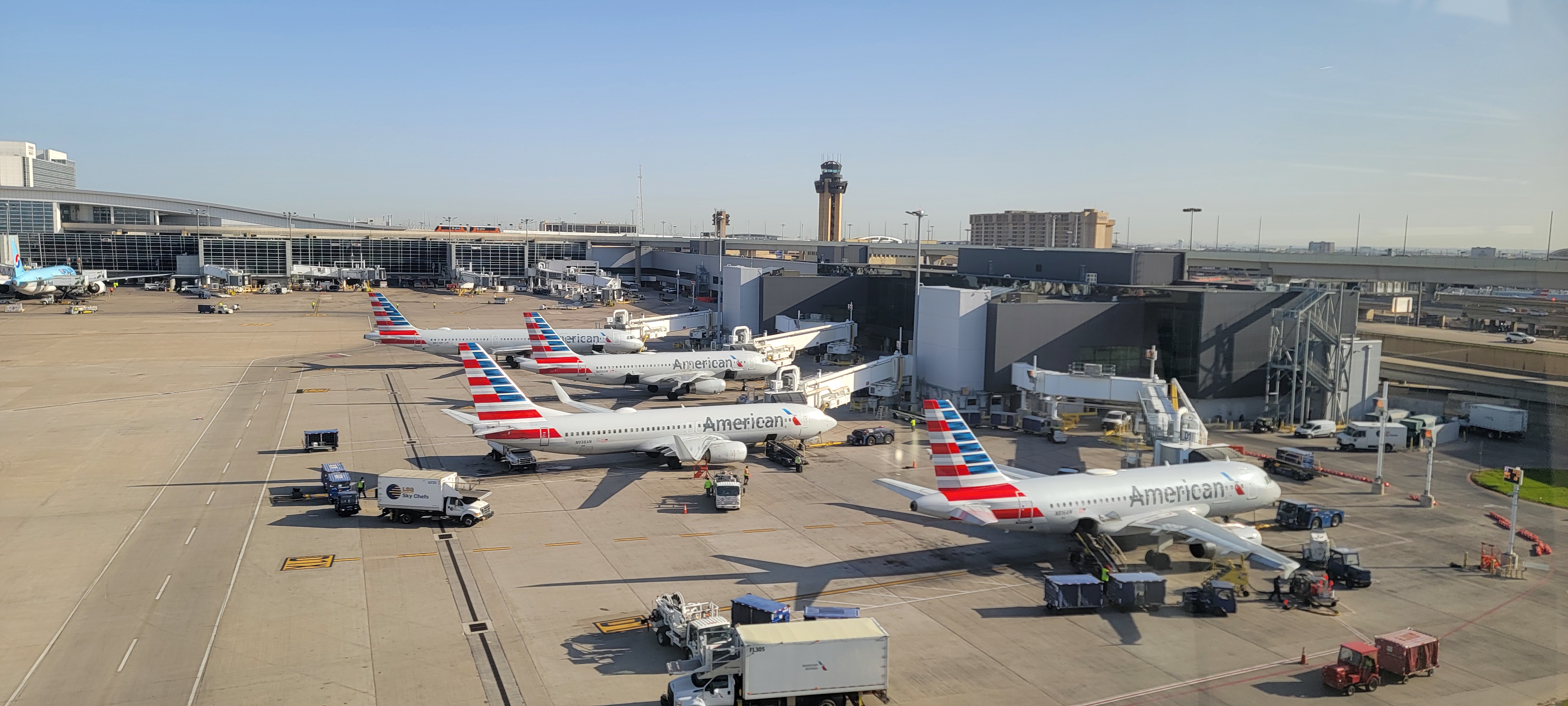
American Airlines, Dallas – Fort Worth
The airline publishes some very short connection times. That is great for moving passengers quickly from their starting city to destination, and privileges display of choices (since that offers quicker itineraries) which helps sales. But it also means that small delays risk those connections.
American starts boarding most domestic flights 40 minutes prior to departure, but they publish conncetions as short as 25 minutes at both Charlotte and Phoenix – even when connections involve a change of concourse. And you can lose your seat if you’re not in the gate area 15 minutes prior to departure.
However they aren’t just holding flights for passengers, they’re telling passengers the flight will be held for them – and how long it will be held. So they can breathe a bit easier. Here’s what this notification looks like:
[CLT] interesting connection experience
byu/Meowcat1029 inamericanairlines
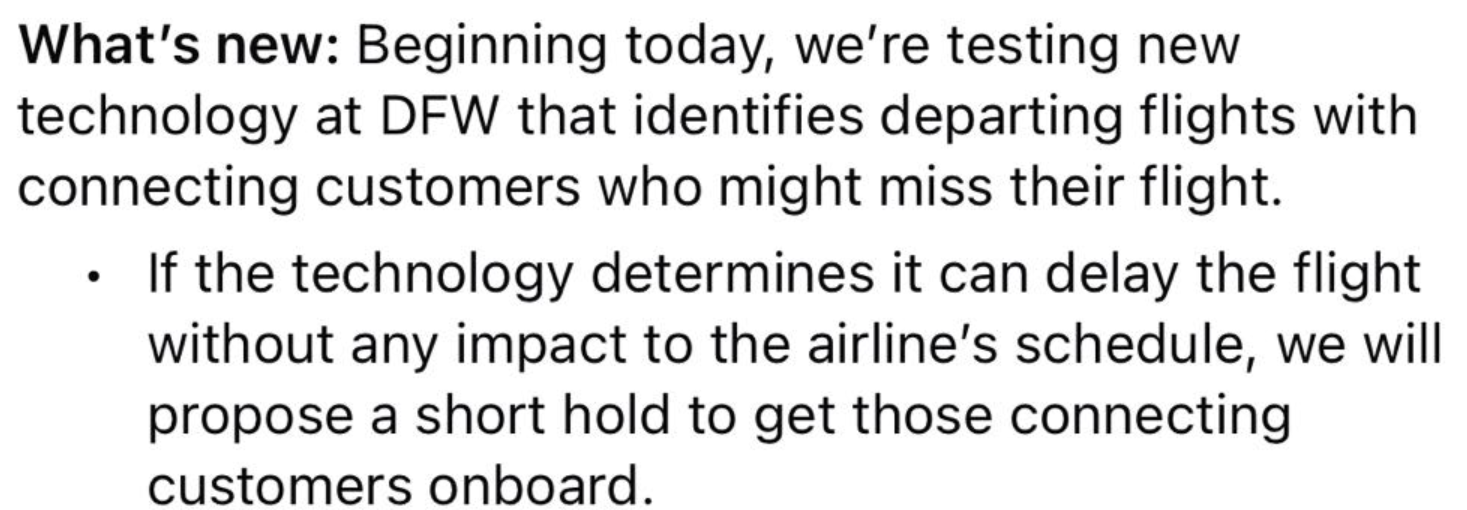
This is what American shared internally with employees about the program when it was introduced:
United Airlines runs something called ConnectionSaver that has been unique until now. They will delay flights for passengers to help them make connections. But they don’t do it all the time. Their computers take several things into account.
- Many flights are projected to arrive early. They’ll delay a flight where doing so means the flight will arrive on-time rather than early.
- Delaying the last flight of the day is more common, because the consequences of missed connections are greater (forced overnight) and because delaying the plane and other passengers has fewer consequences (they won’t be connecting and the plane may just be overnighting). A long delay could require crew to start late the next day to get minimum rest, but a short delay usually won’t have much effect.
American Airlines gate agents can’t hold a flight for connecting passengers on their own. The airline only lets them hold the door instead of closing it 10 minutes before departure when a customer is running up to the gate and in the agent’s direct line of site, or for the last flight of the day they’ve been allowed to wait until 5 minutes to departure for doors close.

Dallas – Fort Worth Gate A16
And agents don’t have to do this. In fact, they may be concerned about getting in trouble if they do because the airline has prioritized exact on-time departures (D0) even when they aren’t needed over over getting those last passengers on board.
In fact American will remove passengers from flights before they even miss them, simply because American’s computers project that they will miss the flight. This lets them give the seat to another passenger that wants to get on – and do it earlier, when it won’t delay the crucial last minutes prior to departure (they call this system ‘AURA’ or the AUtomated ReAccommodation Tool).
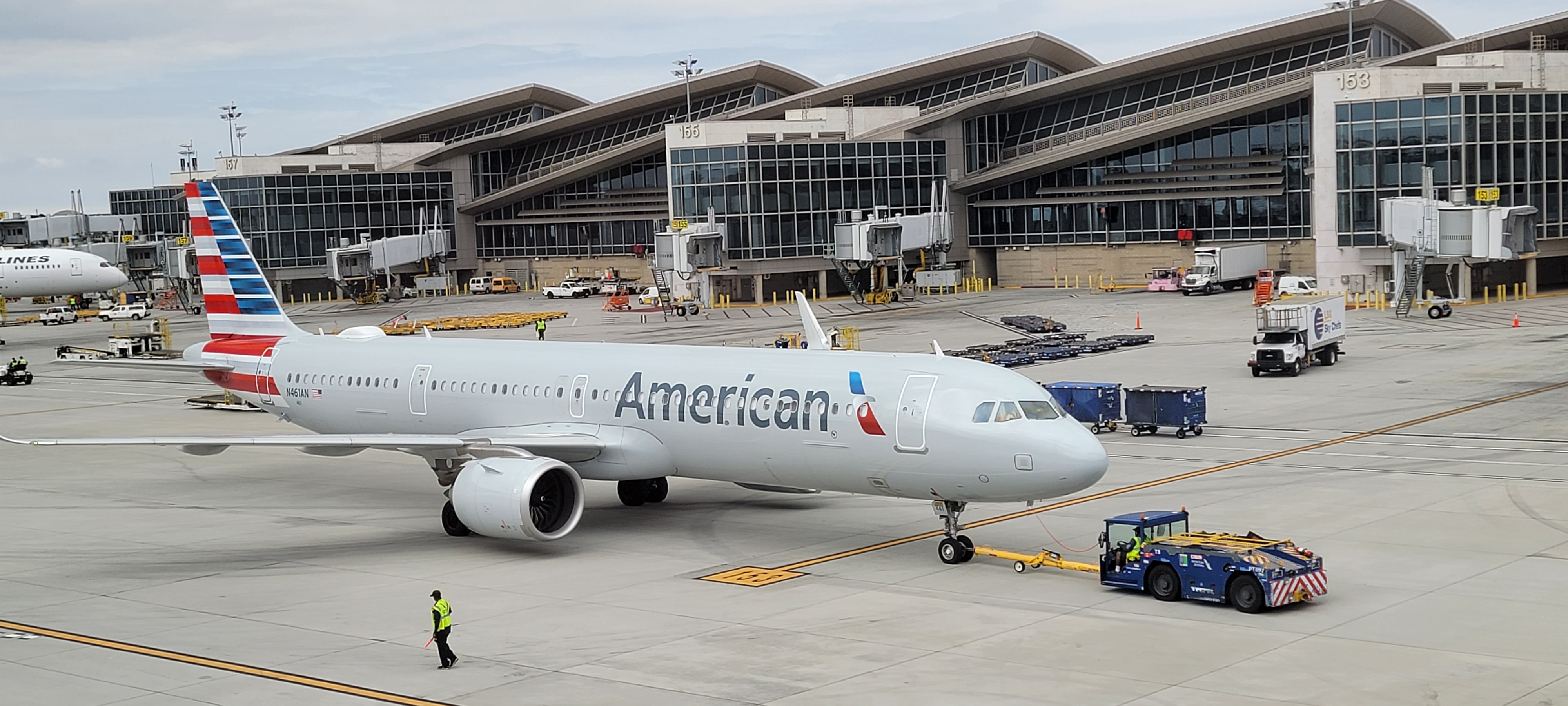
American Airlines
Generally speaking an airline is more likely to hold your flight if,
- a lot of customers are trying to make the connection
- there aren’t other options for getting this group to their destination
- delaying the flight will have only a limited effect on the operation – further delays, crew timing out, other passengers misconnecting later
Even still, United’s ConnectionSaver has held planes for over 2,000 passengers in a day. It’ll be fascinating to watch American continue to tune their new system and see how many connections they’re able to save for customers.
American Airlines DFW Airport Gate D21
It does seem like American has started to make some effort paying more attention to customers and fixing pain points. They just need to articulate a more customer-centric vision so that employees understand the goal and customers internalize their efforts as part of a larger context – and not just as small, disconnected changes.



When the regional carrier was independent- DFW was notorious for inflexible tolerance of tight connections.
That’s great and all, but maybe the AA software can stop kicking people off of connecting flights when the airplane they are connecting on to is the very same airplane that they arrived from? Who knows, maybe AA can walk and chew gum at the same time. AI to the rescue of AA? (Not so much from your article the other week on the topic…)
This is way overdue. They were closing the doors (and assigning YOUR seats to others) well before the doors were closed.
I spent 9 hours in Mia because of this stupidity.
Great news. And I love the communication aspect
If it works, it seems to be good policy all-around, better customer service, enabled by technology. Of course, on-paper often sounds better than in-practice. Anyone experience it yet first-hand?
What about luggage – does that also have guaranteed extra time to be transferred?
This is just IT used to smooth out problems, as it should but good news nonetheless. Glad American joined the movement. I never did figure out why American books very tight connections in CLT when it can take 20 minutes to go from gate to gate.
The DO on time departure culture was inherited from US Airways. I left American for United this year as I’m Houston based. I’m starting all over again from row 23. It’s great flying non stop and not having to worry about 7hr trips with connections to reach Houston. The biggest perk that hit me hardest was the points/miles acceleration with AA elite statues. I’ve had some Star Alliance trips already that yielded 2 miles per dollar at most.
AA held a flight departing DFW for me in June on a day when many flights were delayed. I’m not sure how much extra time they waited, but I was the last to board.
This sort of accommodation wins customer goodwill.
Just quit scheduling tight connections. It should be a minimum of one hour at all hubs. It sometimes takes 15 minutes just to deplane passengers. No one should have to run between flights. And fix the problem with constant delays caused by mechanical and crew availability issues.
Any connection under 90 minutes is never worth the risk. AA will often have a cheaper fare with a short connection time, will have a warning but people go for the cheapest option. Most delays are weather and/or ATC so you’re on your own with regards to lodging and food.
Too much can go wrong (even with good weather) that the 30 minutes that you thought you had between deplaning and boarding called for your next flight is gone in a flash. Hubs are large and it can be a 15-20 minute walk and potentially train/bus ride to your next gate. I’d rather sit at a gate for 50-60 minutes than either spend money on a hotel, and all the other hassles of getting stranded overnight, or sleep (try to sleep more like it) in an airport. Of course, if you have a club membership it really doesn’t make sense to do a short connection.
AA held a flight in DFW for me and a few other connecting passengers last week after our inbound had issues with weather and strong headwinds. Our connection was the final DFW – PHX of the night and missing it would have meant overnighting, but they held the connecting 26 minutes in order to let us all make it home close to on time. This new system is very much appreciated, and I’m glad they’re rolling it out to more of their hub airports!
Side note: It did seem to upset the people in 3A and 3B ahead of me that the plane had been held, I overheard them talking about how the flight was ready to go on time and waiting for all of these connecting passengers just meant their night wold be even longer. If AA could not utilize this system for their next connection, that would be great!
If genuine, this is very good news. I had a connection in CLT last year and my inbound flight arrived late. I (and 6 others) ran to the connecting gate, which was not far, and found the plane pulling away from the gate 7 minutes early. I was furious and the customer service desk just shrugged and said it’s the tower’s fault.
I would think it has more to do with making sure the luggage gets to its destination on time.
@Disco Dave — Turns out, in Charlotte, NC… CLT rubs you the wrong way.
(Yes, I’m sticking with CLT, ‘that’s what Xi said,’ the ‘hummus’ bit, and ‘who’s Akbar?’ Too bad.)
Yeah, airline expenses when bags are separated from passengers is considerable.
@1990
It works. I experienced it first hand………… On United, last year.
Do you how many A321 flights that AA has a 50 minute turn in a spoke airport? As usual the return flight goes out 5-15 minutes late. Some airports are much quicker at turns than others. TUS is the best, MIA is a dumpster fire. If it’s not the last flight out and AA holds a flight 10 minutes with a 50 minute turn at an outstation they those on the return will likely miss their connection. So, where’s the overall win?
Narrowbody turns should NEVER be less than 65 minutes. It is really rare for AA to be able to turn a flight in under an hour unless one of the flights has a very light load. Even then it often gets f’d up.
Glad to hear AA will hold for “conncetions” as well as connections….
@AlanZ — You’re a lucky man!
If I had known this earlier I would have booked AA on my upcoming return from Sydney to Austin. The only AA flight that made sense was a PHX short connection, so I elected to take a SWA direct instead.
AA held our DFWFSD flight on the day before Thanksgiving* a few weeks ago for seven connecting customers and told us they were going to do that about 5min before departure time. Then about 10min after departure, the captain “timed out” and walked off the plane because his duty day ended. About 10min later the first officer told us that “the company” was looking for a new pilot, but a few minutes later customers began noticing on their phones that the flight was cancelled- before the crew knew (or communicated it.) A lot of people were angry that delaying the flight actually caused it to cancel because the pilot was so close to the end of his day.
* I don’t know if this was using the new automated system, but I sure hope it’s sophisticated enough to consider duty times and backup availability for the pilots and flight attendants!
Scheduling or letting people book tight connections is the problem. Just go on various forums and see the many questions travelers often have on missing tight connections.
This would have made so much sense on a flight we took that was late into CLT but which had dozens of people making a connection there to Munich … and then, after being forced to wait on the tarmac for half an hour to deplane, we got to the gate just in time to watch it pull back and depart. The amount of chaos that would have been saved (for both pax and AA, not to mention the costs incurred for the requisite overnight stay) …
While “every little bit helps,” the real issue that AA refuses to address is the multitude of ridiculously close connecting times in hubs. No doubt they are programmed based on the “ideal” situation. In the airline business this occurs no more than 10% of the time.
Line of “sight”
When you on a tight connection and land at the Charlotte (CLT) airport E45 gate but your departure is at gate B14 in less than 10 minutes, the American Airlines app should advise, “You need to run really, really fast like a cheetah to your departure gate B14 so you won’t miss your connection. AA is holding the boarding door open for you for an extra 90 seconds.”
UA Platinum and DL Gold flyer here. I’m flying United right now and was “saved” by ConnectionSaver today. It’s customer focused tech like this, along with UA’s superior global reach (I do a lot of overseas travel) that keeps me loyal to them.
Be interesting to see this makes it to Heathrow and, especially if it works for connection from (or to) BA flights with an AA codeshare you bought from AA. I highly doubt it. My favorite connection is when AA books you from Oslo or Lisbon on BA arriving 45 minutes before the AA flight departs. The BA flights often arrive in another terminal but even if it is the same terminal the AA flight is impossible to catch because you have to clear security in the AA terminal 45 minutes before departure. It assumes you instantaneously get off BA and walk to security in zero seconds! And, of course, the BA flights are NEVER on time at the gate even if they land on time. Why AA insists these are good connections is way beyond me and it has cost AA a hotel several times for me, not to mention disruptions to peoples plans waiting overnight and clearing that wonderful LHR security system in 1 or 2 or 3 or 4 hours.