
Boom Supersonic, which is building a new plane to travel faster than the speed of sound and has notional orders from United, American Airlines, and Japan Airlines, has pivoted into providing power for AI data centers. And the opportunity is big enough, they say, that they’ll be able to self-fund the engine for their high speed aircraft.
A new product, a new customer, a new financing!
Introducing Superpower: a 42MW natural gas turbine optimized for AI datacenters, built on our supersonic technology. Superpower launches with a 1.21GW order from @CrusoeAI Backstory pic.twitter.com/ZfXjrRxHeM
— Blake Scholl (@bscholl) December 9, 2025
Boom has been developing the new jet engine its planned Overture supersonic aircraft (“Symphony”) on its own. They weren’t able to find a major aircraft engine manufacturer to partner with and fund the development.
While doing that, their founder says they realized the hot, high-power “core” of that engine could be repurposed as a stationary natural gas power turbine for things like data centers. Blake Scholl says that he texted Sam Altman, an early Boom investor and CEO of OpenAI CEO, and basically said: “If we built a modern 42 megawatt gas turbine, would you (AI guys) want it?”
That’s their new “Superpower” product, a 42 megawatt natural gas turbine in a big box, designed to power AI data centers. Crusoe, which is building huge AI data centers including OpenAI’s Abilene, Texas site, is their launch customer.
- Ordered 29 units for 1.21 gigawatts of capacity, with claimed $1.25 billion “backlog”.
- They have a new $300 million financing round led by Darsana, Altimeter, ARK, Bessemer, and Y Combinator.
Boom claims that this funding, and the market for their power solution, puts them on a “self-funded path” to finish the Symphony engine and the Overture aircraft (so turbine revenue pays for the plane).
AI data centers are expected to double or even triple US data center power demand by 2028, implying 74 – 132 gigawats of new generation capacity. Most of that likely comes from gas turbines that are fast to deploy and dispatchable. And Boom’s solution is claimed to:
- Run at full-rated power at temperatures over 110° due to what they’d developed for their engine.
- With no water requirement for cooling.
- Offering cloud connection with modern controls.
It’s not clear to me, exactly, how much better the efficiency and behavior at high temperatures is compared to market alternatives. I don’t believe Boom has released verifiable performance data. They also don’t have long-term product reliability data, since it’s new, and no established service network. That makes them appear risky to potential customers. Conceptually this seems real, technically it seems plausible (to me as a non-expert), but this isn’t yet proven in use.
However, existing turbines are mostly old designs derived from 1970s jet engines, aren’t optimized for hot weather ground operation and modern digital control, and even these are back-ordered. So there’s a market opportunity that’s large. And maybe it could cross-subsidize the development of a supersonic jet?
- Boom has had about $600 to $700 million total invested in the project so far.
- Adding $300 million equity plus a prospective $1.25 billion in turbine revenue (not profit)
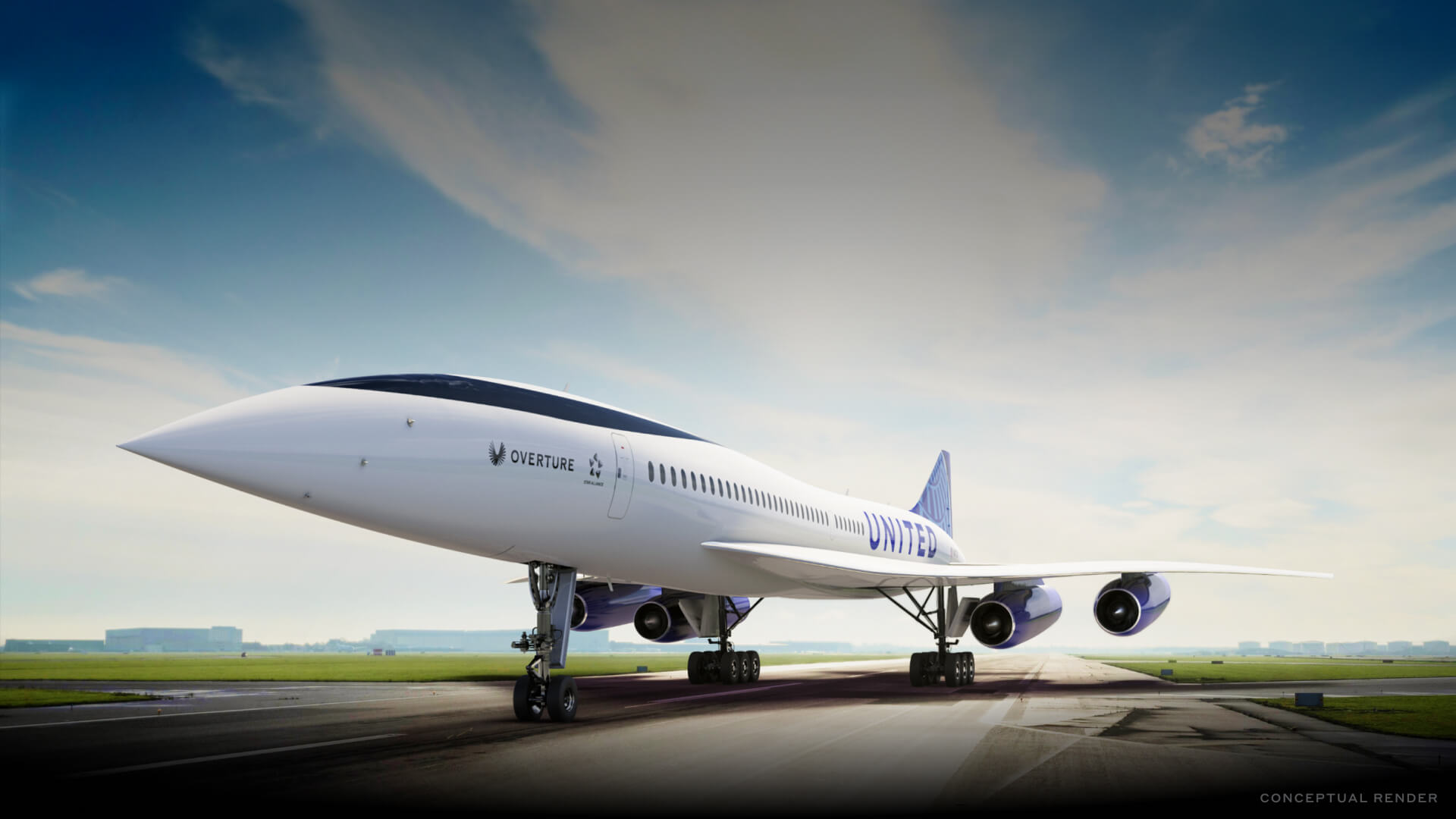
Credit: Boom Supersonic
This could be big for them. But is it “the last round of capital we ever need to raise” as they claim? Engine development and initial airframe prototypes are billions of dollars in costs. Boom is trying to do it themselves on the cheap.
If they actually ship 29 turbines at, let’s say, a 20 – 30% gross margin, then they’re earning $250 – $375 million in profit over the next several years. Together with $300 million in equity they’re doubling the amount of funding they’ve raised. It still doesn’t seem like enough to certify an airliner with an engine.
There seems like a real opportunity here, but presented with overconfidence. And if this line of business really did grow into enough money to fund the supersonic jet, is that really how they should spend the profit? And is this an “accelerant” as Boom says, or a distraction if their core business really remains supersonic jet travel?
- They’ve done supersonic test flights in their demonstrator aircraft this year.
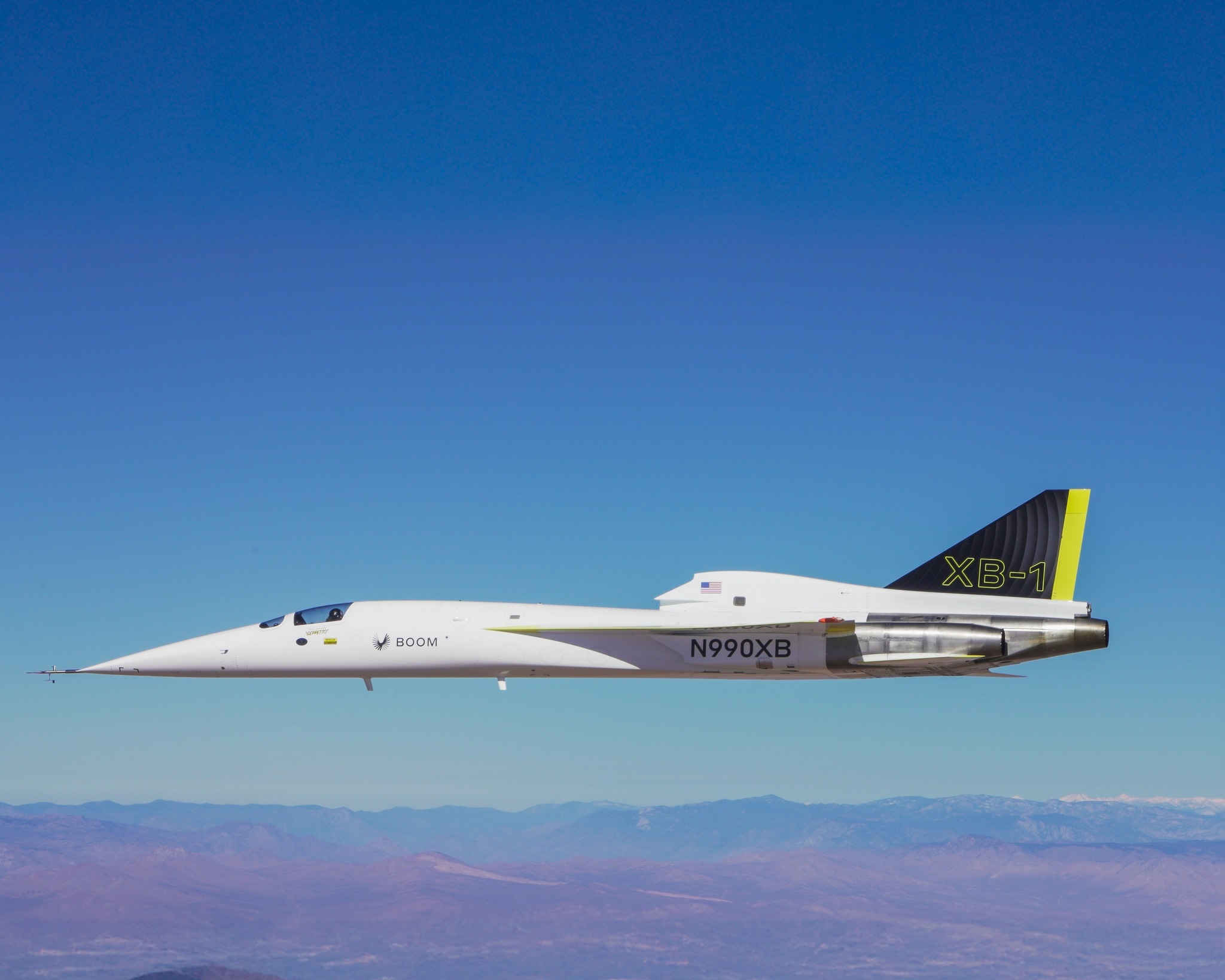
Credit: Boom Supersonic - Their factory in Greensboro, North Carolina has been building, but isn’t yet tooled.
- They have notional orders from American, United, Japan Airlines and the U.S. Air Force.
13/ Today's new $300M financing fully funds the Superpower turbine—and Superpower accelerates profitability, allowing us to self-fund Overture supersonic development pic.twitter.com/FCtAEquA5s
— Blake Scholl (@bscholl) December 9, 2025
But these are not firm orders, the plane isn’t close to flying, and no one has built an engine this way. And it’s not clear what the economics of the plane will look like if they build it and it flies. They say they’re even going to be using costlier sustainable aviation fuel.
Supersonic flight is possible – Concorde did it for years. The question is whether it can be built in an economical enough way that allows airlines to cover the high cost with premium passengers willing to ay more for speed – in the limited overwater markets it’s likely to be allowed to fly (even if they can do so without sonic booms).
Still, their initial test plane flew and they have more funding and a new turbine deal, and that seems to move them from ‘no hope’ to ‘long shot’. They’re likely developing good tech. Their investors might even make money. But full commercial supersonic service still seems way off.
No U.S. airline ever purchased a Concorde, though orders were placed by Pan Am, Continental, TWA, American Airlines, Eastern, United and Braniff. There were also orders from Qantas, Air India, Sabena, Air Canada, Lufthansa, and even Middle East Airlines and others which never came to fruition.
Only British Airways and Air France took actual deliveries of new aircraft. The only other committed order came from Iran Air, and that was cancelled after the Iranian revolution. And Braniff would briefly take over ownership for a few hours at a time to legally operate domestic sectors.

Credit: Boom Supersonic
As for me, it’s been a long time since we’ve had a good points option to book supersonic jet travel.



Unless someone knows a lot more about this than I do, no rational investor would bet on this pivot. It reeks of desperation.
Pivoting to ‘AI’ proves this company was always just relying on hype.
Their major technical and economic hurdles remain. When all three major commercial engine manufacturers (RR, PW, GE) decline to develop the engine, that’s a bad sign, dawg.
Not to mention, those ‘orders’ by AA, UA, JAL, were just ‘options,’ easily canceled without penalty. Do not invest in Boom, or your funds will go… *boom*
Oh, and Gary, great use of ‘AI’ art. I really liked it. I’m others will compliment you, too. I’ll wait…
Maybe, but I’m skeptical and I am about their SST, too. The history of aviation is littered with the wreckage of abandoned projects. I wouldn’t invest in Boom.
“Boom Supersonic, which is building a new plane to travel faster than the speed of sound and has notional orders from United, American Airlines, and Japan Airlines,”
Not notional, fake. No penalty for cancellation. No delivery date. I myself have ordered 200 of these jets, mre than everyone else combined, and on the same terms.
Don’t be fooled by the PR. The $300m raise is on valuation of $1.5Bn, not enough to fund the development of a new fanjet, let alone one with performance parameters outside those of current commerical jets. This repurposing is actually an announcement that they have given up on flight and plan to salvage some worth from the red-hot market for turbines in stationary power generation.
On a side note, the plane they briefly flew at one mile per hour faster than the putative speed of sound earlier this year had nothing in common with the plane they are developing. It was a PR stunt for the credulous.
I would love to see new technology come to fruition and all the naysayers proven wrong. This is still a long shot, but this ain’t no Global Airlines.
It has be economical not just possible. Airlines have never shown real interest in an aircraft with faster speeds but higher operating costs. Considering modern 788s and 350s fly at the same speed as a DC8 introduced in the late 50s.
I don’t see BOOM supersonic jet ever coming to fruition. It will be a failed startup project that ends with initial investors turning a windfall profit.
If they end up making a BOOM supersonic jet I’m prepared to pony up $10,000+ for tickets. I promised my 80 yr old father I would take him. LOL
What possibly could happen is that Boom will extend technology of the the jet engine in it’s quest to make money and manufacture a supersonic airplane. Even if Boom goes bankrupt, the new ideas could change how parts of jet engines work.
Man I love all the less than smart people here acting like a new startup company should have billions of orders before doing anything.
Like the majority of these dudes don’t understand how change in technology happens. There are investments… usually a massive amount, before any orders or revenue is recognized. This is normal.
The likelihood of success is low, but given what they have proven and flown thus far it’s evident they are closer than anyone in the last 50 years to successfully launch a new engine and a new plane.
Good job Booom!
Pratt spent 10 BILLION developing the PW1100G and that has been a disaster. No way Boom won’t go bust.
If generators for datacentres can be such a successful business, why throw the profits into an airplane-building moneyhole instead of returning them to shareholders?
@Pilot93434 — See, we can agree on something. *wink*
@Boomers hate Boom — LOL. Yeah, no, ample non-Boomers doubt Boom. Seems like you work for, invested in, or are just a ‘kid’ who likes the idea of supersonic commercial aviation, but was too young to experience Concorde. Me too, bud, but this is a pipe dream.
“Supersonic aircraft” is a solution in search of a problem.
Once again, if time is that much of the essence, nothing beats photons over fiber-optic lines (i.e. teleconferencing).
And people said Boom was just overhyped bubbly vapor ware. Would Sam Altman of all people get involved with in something that’s been marketed as world-changing while real world results leave very much to be desired? Would Sam Altman make promises of product viability only to continually miss those goals, deadlines and promises?
Boom and OpenAI are genuinely perfect partners.
@raylan — Zing! Got’em!
The Concorde was just a PR stunt from the different main EU countries to test economic and political cooperation in the planning of the EU in the making at that time. It was all government-funded, and the 14 that were taken by AF & BA were forced to them by their government (AF & BA were government-owned and controlled airlines at the time), while they knew the economic models didn’t make sense. They soon cut destinations and started to ground some of them to be used for parts for the others.
Concerning Boom or investing in startups, any companies using “disrupting” or “AI” in their business plans are a no-no.
Boom would be better off reviving the L-1011. I suspect that airplane, with a few tweaks, could have easily been supersonic.