Five passengers and one flight attendant were lightly injured, so this is a serious incident, but it’s one where I find the geometry absolutely fascinating.
On Saturday, May 30, 2026, Eurowings flight 635 from Rhodes, Greece to Cologne, Germany ran into wake turbulence from the aircraft ahead of it. The Airbus A320 was at about 36,000 feet, around 23 miles east of Sarajevo, when air traffic control cleared it to climb to 38,000 feet – behind Emirates flight 1, an Airbus A380 from Dubai to London, which was already at 38,000 feet about 9 miles in front.
As the Lufthansa subsidiary’s A320 climbed through 37,600 feet it encountered wake turbulence from the A380 ahead. The crew stopped the climb and quickly returned to 36,000 feet.
Inside the cabin, a flight attendant was thrown into the ceiling of the cabin. The flight continued to Cologne, where medical personnel met the aircraft. The Eurowings aircraft stayed on the ground in Cologne for about 4.5 hours and its next flight departed about 3.5 hours late. The Emirates flight continued to Heathrow without incident.
- The Eurowings Airbus A320 appears to have been outside the A380 separation minimum: ICAO guidance cited in the reports gives 8 miles for an A380 ahead of an A320 at the same altitude or up to 1,000 feet below.
- Wake turbulence isn’t engine exhaust, it’s the byproduct of lift. As I taught my daughter, a wing makes lift by creating lower pressure above the wing and higher pressure below it. Air curls around the wingtips and rolls into two long, counter-rotating vortices trailing behind the aircraft, like two invisible horizontal tornadoes.
- Every aircraft creates them, but the strongest wakes come from the heaviest aircraft – like an Airbus A380. Widebodies are generally referred to as “Heavy” after their callsign. The A380 is “Super.”
- Those vortices sink, drift with the wind, and decayat several hundred feet per minute, but atmospheric conditions can move them horizontally or vertically. They can last several minutes, and a smaller aircraft following a heavier one at the same level or just below creates a risk. Minimum wake separation reduces this risk, but as these flights show it doesn’t eliminate it.
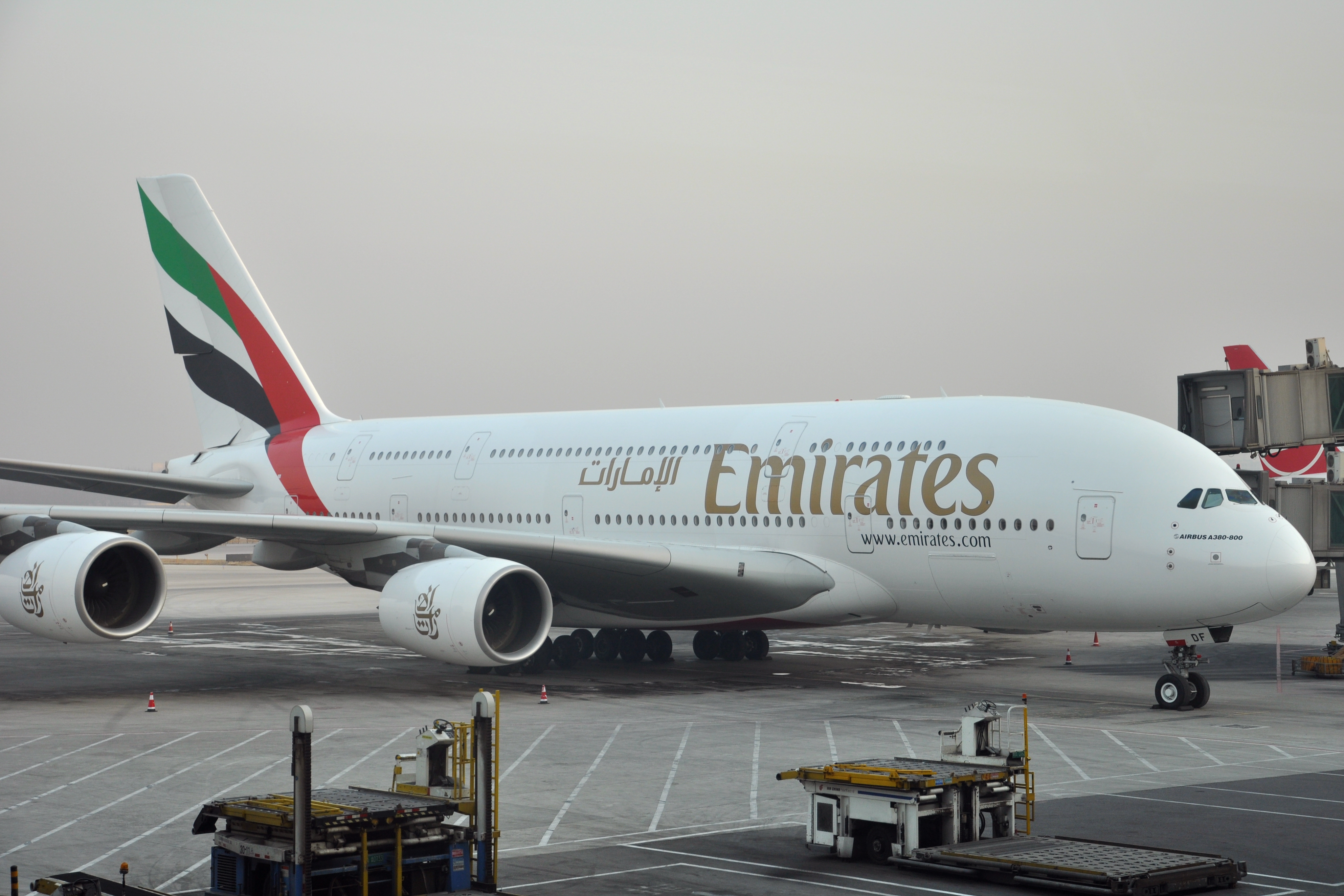
By Kentaro Iemoto from Tokyo, Japan, CC BY-SA 2.0 via Wikimedia Commons
The Eurowings Airbus A320 likely intersected the Emirates A380’s descending wake. That doesn’t appear to have damaged the aircraft, but it created turbulence that injured crew and likely unbelted passengers. (Always wear your seatbelt when seated.)
Wake turbulence exists behind every aircraft. The biggest risk is usually managing it around takeoff and landing, when aircraft are spaced closer together and traveling slower. However enroute encounters are documented semi-regularly.
- One study of upper European airspace found 26 such wake incidents between 2009 and 2012, and estimated it happens about once every 38 days.
- In January 2017, a Bombardier Challenger lost control over the Arabian Sea about a minute after an Emirates Airbus A380 passed overhead in the opposite direction 1,000 feet above it. The business jet dropped about 9,000 feet, rolled through several rotations, and diverted to Muscat with two seriously injured passengers. The plane had to be scrapped.
- In 2001, American Airlines 587 from New York JFK to Santo Domingo encountered wake from a Japan Airlines 747 after departure and crashed after excessive rudder applied by the first officer in response, producing loads beyond the vertical stabilizer’s design capability.
The Eurowings incident with an Airbus A380 is unusual – operating at what appears to have been a normal, albeit close distance, resuling in injuries.
(HT: Paddle Your Own Kanoo)



At least they were at higher altitudes and recovered. AA587 was not as fortunate.
@1990, you may wish to watch any of the multiple simulations on YouTube regarding AA587, it had nothing to do with altitude. The issue was a poorly-trained First Officer, who so violently operated the vertical stabilizer that it sheared off. If they were at 38000 feet they still would have crashed. As for this latest A380 incident, I’m stunned that they didn’t increase the mandatory separations after the 2017 incident.
…violently operated the rudder such that the vertical stabilizer sheared right off that is… Bottom line, the aircraft was doomed to crash regardless of altitude.
“(Always wear your seatbelt when seated.)”
Yeah, I tried to wear it while standing and it proved to be difficult.
I remember once flying from IAH to DFW (likely in an MD80 at the time on AA in the early 1990s) we hit wake turbulance and the entire plane dropped. A little unsettling even for someone like me that already was a DL million miler (switched to AA when DL deemphasized their DFW hub).
Call me Chicken Little. While I don’t have an irrational fear of flying, turbulence is not anyone’s friend. Weather, clear air, mountains and this wake turbulence, I am most happy strapped in with all electronics tucked away. Weird I know.
@Mike P — Bah! Good one!
@TexasTJ — Had there been no wake from the JAL 747, the pilots would not have reacted with the rudder. Like, say, it was just a normal takeoff; they wouldn’t have been just fiddlin’ around.
@1990 AA587’s low altitude was a gift that shortened the terror that the crew and passengers felt. Altitude only would have prolonged it.
@EB — As with every aviation disaster, there are often multiple factors: JAL (without the jumbo in front of them, less turbulence, so likely no overuse of rudder), pilot error (shouldn’t have overused the rudder; better training implemented after the incident), and aircraft design (A300-600 notoriously sensitive rudder pedal system). But, clearly, you two want to just blame those pilots, it seems.
These fat white hogs are dangerous and should be scrapped with immediate effect.
@1990, maybe you should just sit this one out. Your latest comment “Had there been no wake from the JAL 747, the pilots would not have reacted with the rudder” is also not correct. Two points: 1) The separation on take-off was within limits. 2) ATC issued a standard wake turbulence advisory prior to take-off. In sum, the NTSB clearly determined that it was the improper rudder movement by the First Officer that caused the accident. They considered it to be a routine situation which a qualified pilot would have easily flown through.
@TexasTJ — No. You first. I’m in NYC. I know people directly affected by this one. We can re-litigate all you want. AA587 was far more complicated than simply ‘hur dur, silly pilot playing with the rudders too much.’ While you re-write their own report with a different interpretation, the actual NTSB did appropriately threaded the needle as best they could. It was multiple factors (the circumstances with JAL, the training at the time, and the design flaw of the air frame.) Please, dig deeper.
@1990, fair point about Rudder Sensitivity, but once again your first two points regarding Altitude (absolutely no correlation) and link to wake turbulence (when the distance was within limits) were both incorrect. As for the First Officer, he was fully certified on the Airbus A300-600 and thus should have known about the rudder sensitivty on that model. He is not exonerated.
@TexasTJ — Welcome back. My point remains: In 2001, it was bad training, not pilot error. In 2017, it was 10,000 feet of safety that saved them. Yes, tail separation is fatal, which is why the system that caused it matters.
For 2001, NTSB found that American Airlines’ Advanced Aircraft Maneuvering Program trained pilots to use aggressive rudder inputs to recover from wake encounters. The First Officer was executing a flawed corporate policy under high-stress. I personally would not blame those particular pilots. The A300-600 had sensitive rudder pedals. That tragic combination of systemic training failure and design flaw is exactly why the FAA and the aviation industry had to rewrite how maneuvering speed and rudder limits are taught. Safety rules sometimes written in blood.
As for the 2017 Emirates-Challenger incident, altitude was the only thing that mattered. The corporate jet lost nearly 10,000 feet in an uncontrolled free-fall while the pilots flew blind, waited for instruments to reboot, and re-started the engines. If that exact same encounter at 3,000 feet, everyone dies before recovery is possible, aggressive rudder or not.
*2026 (ooof)
Eurowings (2026) and the business jet (2017) each had altitude and better training on their side.
I just hope that the pilots react with the best practices when encountering turbulence.
AA587 did not fly itself but it was airworthy before the flight and during the takeoff.
@jns — A300 included autopilot. (Not really at-issue, but…)
@1990, we’ll need to agree to disagree (but I’ve got the data). The Rudder Sensitivity becomes minor issue given that the First Officer was fully certified on the Airbus A300-600 and thus should have known about the rudder sensitivty on that model (even with AA Training suggesting a different approach). Full Stop. Once again you brought up Altitude (on an entirely different incident), but you know full well it had no bearing on AA 573. You keep on dreaming up reasons why you’re “right”, but none of them apply.