
During the pandemic, American Airlines retired almost half of the long haul-capable planes in its fleet. They were conserving cash, avoiding maintenance costs, and making a bet that travel would not recover for a long time.
Other airlines retired planes, like Delta did with its small orphan fleet of Boeing 777-200s. But the smart move was Scott Kirby’s at United to take a wait-and-see approach. In April 2020 things looked dark but we just didn’t know what a year and two years into the future would look like. United kept its options open and didn’t retire fleets of planes.
American Airlines had 24 Airbus A330s.
- 15 Airbus A330-200s, initially placed in temporary storage, then permanently retired in the third quarter of 2020.
- 9 Airbus A330-300s, where the retirement decision was made in April 2020.
It wasn’t crazy to retire the 9 A330-300s. The 15 A330-200s were the big mistake. They were relatively young and would have been especially useful during the 2022–2024 Europe travel recovery. They also would have made a good Hawaii plane. I believe the A330-300s were leased (and American was still paying on them after they were parked) while the A330-200s were owned.
And even six years later, they still have a lot of life left in them. 8 are now reportedly headed to their next life in Vietnam.
Sun PhuQuoc Airways is getting 8 ex-American Airlines A330-243s that were parked and stored during COVID.
These jets sat in the desert for years after AA basically gave up on the type post-pandemic. Now they’re heading to Vietnam with deliveries kicking off 15 June 2026 and… pic.twitter.com/938rY129AT— Fahad Naim (@Fahadnaimb) April 25, 2026
In 2020, American recorded about $1.4 billion of non-cash write-downs and $102 million of cash charges tied to early retirements of the A330-200, A330-300, Boeing 757, 767, and Embraer E190 fleets.
Brian Znotins, who runs network planning for American, has said he prefers domestic flying over international. He also prefers “adding a second frequency to some destinations, using two of these smaller planes instead of one larger one.”
[T]hat sixth trip from DFW to Indy is what we’re going to be earning a profit on instead of going to some speculative destination in Europe or Asia where you don’t have as many people wanting to go there and we’re not as successful on those routes.
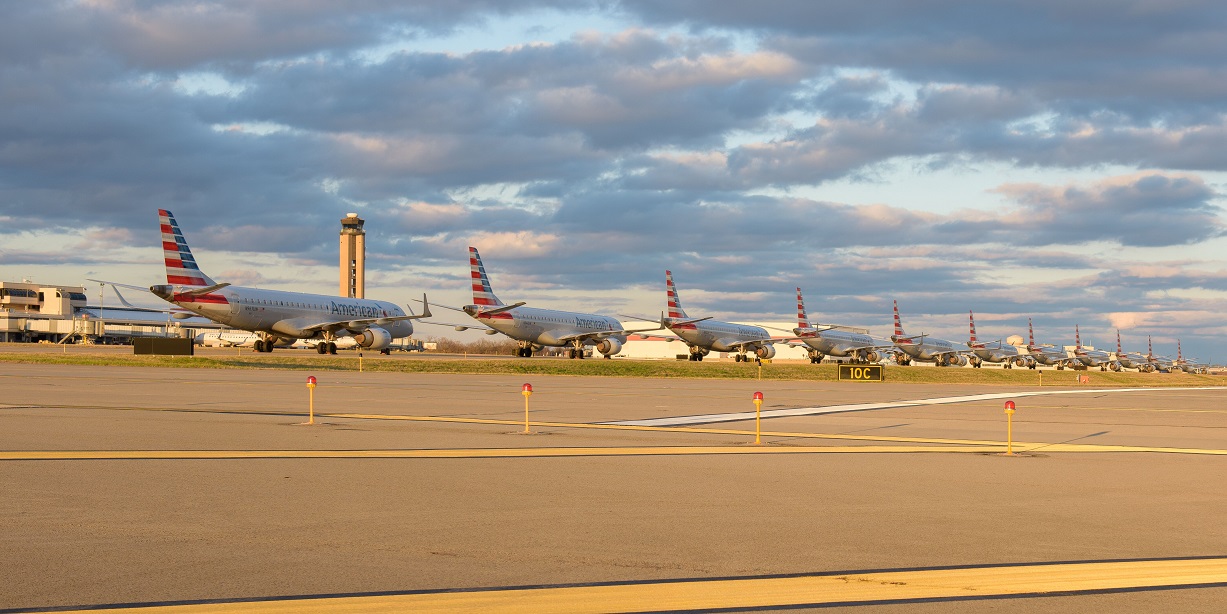
During the pandemic A330s and E190s Were Parked in Pittsburgh, Credit: American Airlines
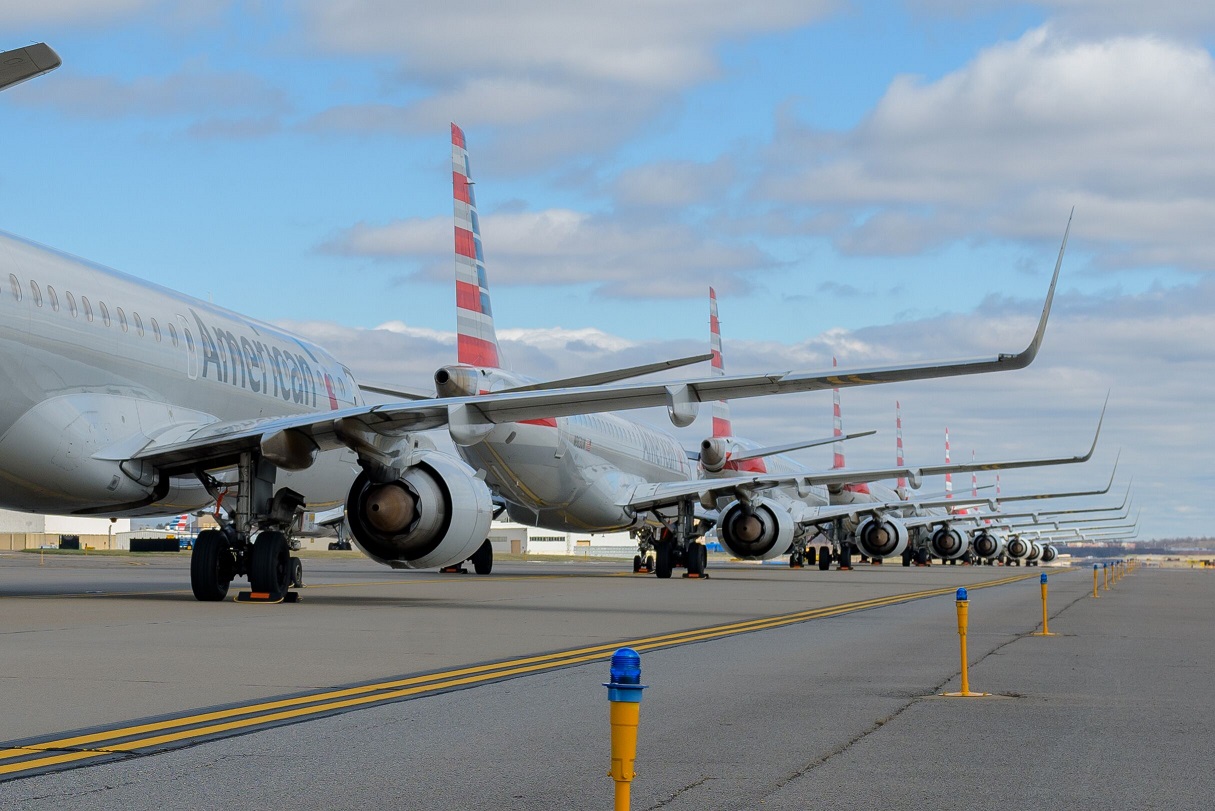
During the pandemic A330s and E190s Were Parked in Pittsburgh, Credit: American Airlines
American had 17 Boeing 767-300ERs at the start of 2020, when that fleet was retired. They were old, maintenance-heavy, and weren’t as nice in business class (though they were my favorite coach plane). They were still useful for cheap long haul flying, good for experimenting with new routes. Several of these planes found new life as freighters for Amazon.
They had 34 Boeing 757s at the start of 2020 and these were retired at the outset of the pandemic as well. I believe that AerSale acquired a couple dozen of them, and Northern Pacific eventually acquired nine. They were old and fuel inefficient, but useful for thin transatlantic routes. They were retired with no replacement on the immediate horizon (the Airbus A321XLR did not debut until late 2025).
Finally, American had 20 Embraer E190s and retired those as well. Alliance Airlines in Australia bought 16 of them for $65 million, and fly them for Qantas.
These retirements all came right after they had just finished retiring their MD-80 fleet in September 2019. At final retirement they still had 26 of these planes (at 2003 peak they were operating 362 of them). As of last year 18 of these were still flying.
This all had major downstream consequences for American.
- American missed the 2022–2024 transatlantic boom because it lacked aircraft. They blamed Boeing, but that’s not really fair.
International traffic recovered sharply in 2023 and 2024. International grew about 40% in 2023 and then another 13% in 2024 – growing past 2019 levels. By removing 24 A330s, 17 767s, and 34 757s, American retired 75 long haul-capable planes which was about 40% of their total.
American blames Boeing delays for having so few widebodies but American itself deferred 787s. In 2021 it reached an agreement with Boeing to defer and convert five Boeing 787-8s to 787-9s. Then in late 2023, American deferred 10 of 30 remaining firm 787-9s, originally due in 2024 – 2025, to 2028 or later, saying that delivery schedule better aligned with anticipated demand and growth plans.
At some level, it was arguable at the time to retire the 757s and 767s and even the A330-300s. It seems like an obvious error to have retired all of those and to rely on Boeing hitting timelines for replacements. It left them without cheap planes, optionality, or platforms for growth. But retiring perfectly good A330-200s was nuts.
Keeping the A330-200s in a condition to restart them flying in a couple of years might have been a $100 – $200 million decision. That was the original plan.
- It’s also a good part of why they found themselves in the hole in Chicago. American’s post-pandemic network strategy clearly emphasized high-return, high-scale hubs such as DFW and Charlotte. Without the 757s and E190s flying elsewhere, planes that might have returned to Chicago couldn’t. That meant less flying out of Chicago, and when the airport reallocated gates based on usage earlier than expected, American had gates taken away.
United made option-preserving decisions. In May 2020, United hadn’t retired an aircraft type and said it wanted more visibility into recovery before making permanent fleet decisions. By 2024, United was planning its largest-ever transatlantic schedule and had leased Airbus aircraft to mitigate Boeing delivery uncertainty. That contrast was marked.
American talked throughout the pandemic about its ‘Green Flag plan’ to come out of Covid-19 ready to race ahead of the competition. But the management and board at American chose to ditch aircraft that still had life in them, betting that the future market for their product and business would be much more limited than it had been in the past. That falls on CEO Doug Parker and the board, but the current CEO of the airline was President then, too.
Those fleet decisions in 2020 made sense if you believed travel demand would stay limited for a long time. It’s another example – along with leadership’s pre-pandemic view that success in the airline industry meant modeling Spirit Airlines in Frontier – of management simply having the wrong vision for the airline, misreading the direction of travel. That’s one of the key jobs of a CEO.



“Those fleet decisions in 2020 made sense if you believed travel demand would stay limited for a long time.” *new forever-war, increased fuel costs, shortages*
@1990
You can’t be certain about it being a forever war. I don’t trust the administration to make the right decisions but I also don’t think they’re predictable.
@IsaacM — Pandora’s box is open.
Still gets those CEO salaries and his golden parachute when he gets ousted, not bad for a guy who didn’t listen to his employees in the trenches. The bean counters are running AA, the old time type of grassroots airline guys aren’t around anymore. Where’s Bob when we need him???
Their problem is they think low margin high frequency flying is profitable. But that relies in a segment of the population that doesn’t fly often and has little money to fly when they do. Those are not repeat customers.
Hind sight is always 20/20. But you could look at their track record and the track record of ULCC’s and see their plan was not sustainable. Now they are 10 years behind the competition playing catch up with a high debt ratio and low operating margins. The competition will continue to pull away for 5 to 10 years while they play catch up. That means they are 20 years from catching up, assuming they ever do and can avoid another bankruptcy. And good luck on that. High fuel prices and a looming recession are economic pressures they are not prepared for.
unionTHAT
AA’s financials, like WN, made a pretty dramatic turn in just one quarter. When you walk away from being cattle class and embrace higher levels of service, it has a pretty dramatic impact on finances – which means you can either start paying down debt (in AA’s case) or invest in even higher levels of service (as WN is doing).
I’m not sure how much more can be done to the product – but DL is in the best position to keep pushing it to a new level; they have had a stable higher level product for 10 plus years. UA is investing in product now but are spending enormously on growth and they could easily have AA levels of debt if the competitive situation in their markets swings in the competitions favor – such as AA at ORD, WN at DEN, DL at LAX and NYC – even as fuel prices remain elevated.
AA does not need to invest near as much in fleet as UA is doing and it is far from clear that UA’s focus on size will really translate into better financial results or brand preference outside of their hubs where they are already dominant.
and WN could easily become a 4th viable global carrier operating widebodies within 5 years. add in whatever AS does and the 50th anniversary of domestic deregulation could result in more large airlines than the US has ever had.
American’s 767-300ERs were on their last legs. Built and delivered between 1988 and 1992 (but for 6 or 7 they bought new immediately post TWA in 2002), these birds had dated interiors, not so great dispatch reliability and were isolated to PHL for the most part.
The A330-300s (9 frames) were built and delivered to USAirways between 1999 and 2001 I believe, and were in good shape.
The A330-200s (15 frames) were the newest. They also had received nose to tail refurbs in 2018-19.
These fully paid down planes, plus the ER capable 757s would have allowed AA to fly secondary and tertiary markets across the Atlantic during the 2022-2025 boom that followed the pandemic. It was not a mistake to park them. It was a mistake to withdraw them fully considering the bailout the US industry got as a result of the pandemic. AA could have kept the A330 pilots and mechanics.
people love to tell us that AA made a mistake in retiring so many internationally capable aircraft but DOT data – which is compiled from data airlines PROVIDE to the DOT – show that AA has not made money flying its Atlantic system since 2018 and its losses over the Atlantic remained at least half of the $1 billion plus during covid until 2025.
AA hasn’t made money flying the Pacific for the past decade.
AA does make money flying to Latin America but that is not enough to offset its TATL and TPAC network.
and Latin America can and is flown by some narrowbodies.
While I have doubts that AA will find economic success with its 321XLR strategy, those planes are much lower risk since they can be redeployed domestically.
AA did not make a mistake in getting rid of multiple fleet types during covid.
@shoeguy — Yeah, when that 763 at ORD literally caught fire (N345AN as AA383 in 2016) that felt like the beginning of the end. (And, as it relates to a common point of discussion on here, even back then, NTSB called for research into countermeasures against passengers evacuating with carry-on luggage despite being specifically instructed not to do so by crew…)
@Tim Dunn — I think AA did just fine retiring these; for them, 787, XLR, Flagship Suites are the future anyway.
US Airways was set to be the launch customer for the A350. The most popular wide body in the world today. American acquired that order, delayed it and eventually cancelled it. Delta continues to beat American on new long haul with what…. The A350.
@1990
No, now it’s open.
American much like the country is a dying garbage with garbage people.
Rob,
US inherited an order for what was then an enhanced A330; the market spoke for an all-new design which is the A350 which is a primarily carbon fiber ultra long haul capable aircraft that beats the 787 in performance and economics. Airbus has used the same strategy multiple times with competing models- allow Boeing to introduce a new model and then best it with an Airbus design
and the A350-1000 is where the differences will really matter as DL puts the 35K into service within about a year. the 350-1000 will be the longest range, most economical aircraft in the US carrier fleet and Boeing simply will have no answer until at least when the 777-8 enters service for a US carrier and that is at least 5 years off. The international market can and will change dramatically over that period of time.
High J 787s might come close the 35K in range but DL’s 35Ks are also fairly low density for the 35K. The 321XLR might allow some international routes to operate that AA and UA can’t make work otherwise, but the per seat costs will be higher than widebodies.
@Tim Dunn — Saw what may have been the layout for the 35K. Kinda surprised there’s that extra two rows of J after the second set of doors. Is that where all the wealthy kiddos will go? Hope so, no one buying Business Class wants a screaming baby 16+ hours.
@1990,
I believe the AA 767-300ER that caught fire at ORD was among the newer build frames, acquired post-TWA acquisition. AA bought 6 or 9 763s to replace the TWA ones, which were on very high lease rates due to TWA’s very poor credit rating. Those 763s were used from JFK to CAI, RUH, CDG, and TLV, plus STL to LGW and HNL in the final days of TWA’s existence.
@shoeguy — So the one at ORD was just super unlucky. That said, I don’t necessarily miss TWA, especially later years (I recall less-than-ideal connections in STL.)
You’ve been the CEO of how many airlines ?????
@DesertGhost — Bahaha… this freakin’ guy…
AA acquired a heavily used clown car when USAir took over
Definitely an error in hindsight.
But at the time, AA was looking at zero international travel when it had already been building steam toward getting rid of these fairly small widebody fleets. To them, it looked like an opportunity to cut costs at a time when they were begging Uncle Sam for money to stay afloat. Ended up costing ’em more than they saved in the long run. Go figure. But for an airline whose focus is more domestic/Americas vs long haul transoceanic, it arguably made sense at the time. It just ended up being predicated on an inaccurate guess at the future. Win some, lose some.