
I read the total combined 343 pages of the American Airlines SEC 10-K and the proxy materials for its board meeting over coffee. There’s one headline that’s going to be the biggest one – the CEO’s compensation package – but it’s not actually the most interesting story on its own.
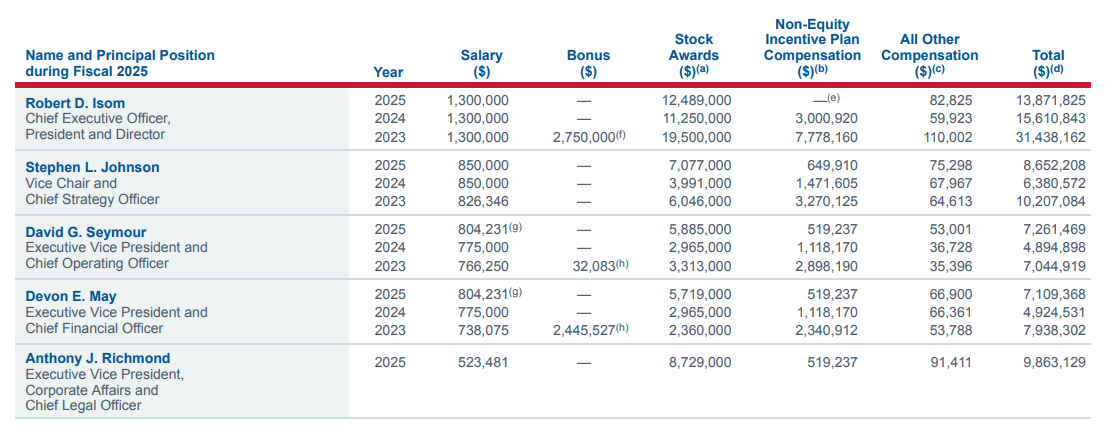
People are going to pay attention to CEO Robert Isom’s $14 million pay package. That’s a lot, but it’s not a lot for the CEO of what by some measures is still the largest airline in the world. What’s notable is how executives have been largely shielded by the collapse in financial performance of the airline. Good CEO performance would be worth much more! An outsized portion of profit is being paid out as executive compensation at American Airlines. That’s the real story.
Financial Problems At American Airlines
By now it’s well-known that American generated $54.6 billion of operating revenue in 2025, up only 0.8%, while net income was down 87% – they made just $111 million while Delta and United earned billions.
Their capacity grew 2.2%, but passenger revenue was flat at $49.6 billion. Their flying was earning them less – Load factor fell 1.3 points, yield fell 0.5%, and passenger revener per available seat mile fell 2%.
And that $111 million net income?
- They received $6.2 billion in cash payments from their cobrand credit card. They’ve previously reported a 53% margin on the AAdvantage program. So if there’s about $3 billion in profit on the card, then everything else (flying) lost $3 billion.
- Costs are way up for labor. Salaries, wages, and benefits rose $1.5 billion (9.6%). That ate up prior year profits. They had 139,100 active full-time equivalent employees at the start of the year. That’s more than other airlines, because their union contracts allow them to outsource less (86% of employees are covered by union contracts).
American Makes Money And Pays It To Top Executives – And The Board
American Airlines produced record revenue but almost no profit, while executive pay barely moved down. Management was insulated from the collapse in shareholder returns.
- The company’s five executive officers and 12 directors received $50.53 million in combined compensation, equal to 45.5% of the company’s entire annual profit.
- Robert Isom’s compensation alone was $13.87 million, equal to 12.5% of American’s full-year GAAP net income.
- Profit fell 87%, but Isom’s pay fell only 11%.
The CEO earned in one year what the median American Airlines employee at $89,429 would earn in 155 years. That will outrage some but a CEO who converted $55 billion in revenue into $8 billion in profit would be worth multiples of that.

Isom gave up his bonus, and the company tells that story in these documents, but if the CEO recognized the company missed its targets so badly, why was the rest of the compensation structure still so protected from an 87% profit collapse?
And previous year baseline profit was low. At the airline’s Media and Investor Day in 2017, then-CEO Doug Parker famously declared that the airline would ‘never lose money again.’ His presentation described the airline as being like an annuity. They were, effectively, on autopilot to earn $3 billion to $7 billion per year and would average $5 billion annually into the future. There’s been 20% inflation since then – just staying even should mean $6 billion!

The board’s pay may be normal by peer standards, but it’s absurd against American’s results. Directors received about $3.8 million, equal to 3.4% of full-year GAAP profit. A good board would be worth much more. The problem is not that directors were paid. The problem is paying millions to a board overseeing collapsed margins and weak shareholder returns but that’s done little about it.
The best rebuttal American has is that Chief Legal Officer Anthony Richmond’s $9.86 million compensation included an $8.73 million new hire make-whole equity grant which inflates compensation numbers slightly, but even excluding him executive pay remains enormous relative to profit.
If United Bought American Airlines, CEO Isom Pockets $40 Million
Ten years ago top executives at American Airlines didn’t have contracts with non-compete clauses. The board at American fired Scott Kirby in order to retain Robert Isom. And Kirby immediately became President, now CEO, of United Airlines. That was a bad deal. Now, the airline has non-competes and the board made an even worse deal.
If American Airlines is taken over by another carrier, Robert Isom gets $33 million. If they’re taken over and he’s terminated (the likely outcome), he takes home $41 million. If he’s just fired for performance, he gets about $32 million. Other top executives are similarly-situated.
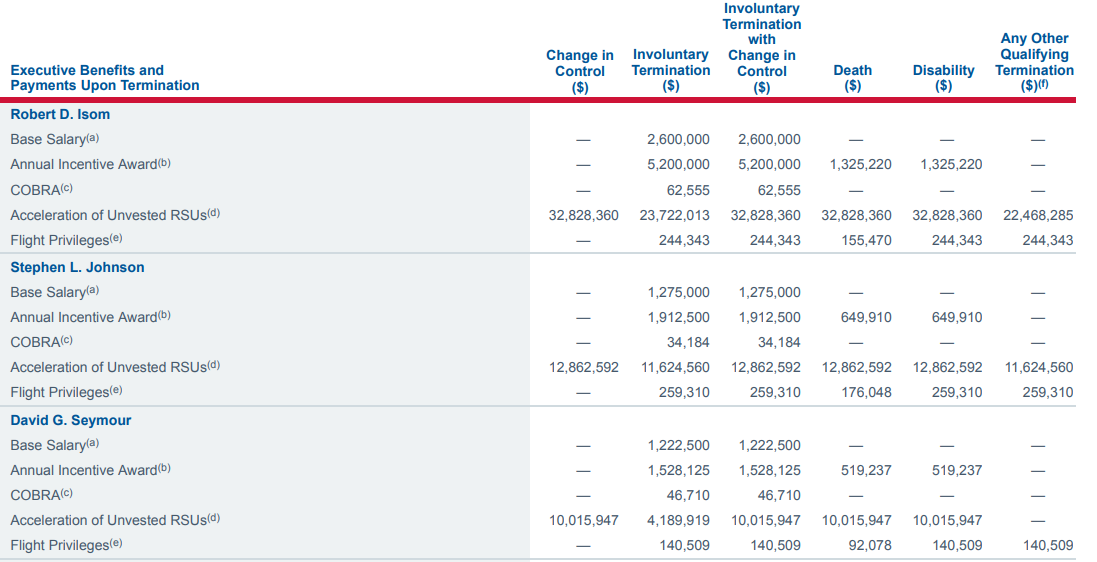
The irony, of course, is that that the best financial outcomes for the CEO are either massive outperformance of the industry (which seems unlikely) or performance that’s bad enough to finally get fired, although the the Board has never shown an inclination to hold management at the company accountable.
And paying out $32 million for poor performance – to keep him from running another airline right away – seems completely unnecessary. Delta, United, Alaska and others won’t be chomping at the bit.
The Board Wants To Reward Executives Non-Financially
Proxy materials include details on a vote to amend the certificate of incorporation to limit officer liability to the fullest extent permitted by Delaware law.
Shielding themselves from responsibility is exactly the problem – and a bad look precisely when they’re underperforming.
There are incredible shades of Teldar Paper’s annual meeting where Gordon Gekko makes his ‘Greed Is Good’ speech. It was a speech about accountability, and how management lacks a real stake in the company’s outcomes. “You are all being royally screwed over by these bureaucrats with their steak lunches, their hunting and fishing trips, their corporate jets and golden parachutes.”
Interesting Things I Learned
American’s fuel financing facility is secured on a second-priority basis by intellectual property including the “American Airlines” trademark and aa.com, with a maximum outstanding balance of $1.0 billion, at an interest rate of SOFR plus 3.75%. Fuel financing obligations rose from $74 million at year-end 2024 to $914 million at year-end 2025.
They most recently report debt paid down to $35 billion. But they’re going to need to do quite a bit of refinancing:
- $3.6 billion due in 2026
- $4.5 billion in 2027
- $7.3 billion in 2028
- $4.0 billion in 2029
It’s tough to pay this down and off without earning profits. They can do this only by tightening their belts on capital spending, when there’s a real capital spend deficit with lack of widebody aircraft orders and a real need to invest in aircraft interiors and airport clubs.
The stock performance table shows that $100 invested in AAL at year-end 2020 was worth $97 at year-end 2025, while the S&P 500 equivalent was $182.
Here’s the extent that the American Airlines brand is actually outsourced to other carriers (including wholly-owned ones like Envoy Air, Piedmont, and PSA): 57 million passengers boarded regional flights in 2025, and about 42% connected to or from mainline flights.



And yet… they and the oligopoly (AA, DL, UA) will beg for a bailout soon. Shameless.
Socialism for the rich and their corporations… rugged individualism for everyone else.
@GARY: ‘executive pay remains enormous relative to profit.’
Not at all, based on the numbers you showed. It is all redeemed stock incentives. Cash pay was low.
Read 300+ pages while drinking coffee? WOW! Either a HUGE cup of coffee or a speed reader extraordinary!
The issue is that this is the same management team that made decisions that got the airline where it is. It won’t be easy or quick to change prior blunders. Sure, the management team should be sent to pasture. At that level there can be no oopsy, even if your best future analysis turns out wrong.
That being said even a new management team would find the going rough. Widebody planes can’t materialize overnight. Crew have to be paid competitive wages, particularly pilots. Investments in the product have to pay dividends and investments in the coach product rarely ever do. I would bet money that de-Oasing coach would not provide higher revenues. A couple more rows of MCE could.
Agree completely with @George R, although is it de-Oasising?
Lots of debt, but they appear to be managing it reasonably. It just completely hampers growth and is a competitive disadvantage compared to Delta and United.
If they can actually improve their hubs like they are finally doing in DFW, that will also have a big impact for AA – never good to have a perception (and the reality…) that you’re the airline that’s constantly running an hour late and causing missed connections.
The lack of MCE continues to be baffling, especially on their newer planes. The XLR basically has MCE in the form of exit row seating that families cannot take advantage of (very European of them, but misses the American market). The 787-P has all of 18 MCE seats, 12 of which are non-exit row (and having been on the plane recently, unless you get the 9 in the mini-cabin, the other 9 are where every passenger will congregate for the lavs because AA put zero lavs in the rear of the plane). I do wonder what customers think of these planes (at the moment they have the new plane smell and I presume do well in scoring, but who knows).
What’s amazing to me is that Kirby’s histrionics actually make Isom and Co. look measured and reasonable. The messaging from Isom the other day was not only reasonable, but actually articulated a “global premium airline” vision. Are they there yet? No. But you need to have a vision statement for employees and investors to buy into. At least they finally realize what they need to become, although I think we would all prefer a new management team to try and execute on that vision over the next 5-10 years.
@L3 – Executive pay refers to compensation not just cash salary. And as I say, compensation was not out of line for what you’d expect to executives of an airline of this size – what is frustrating is that it doesn’t scale down even close to proportionate with performance.
@1990 why would a company that makes $3 to $5 billion annually need a bailout? Or even $100 million? Bankruptcy and bailouts come after years and years of losses. The three airlines you claim will be asking for bailouts are nowhere near that level of financial peril.
@ Gary — So, how long did it take you to read 343 pages? You read every word?
@Gary: The point is ‘American Airlines Made Just $111 Million — Top Officers And Board Got $50 Million’ is wrong, and misleading. It compares current net income with compensation that is the result of years of capital gains. Any relationship between the two is meaningless.
@Matt B — Totally agree. It would be absurd. They’ll still try. Free money.
@Gary Leff — No, executive compensation here and in-general has gotten out of hand. 20x average worker pay is one thing. 200x or 2000x is ridiculous, especially when the same companies then claim they can’t afford to pay their workers a living wage. All said, these CEOs are mere mercenaries for the ownership class, which create loopholes to skirt their obligations. These are not ‘job creators,’ so much as parasites, siphoning on our public resources.
The Bezos model is better, stock options and low salary. If a company goes bankrupt then the stock options are worthless.
@derek — Speaking of Bezos… Amazon has been struggling lately. Like, I’ve had an increasing number of deliveries canceled/delayed… and that’s WITH Prime. WTF.