
American Airlines completely restructured its largest hub in Dallas, moving from 9 heavy peaks of flights arriving at the same time and then departing at the sme time to 13 smaller peaks throughout the day.
They’re also spending millions padding flight times but by reducing misconnections and missed bags they should actually save money overall and give customers more flight options with less stress – even if it makes total travel time a little bit longer.
- A bank is basically a coordinated hub “wave” with lots of arrivals coming in, customers and bags connecting, then lots of departures go out.
- But everything has to go perfectly. If a flight doesn’t get off its gate, a new one can’t come in. Passengers and crew can’t get off and move to the next flight. Delays cascade. Plus there’s little time between flights, so small delays means a lot of missed connections.
- De-peaking or spreading out the operation reduces stress on gates, crews on the ramp, baggage systems, customer service agents, taxiways, crew connections, and ability to recover during irregular operations.

At the quarterly internal ‘State of the Airline’ employee meeting held right after their earnings call on Thursday (a recording of which was reviewed by View From The Wing), Jim Moses who runs the DFW hub addressed employees.
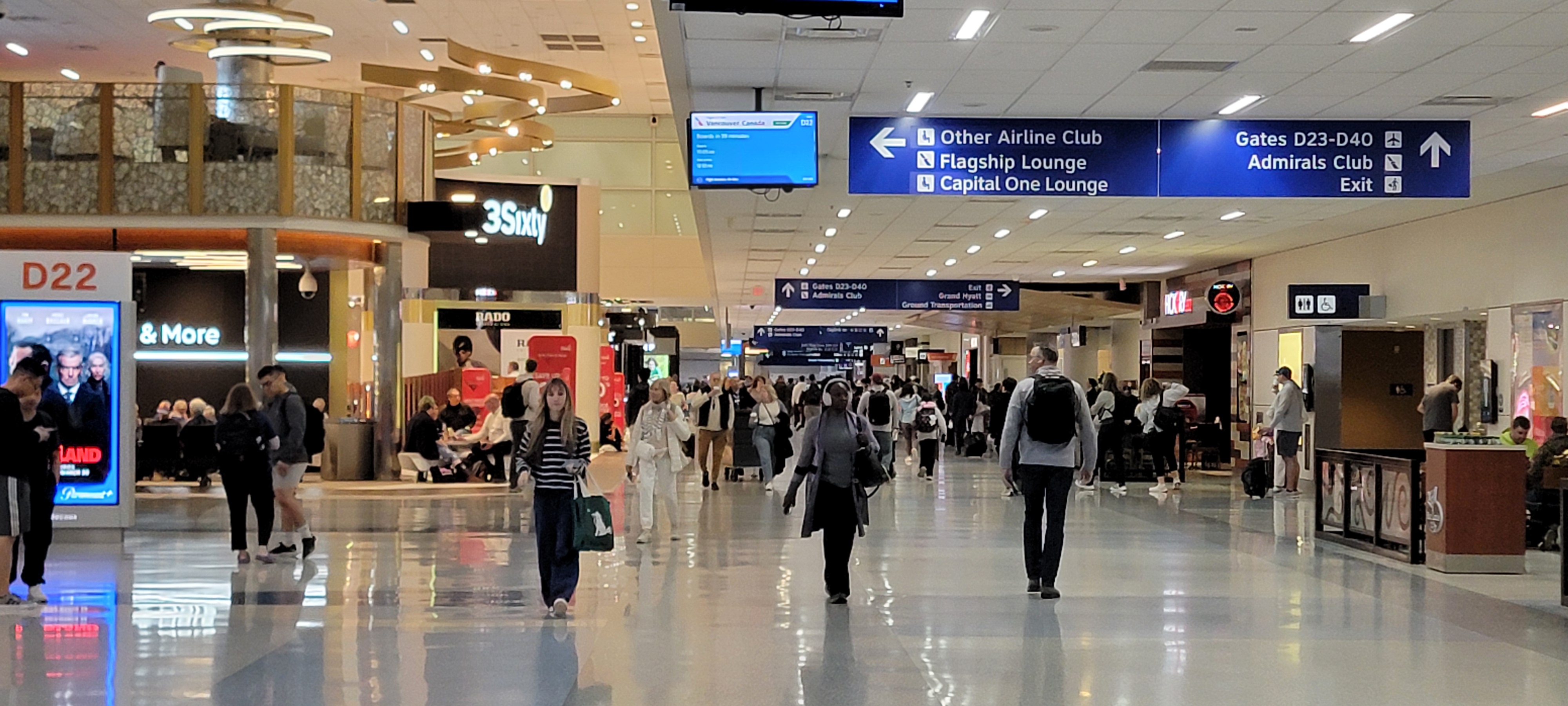
Despite only a few weeks of data, Moses reported that American is performing better on missed bags than ever before, and has improved on-time departure and arrival performance. Net-promoter socres are up 22%, missed connections down 50%, and customers are reacting positively to reduced rush.
It is not often that we set records. I know. We will start with that.
I am going to talk a little bit about 13 banks, but first, to Robert’s point about the record, we wanted to mention that yesterday the DFW hub set an MBR [missed bag report] record, our best in the history of the DFW hub. That number actually started with a three, so the team is incredibly proud. It gets even better, because yesterday American Airlines also set our best MBR record. That speaks to the outsized impact DFW has on our network. A big thanks to the entire team for delivering that.
As Anne mentioned, we transitioned into this reimagined flight schedule at DFW 17 days ago. The early results have been really promising. We know they are early results, but we are incredibly encouraged by what we are seeing. I want to thank many of you in this room and throughout our company who have been working cross-departmentally for quite some time to bring this reimagined DFW schedule to life. It did not happen overnight.
What is this new bank structure? We have transitioned into a 13-bank structure. For the past decade at DFW, we have run a nine-bank structure. For those not familiar with what a bank is, think of a bank as a rush hour. At DFW, we had nine really big rush hours throughout the day. Now we have 13 rush hours. You may be thinking: Jim, you went from nine to 13. Why is that better?
…How is nine to 13 good? We have flattened out those rush hours. I mentioned nine really peaked rush hours. Now we have 13 rush hours that are flattened out. Early results show that this flatter schedule is better for our customers, team members, bags, and connections.
As I mentioned, DFW has an outsized impact on our network. The team works really hard to support that. Every day, more customers, more bags, and more crew members go through DFW than any other location or hub we have. It is important that we get DFW right.
While I will talk about some of the early stats we are seeing, what is really important is what we are hearing from team members and customers. Early comments and feedback have been really positive, whether from our hub-control center about how we gate aircraft; from team members working in our terminals; from customer-service agents, CSMs, or fleet-service agents. The feedback has said: now we are able to deliver like we have wanted to deliver. We do not see the same rushing in the terminals that we saw in the past.
Last week, one of our 737 captains stopped me in the terminal and said, “Jim, we are getting into the gate quicker at DFW. What happened? We are not taxiing as much as we have in the past. We are saving taxi time. We are noticing a difference at DFW.”
A customer also stopped me around day four. I thought he was going to ask where his connecting gate was. Instead, he said, “You work here, don’t you?” I said, “I do,” and that can always lead somewhere. He said, “I am an Executive Platinum. You and your team are getting it right here. We notice a difference.”
We still have a lot of work ahead of us and a lot more to do. But we are seeing better on-time departures and better arrival performance. We have seen a 22% increase in NPS over this period compared with where we were. That is the work of our team and the result of setting the team up for success.
Misconnecting customers over DFW have decreased by 50% compared with the same period last year. We are on track to have our lowest misconnect rate in years at DFW this April. We have to keep that going.
We have also had six of our best-ever mishandled bag rate days at DFW since April 7, when the new schedule went into place. The team has done a fantastic job.If you fly in and out of DFW, you have probably noticed construction. There is a lot of construction, but we are also investing in DFW. The roadways as you enter and exit International Parkway are under construction, and that will wrap up for World Cup very soon.
We are excited about Terminal C and reimagining Terminal C. We opened the first two gates in the Terminal C pier a few weeks ago, and the rest of the Terminal C pier will open in early June. Later this year, in the fall, we will open the Terminal A pier. That A pier will allow us to start growing DFW. Not far behind that, late next spring, we will open phase one of Terminal F at DFW, which is going
to be an incredible facility.
CEO Robert Isom added, “A lot of people are going to ask why we did not do this earlier. As you grow a hub, you think of different ways to produce revenue and improve the customer experience. We are going to grow DFW to be the largest single-carrier hub in the world. When Terminal F opens, we will have the capacity to run 1,100 flights. It is really important that we get this right.”
So why not earlier? They were focused more on cost than revenue. And while they emphasized running a strong operation, they didn’t invest properly in delivering it. That strategy changed – they’ve been more willing to invest, as seen in the much-improved vision for new terminal F in Dallas, the investments they’re making in Miami, and a new slate of clubs. They still need a widebody aircraft order, so they haven’t quite gone all-in on capital spending, but they’ve turned around their approach.
Some of this improvement at DFW may not be sustainable through summer thunderstorms, summer schedule growth, and construction across terminal C and F. But it should set them up for better performance through these challenges than they’d otherwise experience.



they didn’t rebuild the DFW hub earlier because they weren’t willing to admit what they were doing wasn’t working which is typical of how AA has been operated for at least a decade.
But they have fixed it and it will yield results and DFW will be a much better hub.
While operational improvements at DFW (or anywhere) are good, reliability has been an issue, generally and industry-wide.
Incessantly scapegoating the ‘weather’ (or the FAA or ATC, which, yes, should be properly staffed and funded, but isn’t the primary issue) just isn’t cutting it anymore, when airlines prioritize profits over follow-through by over-scheduling, under-staffing, and/or failing to properly maintain aircraft. Customers pay a premium for specific flights, routes, dates, times, etc. When you can’t deliver, it’s more than just a mere inconvenience.
If we actually had an EU/UK-261 (or Canada’s APPR) equivalent in the US, watch as excessive delays and cancellations reduce, because the proper incentives would be there to avoid having to compensate passengers for operational failures. That enhanced reliability leads to greater efficiency, consumer confidence, and ultimately greater profits for these companies. There is a business case to be had for such rules, and it can make us all better.
So, yeah, kudos to American for its voluntary fix, but there’s a lot more we can do here…
@1990 You keep babbling about EU261 but you seem to be clueless to the fact that weather, ATC holds, and airport flow would all be exempt as they are not considered within the control of the airline. If the tower tells a pilot to hold short of a gate because of congestion that’s not something the airline can directly control.
Heavily banked hubs came from the US Air days but were designed and operated with a much smaller CLT and PHX. They do not work for huge, high traffic hubs like DFW, ORD and now what CLT has become. It puts too much traffic into tight spaces all at once. PMAA debanked hubs to improve connectivity and reduce misconnects. People act like hanging out in an airport for an hour is some kind of torture from hell.
Good on AA and particularly Moses for seeing this through. There’s something particularly distasteful about an airline selling itineraries with unreasonable connection times, then routinely dealing with missed connections and the problems which cascade with it.
It’d be nice if they could do the same at CLT. I don’t know if they still have the 25 min MCT there or not, but it’s a beast to attempt to deal with, and if you’ve got a leg to/from an Eagle-only outstation, there’s often not many good alternative options.
DFW is an amazing hub and an AA jewel in the network designed prior to the onset of deregulation. Proudly it’s in Texas too, and functions well unless_ _ _ _ _ _ (just fill in the blank). Fortunately the hub functions year round 4 out of 5 times quite well is the norm I find. Not at all bad for such a large focus for connection across our nation. I give credit to all who operate it and make this place work logistically.
@ Tim — You absolutely can’t stand it when any airline other than Delta improves. Well, how about the chiseling away of Diamond benefits — reducing the value of the AMEX credit, no more free Clear. What next? Good for AA finally improving something. Maybe Delta should try it.
“A lot of people are going to ask why we did not do this earlier.”
No, we’re asking why did you bank the way you did when it was clear from the LAA days it couldn’t be done.
Gene, the facade is cracking on Georgia Klan Air, their ‘hometown’ paper has a good article today on the chaos.
As an ExecPlat I am thrilled to see AA improve. More to go but baby steps finally.
@George Romey — C’mon, I explicitly referenced that above (“Incessantly scapegoating the ‘weather’ (or the FAA or ATC…”) Just because an airline blames the weather, it doesn’t mean that it is the actual reason or a valid reason. In those jurisdictions, EU261, for instance, the burden is on the airline, not the passenger, to prove that the defense of ‘extraordinary circumstances’ is valid. So, with weather, should it only be weather at origin/destination? Weather on-route? Weather at the origin of the inbound aircraft? Is it mere ‘rain’ anywhere? Who determines the ‘severity’ of ‘weather’ within that context? It’s far more nuanced than you suggest. It also should be further streamlined. Passengers should be compensated when these delays and cancellations are under the airlines’ control. Currently, in the US, we have no such protections. That’s the shame.
@George Romey — Nice strawman: “If the tower tells a pilot to hold short of a gate because of congestion”… that doesn’t sound like a ‘significant’ delay. As with these rules, we’re talking about 2-3+ hours of delays at a minimum. Mere congestion rarely if ever would cause that. C’mon, man…
@ Jim LeJeune — Interesting article. Tim is likely having a nervous breakdown as his dear Delta falls from grace.
“It is not the critic who counts: not the man who points out how the strong man stumbles or where the doer of deeds could have done better. The credit belongs to the man who is actually in the arena, whose face is marred by dust and sweat and blood, who strives valiantly, who errs and comes up short again and again, because there is no effort without error or shortcoming, but who knows the great enthusiasms, the great devotions, who spends himself in a worthy cause; who, at the best, knows, in the end, the triumph of high achievement, and who, at the worst, if he fails, at least he fails while daring greatly, so that his place shall never be with those cold and timid souls who knew neither victory nor defeat.”. — Theodore Roosevelt
@DesertGhost — “And you’ve been CEO of…” (Oh, nice Teddy quote.) *wink*
For those speaking about the 261 rule, “sleepy Joe’s” administration actually put protections in place for airline passengers. Then, the Trump administration removed the protection. Yes, your do no wrong MAGAT president screwed the blind followers once again! How are these gas prices holding up for everyone? How about inflation? What other promises were made that y’all were screwed over on?
Someone should tell AA management about rolling hubs.
@You got T-R-U-M-P-E-D — I recall, vividly. It was a last-minute thing. Should’ve implemented sooner. Should’ve attached to the grants/bailouts during the pandemic, along with other worker and consumer protections. The reality is that for lasting improvements, we actually need Congress to legislate it, for once. This isn’t a DOT/FAA rule or Executive Order fix. Oil prices are up; shortages are coming. The stock market is irrational. Thanks for your attention to this matter.
Gene,
you have some serious scratching on that lens that you read through.
Nowhere did I criticize AA for fixing its DFW other schedules other than saying they should have done it earlier – but that has been true about a whole lot of things at AA.
and it is precisely because DL uses so many fewer regional jets (see Gary’s article about AA’s anniversary plane) that DL’s ATL hub is nowhere close to being challenged in number of passengers carried by what AA does at DFW.
Seriously, Tim. Let’s take a poll.
no poll is necessary.
You have scratches on your eyeballs