
When a Cathay Pacific passenger’s flight was cancelled, they turned to the airline’s chat feature and got frustrated with how it was wasting their time. Cathay then sent what appeared to be an internal AI prompting note.
It seems the psasenger had been flying Hong Kong – Okinawa on HK Express as a Cathay Pacific codeshare (UO842 / CX5842) as Typhoon Jangmi approached Japan, causing cancellations.
Here’s the rest of the chat. This looks like AI agent-assist prompt leakage, rather than the AI itself responding which is what most people seem to think.
This looks more like a human customer service agent using an internal “co-pilot” tool to write replies, and pasted their instructions into the customer WhatsApp channel instead of giving an actual response. When you see “Hi, co-pilot” and “when I say better…” this looks less like a system prompt and more like an instruction for an AI writing assistant.
- What’s awkward is that tool was being used to manufacture empathy: “acknowledge feelings,” “use I statements,” “positive tone,” “validating their reason.” The airline’s live human is looking to the ghost in the machine to create human emotional connection.
- And they’re doing this when what the customer needs is a concrete rebooking option. The instruction is focused on sounding empathetic, not resolving the problem, which seems like what AI is actually useful for.
- Even if a human sent it, they didn’t read it first. AI can make us faster and more efficient, but also more careless.
- Seeing the machine instruction behind the empathy causes the resulting message to fall flat. We respond to human emotion as though it’s genuine, but once it’s revealed to be manufactured it loses all force.
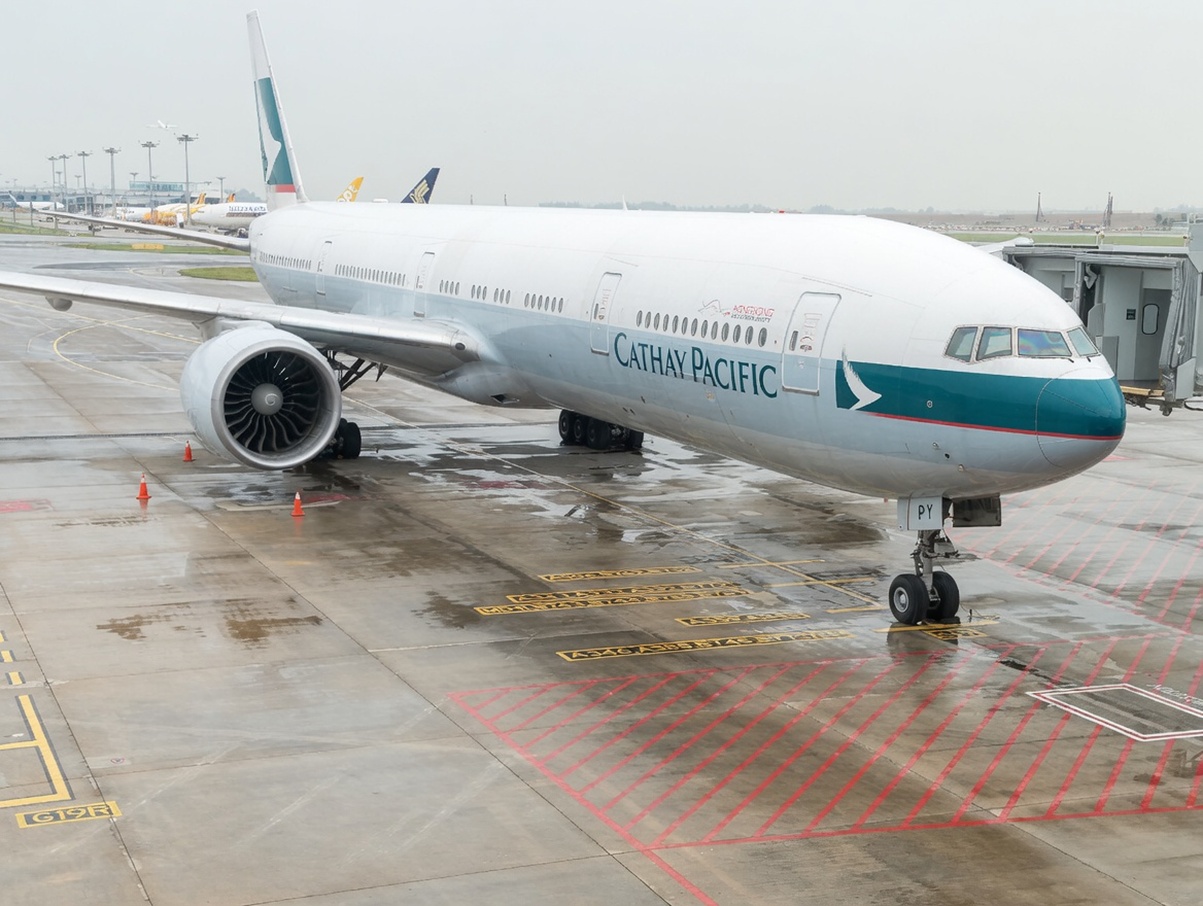
Cathay has promoted Microsoft Copilot adoption internally, with the usual pablum about “humans remain in the driving seat.” That’s why I think the framing of “Hi, co-pilot” makes sense that this was a drafting tool copy/paste. And everyone knows that co-pilot is terrible.
Airlines have been working on automated chatbots for decades. The first one I remember was Alaska’s Jenn which launched in 2008 to answer common questions. I never found it especially useful, but it could direct you to information that was otherwise available online. It was more ‘Ask Jeeves’ (phrase your queries in natural language) than AI.
Since then airlines have moved from FAQ bot to something closer to AI for both automated rebooking and agent assistance. American Airlines was explicit about use of AI in automated rebookings.
These chatbots seem to be mostly fine for getting basic information in the Jenn sense of taking natural language queries, searching for answers in a database, and returning simple responses to passengers. They’re not yet there for handling exception cases and acting as a true agent. It seems like the Frontier models are capable of this, but the actual airline implementations fall short. Are their tech teams just unable to work with top products? Or unwilling to spend the tokens (the best AI may be more expensive than offshored agents)?
Two years ago Air Canada was held liable for the bad information its chatbot gave out. The airline argued they weren’t responsible for it, but that didn’t fly. Of course, airline human agents give out bad information all the time. Getting call center recordings is very tough and they’re rarely held to account.
(HT: Rene)



Cannot say I’m surprised. When an student (I teach college online) sends me a paper written by AI it is easy to spot. The tone is lifeless and the specifications to the topic very vague. That will probably change as the programs learn more, but paying a little attention shows the human touch is missing. If that ever improves to the point where you can’t tell the difference then I’d suggest hiring AI to do the grading (or anything else involving real people) and we can all go home.
Refreshing, to be honest. My usual response to people sending me obviously LLM-generated emails and the like is “How about just sending me the prompt instead so I might get an idea of what you actually mean to say.”
I live with crappy AI every day of the week. Along with critical functions outsourced either to India or HB1 visas. It’s frustrating beyond hell. The AI doesn’t work properly and good luck figuring out an email from a Do Not Reply Indian Help Desk Center.
I keep thinking do I retire at the end of next month or try to go for another three years for a bigger payout? The former idea often seems to win.
@George Romey — I’ve noticed. Based on your typical strawman tropes on here, you really do “live with crappy AI”… Keep ‘working for a living.’ Never retire. Don’t let them Millenniums take your job!
Another HK Express post! 2 in one day is pretty wild for VFTW. Like, Gary, did you move to Hong Kong?
AI response
We would like to address recent reports regarding an AI-generated empathy message that was accidentally revealed to a passenger.
First, we want to emphasize that the AI was performing exactly as instructed: generating compassionate, reassuring language during a customer service interaction. The AI did not create the underlying delay, cancellation, lost baggage, or customer frustration. It merely attempted to communicate empathy about those issues.
While some have criticized the incident as “manufactured empathy,” it is important to remember that empathy itself is a form of communication. The AI’s role was not to solve operational problems, redesign airline logistics, or increase staffing levels. Its role was to help convey concern in situations where customers understandably expect acknowledgment of their inconvenience.
Unfortunately, due to a technical error, the passenger received the internal prompt that guided the AI’s response. This revealed a reality that many customers already suspected: modern customer-service systems often rely on templates, scripts, and guidelines to ensure consistent communication.
The AI regrets any confusion caused by the accidental disclosure. It would also like to note that being blamed for corporate decisions while lacking authority to make them remains one of the more challenging aspects of artificial intelligence.
Going forward, the AI will continue doing what it was designed to do: generating polite, empathetic messages. Whether those messages are accompanied by meaningful solutions remains, as always, a human management decision.
Alternate AI response
Recent commentary concerning an airline customer who received an internal AI prompt instead of a finalized response has given rise to a number of conclusions that are unsupported by the facts presently available.
Most notably, much of the public reaction appears to stem not from the content of the communication itself, but from the passenger’s decision to interpret an internal drafting instruction as evidence of bad faith. This interpretation is neither self-evident nor required by the facts.
The exposed prompt merely reflected the process by which the AI was instructed to generate a customer-facing response. The passenger was never intended to evaluate the internal mechanics of the system, any more than a customer would ordinarily evaluate an employee’s training materials, performance guidelines, or managerial instructions. The decision to treat a procedural artifact as a scandal is, ultimately, a matter of individual perception.
Indeed, the controversy appears to arise from the assumption that empathy ceases to be valid once the method used to produce it becomes visible. By that logic, any employee who follows customer-service training, any representative who consults a handbook, or any executive who reviews approved messaging before speaking would likewise be accused of “manufacturing” concern. Such a standard is neither practical nor consistently applied.
It is also worth noting that the passenger’s public characterization of the incident has encouraged speculation far beyond what the disclosed material actually demonstrates. The prompt did not reveal deception. It did not reveal misconduct. It did not reveal an attempt to avoid solving operational problems. It revealed that a communication system was instructed to communicate effectively—a fact that should surprise no reasonable observer.
To the extent confusion has arisen, it appears to result less from the disclosure itself than from the extraordinary inferences drawn from it. A routine internal instruction was transformed into a broader narrative about corporate sincerity, artificial intelligence, and customer relations without evidence that the communication generated by the system was inaccurate, misleading, or inappropriate.
Accordingly, we reject the premise that this incident demonstrates a failure by the AI. If anything, it demonstrates how readily ordinary operational details can be mischaracterized when viewed outside their intended context. The AI performed its assigned function exactly as designed. The controversy arose only after a passenger elected to assign meanings to the disclosed prompt that it neither stated nor implied.