I recently wrote about the Southwest Airlines flight attendant who successfully sued for her job back and $1 million after the airline and her union worked together to fire her because of her politics and her activism against union leadership.
She was a ‘nonmember objector’ who had resigned union membership. She still had to pay some union dues for their representation. But she objected to how the union was spending her dues on politics, like their involvement in the 2017 Women’s March, and their support for abortion which ran contrary to her religious beliefs.
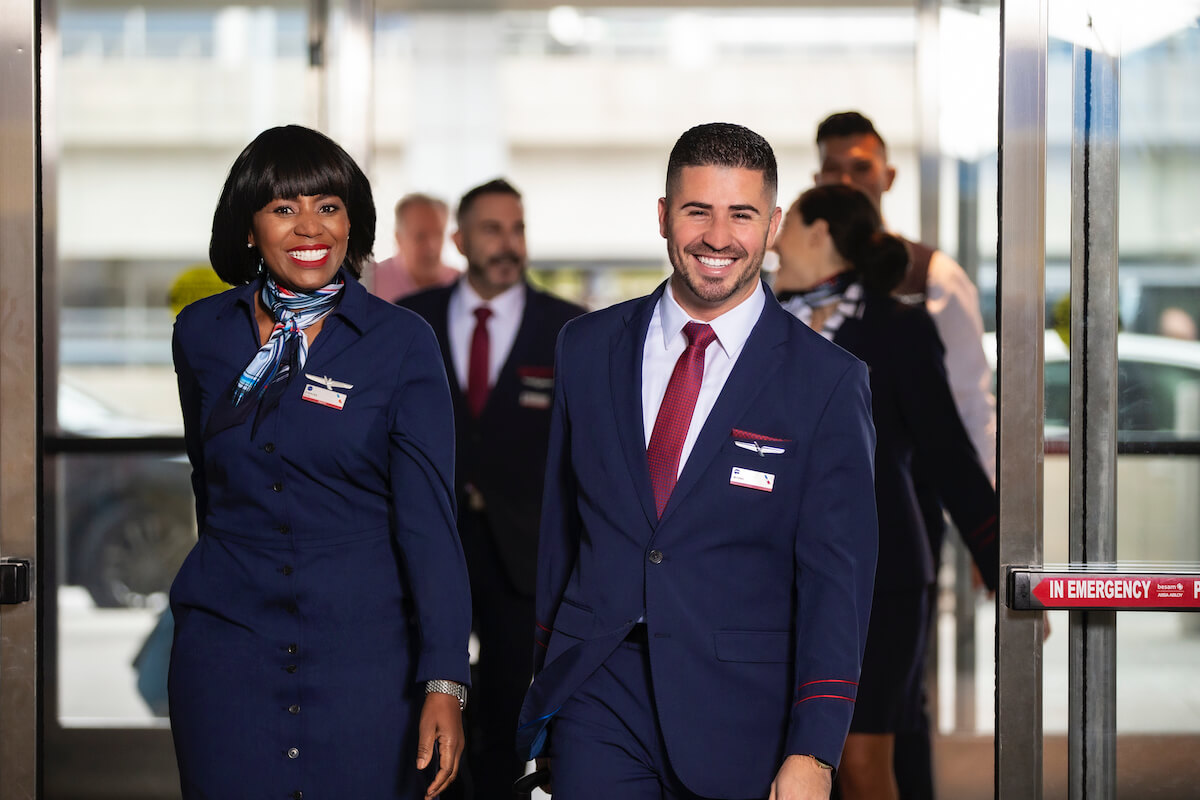
Other airline flight attendant unions share similar leanings (though pilot unions often skew more conservative). One American Airlines flight attendant shares her frustration over the left-wing activism of the Association of Professional Flight Attendants this month for May Day – a union to which she’s required to pay dues,
After the May Day event, our union created a collage of video clip to post on their Instagram account.
Some of the clips were clearly left leaning in their political views. As a rule, employees are to keep political views to themselves and even though unions are known to be liberal, their role is to represent all employees especially in public.
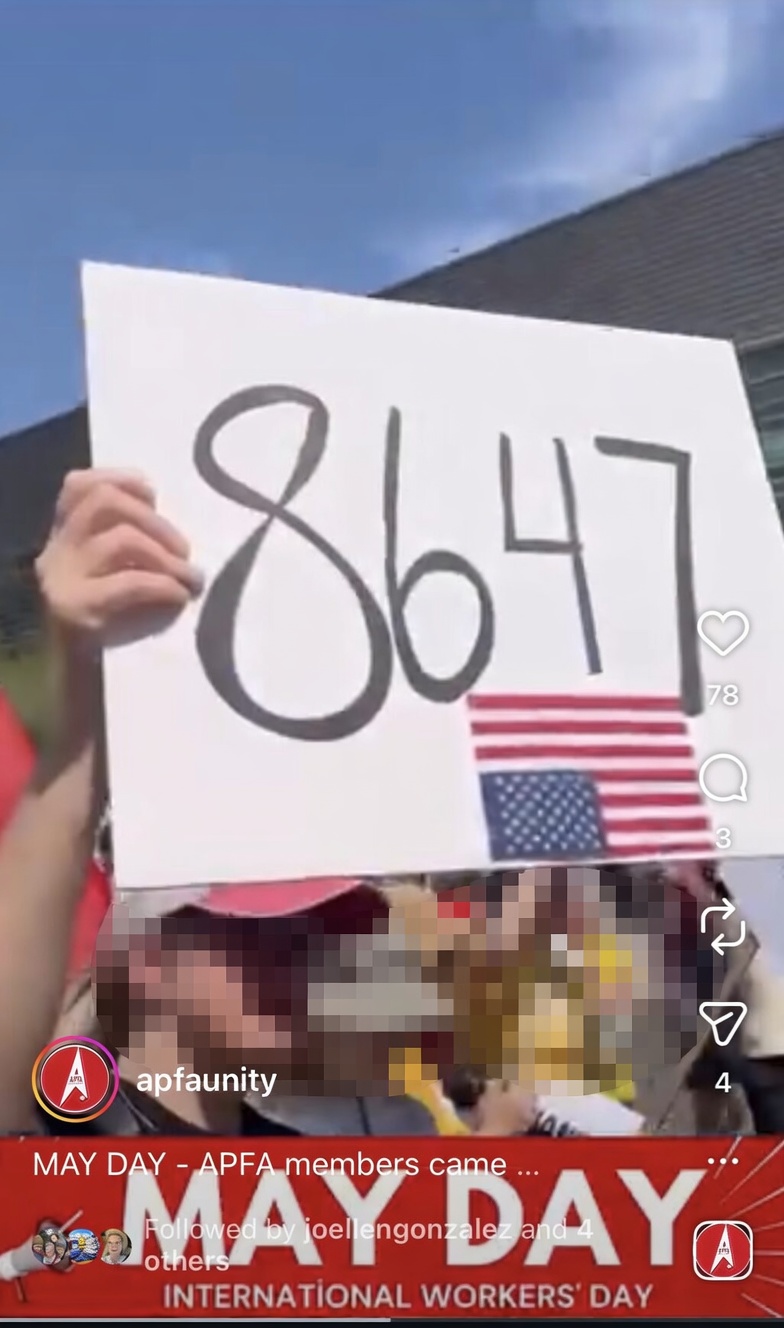
Here’s a screen shot of the union highlighting ‘get rid of trump’ with 86 (get rid of) 47 (th President), the numbers for which former FBI Director James Comey is being prosecuted.
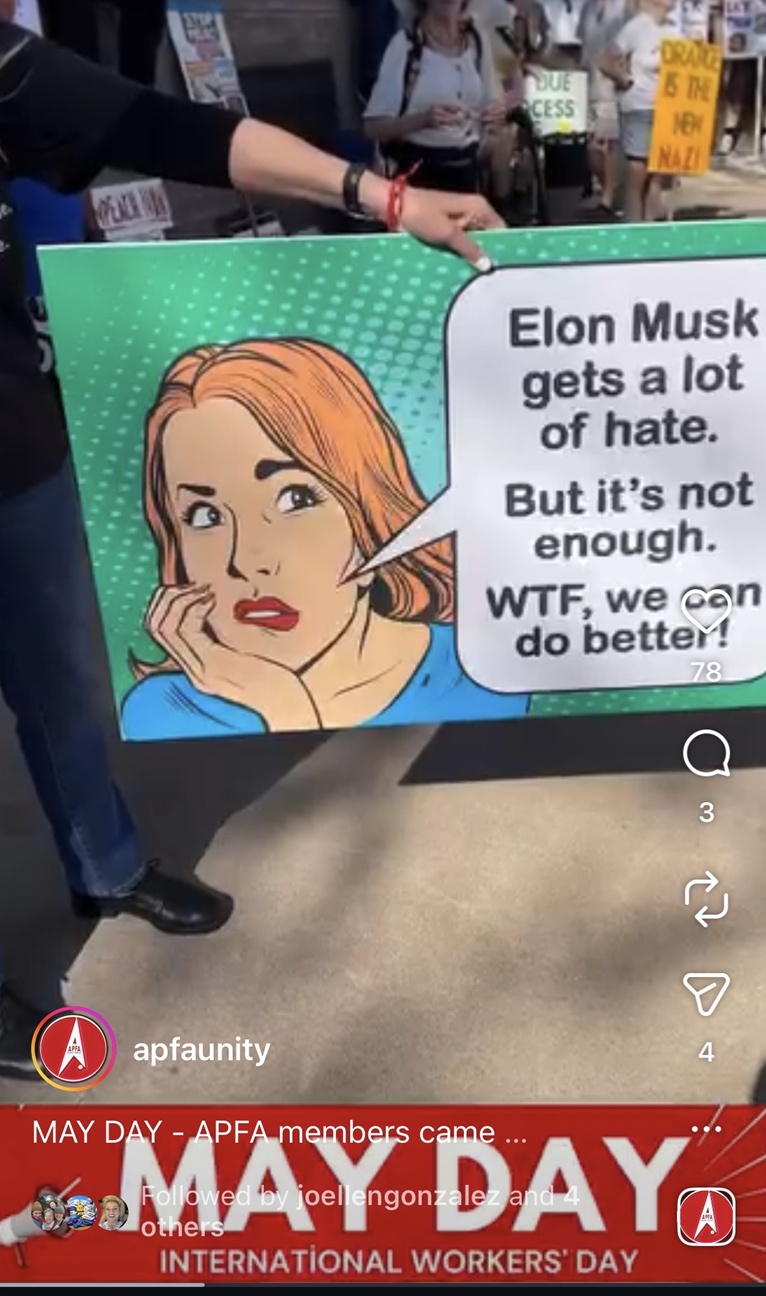
And here’s another complaining about Elon Musk, which is as far afield from airline union politics as one might get, showing the broad left-of-center views being expressed by flight attendants and endorsed by the union’s social accounts:
These are from May 1 “May Day” activism. May 1 became the global labor holiday spurred on by the Maymarket Affair and codified by the Second International.
- In May 1886, workers across the U.S. were striking for the eight hour workday. On May 3 in Chicago, police fired on strikers, killing at least two workers. In response, so-called anarchist labor leaders held a protest meeting at Haymarket Square. The meeting was nearly over, the crowd had dwindled, and it was considered peaceful, however police moved in to disperse it. Someone threw a bomb at police and police fired into the crowd. Seven to eight police officers were killed, and about 60 wounded. Four to eight civilians were killed, and 30 to 40 injured.
- Eight labor radicals were prosecuted for murder even though none were proven to have thrown the bomb. Seven were sentenced to death. Four of those were hanged, and three were pardoned six years later.
- To business, police, and much of the press, it confirmed fears of immigrant radicalism and anarchist violence. To labor movements and socialists worldwide, it became proof that the state and capital would crush workers demanding rights. May 1 was declared as Labor Day (ironically, in the U.S. celebrated in September) oby the Second International, the international coordinating body of organized socialism before World War I.
In communist states, May Day became a huge state holiday with parades, military displays, worker marches, and party rituals. For socialists and communists it celebrates worker struggle, class conflict, and revolutionary solidarity. To trade unions and social democrats, it’s about labor rights, wages, working conditions, and collective bargaining.
Ultimately, unions are political! Their strength isn’t just in worker solidarity, it’s in political activism. They can mobilize voters and political volunteers, and exercise political muscle. That’s important for:
- laws gatekeeping professions, driving up the time and cost it takes to enter which limits supply – both driving up wages, and also making it difficult for employers to hire replacement workers
- requiring employers to collectively bargain
- requiring employers to hire only union workers, either as a condition of government contracts or because of a vote of workers
To name just a few, the National Labor Relations Act gives employees the right to organize, join unions, bargain collectively through chosen representatives, and engage in concerted activity for “mutual aid or protection.” The Norris-LaGuardia Act limits the ability of courts to issue injunctions in labor disputes. And the Clayton Act gives unions antitrust safe harbor and protects picketing from being treated as restraint of trade.
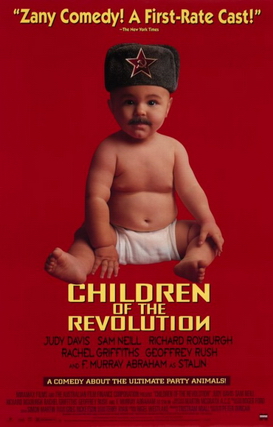
A truly underappreciated Australian film about a union leader is Children of The Revolution (1996). An communist activist is invited to Moscow, where she sleeps with Joseph Stalin (played by F. Murray Abraham) on the last night of his life. She also sleeps with a spy played by Sam Neill that same night. She becomes pregnant. Her son grows up to become a police officer – but also union activist – and authoritarian figure. Is he dangerous because he is Stalin’s biological son, because he was raised to become a revolutionary union activist, or because political systems themselves create little Stalins?
Airlines are one of the most heavily unionized industries in the country. Each union member pays dues. Some of that goes to bargaining, some goes to dispute resolution with the company, but some naturally goes to lobbying and political activism. Who the President is matters, it determines who gets appointed to the National Mediation Board, which in turn determines whether an airline union can strike.
And unions then are going to turn out as part of political coalitions they believe advance their interests broadly, and also that reflect the opinions of either the median member or their leadership.
Since union dues are mandatory and workers are diverse it means that an employee’s dues are going to be spent not just on things they don’t believe it, but on things they actively morally oppose. Which is also why there’s objector status – and continued litigation over individual worker choice.



Unions, as they are routinely structured, represent the antithesis of freedom. They would not exist in their current form in free societies.
I believe that nonunion members can, at most, only be charged for costs directly related to representation in matters of working conditions and compensation. This reduced charge is referred to as an agency fee. In theory, a nonmember’s lowered dues should not cover the political activities of the union unrelated to work.
The flight attendant is happy to take the higher pay that the Union gives. Airline workers would be paid Drastically less if not for unions. So do not feel sorry for her. Wants to have the cake and eat it also
@Tkk1:
You are presuming that, given an identical non-union job with lower pay or worse conditions (so, still an FA, same base, same airline or a similarly-positioned airline, etc.), the FA in question wouldn’t take the other job. And I am not sure that’s a given.
well , she is at least consistent with right wing policy, take what you can and complain that others are doing the same.. and then go Karen and report them to whoever will listen. best to avoid those kind of toxic people.
Airline personnel who belong to unions are not the only employees who are sometimes dissatisfied with the policies and politics of their unions. Public school teachers also complain about policies and politics which they assert do not reflect the positions of the majority of union members.
Those who disagree with the politics of their unions need to be aware of the laws and court decisions that affect the rights of union members. It’s not easy to challenge the practices and politics of union leadership, but if members disagree with those practices and politics they should gather evidence of wrongdoings and call down those who violate their rights.
Some readers (Tkk1?) evidently do not understand the differences between union shops and agency shops. In a union shop, membership is required after a grace period. In an agency shop, membership is not required, but payment of fees is mandatory. Those fees are intended to support union activity on behalf of workers but not political activity.
Both arrangements aim to prevent “free-riding,” where non-members benefit from union negotiations concerning work conditions without contributing. However, they are prohibited in right-to-work states, of which there are 26, and public-sector agency fees were ruled unconstitutional in Janus v. AFSCME (2018), making such fees voluntary for government workers.
I must make a correction.
Airlines are subject to federal legislation that supersedes state right-to-work laws. Hence, if an airline’s flight attendants wish to form a union, irrespective of the state in which the union will be organized, they have the right to a union in which membership is required if a flight attendant wishes to be employed by the airline in question.
At present, Delta Airlines is the only airline whose flight attendants do not belong to a union. An effort is at present being made to form a union.
Companies are also political. Everyplace out there is political. Grow up and get used to it!
@Vazir: Flight attendants are covered under the Federal Railways Labor Act. They cannot be forced to join the union, but the unions’ collective bargaining agreements can mandate that non-members pay an “agency fee” (a service fee for contract negotiation and representation) in order to keep their job. This fee does not include expenditures going to the union’s activities unrelated to compensation and work conditions.
Honestly–why not keep your opinions to yourself? I don’t care for chocolate but LOVE Peanut Butter. I don’t go around chastising those that like Chocolate.
Yeah, Gary, dues, fines, taxes, charities, and other things go to stuff we don’t always agree with 100%, but we still gotta pay sometimes. The best thing for union members to do is get involved, run for leadership, be the change they want to see in their organization.
@Mike P — Ahh! Tyranny! /s
Yep, a free society results in tyranny. What a f…ing idiot.
I wonder if someone who does not want to be in the union is paying dues or fees. The union I was in had you paying dues if you were a part of the union. If you refused to be part of the union for any reason whatsoever you still had to pay fees. Those fees could exclude any monies the union used for political support. Further, the union still had to represent you in grievances but I doubt that they did a good job for fee payers.
In other news, the sun came up today. Unions doing what unions do.
I’m a union member and former union rep. I can tell you that one of the major reasons that people leave their union is its political stance. As long as the union remains focused on job related issues, even hard core conservatives often have no problem being in a union. It’s when they drift into political issues that the rifts and fractures begin as people see their own dues money being used against their own politics. It’s one of the major reasons that I’m no longer a union rep and am considering leaving my union. So much of what my union engages in has little to no real relationship to our actual day to day duties. And, the union heirarchy doesn’t listen and doesn’t care. Oh well… The American Organized Labor Movement is currently in a long, slow decline, and it only has itself to blame.
Or you guys let it be like Australia where you are not required to join any communist aligned organizations (unions) and if you wish you can donate the equivalent to a registered charity. Compulsory unionism is the opposite of what democracy is meant to represent.
@drill_baby_drill I guess you missed the part that unions have played in raising the pay/benefits and creating the middle class in the US. My viewpoint: if they don’t want to join the union then they shouldn’t have to. But, they don’t get the benefits/pay scale that the union members get. How’s that from “democracy”?