
Commentators in the U.K. are blaming climate activists for the declining value of British Airways frequent flyer miles.
- BA has long been an ‘expensive’ program for redeeming awards
- They raised both points prices and cash surcharges in December
- And they raised surcharges again in May

But this isn’t because of environmental pressure, though there’s the silly notion that frequent flyers are to blame for climate change. The U.K.’s Climate Change Commission supports “bans on ‘air miles’ rewards” because they saw it as one of several “easy levers to implement” but insufficient on its own, concluding that “restrictions on ‘air miles’ rewards may be useful for supplementing other policy but would likely have limited impact alone.”
The truth is that IAG Loyalty doesn’t see this as a threat. And they are devaluing because the think it’s good for their bottom line. There were 200 billion Avios collected in 2025 with 20% profit growth, and they just announced a plan this past week to grow to £1 billion profit for the loyalty program.
The climate claims against loyalty programs are reductionist and broadly speaking fallacious. U.K. media has literally blamed me for climate change arguing that
- frequent flyer programs incentivize more flying, unnecessary flights, and premium cabin travel (a plane with business class seats carries fewer passengers per emission count than a densely packed one).
- people who fly a lot have higher carbon footprints.
- and I encourage this.
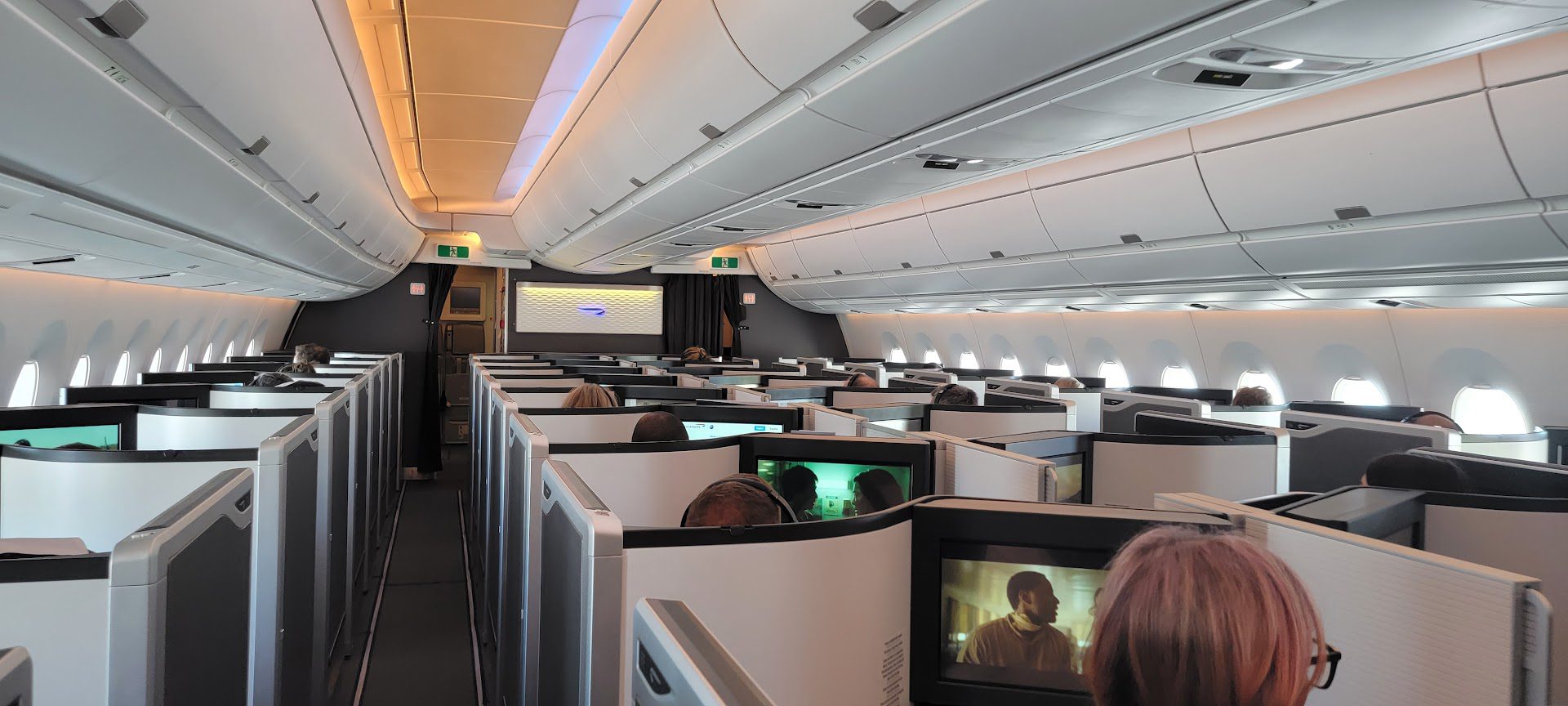
The piece focused on mileage running, which is far less relevant than it used to be, and status can increasingly be earned through non-flying activity. Saver awards and cheap fares often fill seats that would have flown anyway. It’s full fare business travel that’s much more likely to drive incremental air service. Deals exist precisely because seats are flying anyway and going unsold, and the better the deal you get the less likely you are to have a marginal climate impact.
Regardless, this is all performative. Each European country’s air traffic control protectionism causes inefficient routings and extra flying that increases fuel burn 9% – 11%. This is an easy policy fix, but one that’s politically hard because of local union opposition. Blaming flyers completely misses the real unnecessary carbon generation. And until they get together on a Single European Sky, everything else in Europe is just window dressing.
The approach, though, is ‘so European’. De-industrialization is leaving Europe dependent on the United States and some countries elsewhere dependent on China). It’s not that there’s less industrialization, just less of it in Europe. They don’t have sufficient energy for current needs let alone for independence in AI.
The real solution to what’s a real challennge in climate has to be technological – new energy sources (certainly not today’s biofuels which are a boondoggle) and carbon extraction, as well as making travel more emissions-efficient (commercial air travel is about 2% of emissions, perhaps one fourth that of fashion).
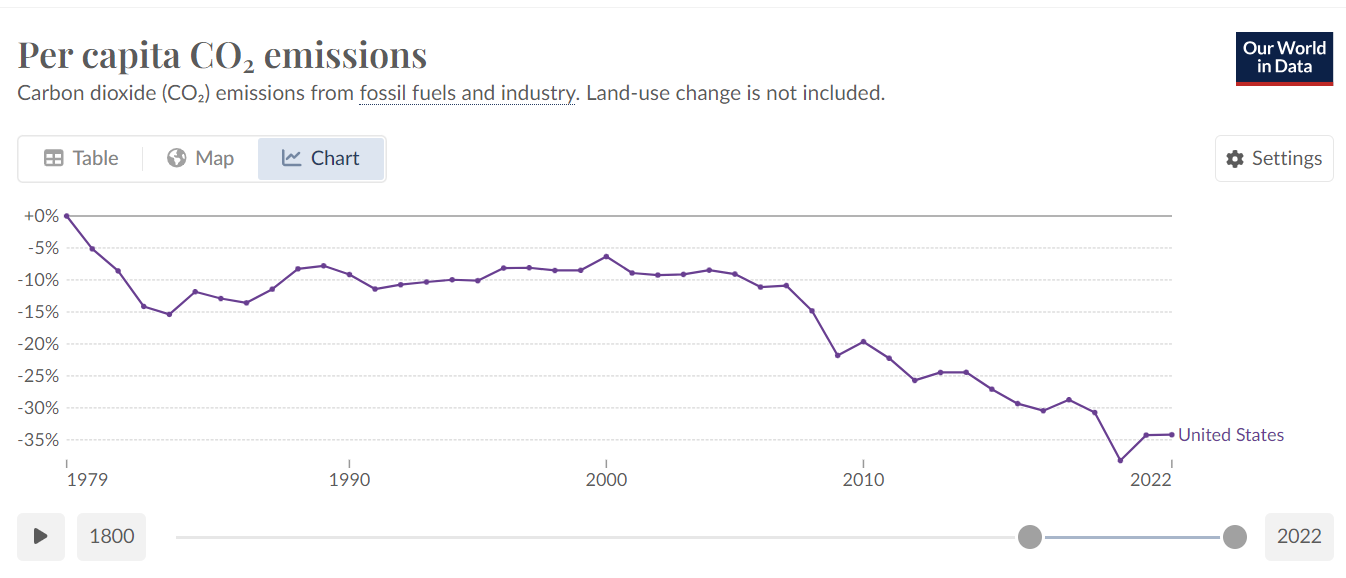
Did you know that per capita CO2 emissions in the United States are back to their 1913 levels? Here’s the relative decline since 1979:
It turns out that just 15% of flying leads to the formation of contrails. Hydrogen-based fuels won’t solve the contrails problem. But a 2,000 foot increase in cruise altitude reduces contrails 62% (a 4,000 foot increase would reduce it by 92%). To approach this, and it isn’t always possible, airlines need better meteorological data for flight planning. American Airlines and Google actually experimented with this and it works,
A group of pilots at American flew 70 test flights over six months while using Google’s AI-based predictions, cross-referenced with Breakthrough Energy’s open-source contrail models, to avoid altitudes that are likely to create contrails. After these test flights, we analyzed satellite imagery and found that the pilots were able to reduce contrails by 54%. This is the first proof point that commercial flights can verifiably avoid contrails and thereby reduce their climate impact.
Or you could be like Delta and just buy fraudulent carbon credits.



Ban All Climate Advisors
Before making rash decisions, I think the elites should fly their private jets to a high-end resort to discuss this.
Oh, please. This is performative nonsense to get clicks (both said commentators and Gary). This is classic corporate capture: airlines love this narrative because it lets them blame ‘climate pressure’ for gutting consumer loyalty programs while hiding massive profit margins behind fake fuel surcharges. We don’t ‘save the planet’ by letting airlines scam consumers.
@Matt — And if the private jets aren’t available, please consider… Delta? (@L737, is it *that* Matt?)
Here’s a hot take if I’ve ever offered one:
If carbon emissions are such an existential threat, European governments should be announcing support for NEVER reopening Hormuz and openly discouraging negotiations to that effect. Yes, I realize there are knock-on effects (particularly in Asia)…but guess where most of the emissions growth in the last few decades has been? Hint: Not Europe.
(It is perhaps a sign that God has a particularly dark sense of humor that the best shot at cramming down global carbon emissions is coming under these circumstances – that a “forever war” that shuts off the Persian Gulf might just be the most expeditious path on this front.)
@Gray — While you’re at it, why not strangle the Strait of Malacca?