
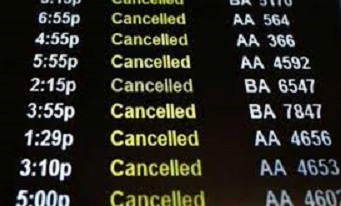
United and American are getting much better at telling passengers the real reasons their flights are delayed. That transparency is useful, but it also exposes a long-running airline habit: blaming weather or air traffic control when it’s actually something within their control – like mechanical issues or available crew – that caused the delay in the first place.
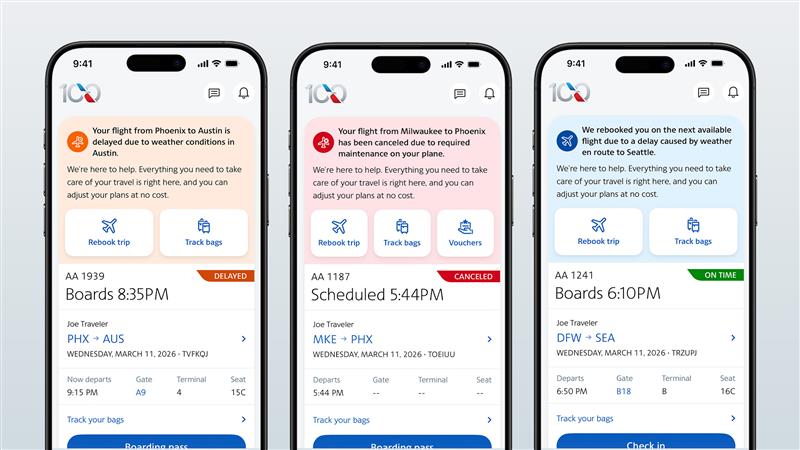
United Airlines has done the most to improve customer communications during delays and is even working to use AI to send out maintenance videos with explainers when a flight is delayed for a mechanical issue. I’ve seen messages from United like,
“We want you to know your flight is departing late because we needed to finish cleaning your plane.”
“…our connecting flight to Bangor was canceled due to a lack of FAA staff.”
“…we care about our customers and are just waiting on a few more people before we can take off…”
American Airlines has moved to using AI for plain language explanations of why flights are delayed as well.
That’s great for customer service, but it’s running headlong into laying bare a long-running strategy of the airlines to lie to customers during delays! Airlines over-classify delays as being due to weather so that they do not have to provide costly assistance to passengers. But they’re also putting in writing the real reasons for delays, and the two come into conflict.
Here’s American Airlines telling a passenger that their flight was delayed for controllable reasons – maintenance – but then blaming the delay on air traffic cotrol, so the passenger gets nothing.
In reality, maintenance delayed the flight and then because it was delayed it ran into a further delay. The delay code that gets the airline off the hook is the one they care about, while passengers understand that witheout the flight going mechanical, that further delay would never have happened.
Super scummy @AmericanAir:
Flight AA 2509 delayed today first for mechanical, then for ATC mismanagement, then cancelled due to weather? There were no weather issues-your crew ran out of hours and you did not want to pay. I have receipts… pic.twitter.com/df83nlxkDz
— Mark Jones (@markkjones) June 7, 2026
Airlines treat weather as a customer service get out of jail free card. Since they are considered to ‘owe customers nothing’ as weather isn’t their fault, they aren’t going to provide overnight lodging in most cases to displaced passengers, or provide meals or put you on another airline. All of those things are expensive.
Here United sent out a messaging saying a delay was mechanical but later claiming weather to avoid compensation. And here mechanical delay changed to weather also.
In 2019, the CEO of American Airlines actually said the quiet part out loud. I reported on internal converstions where Doug Parker explained that so-called ‘weather delays’ were really being caused by mechanical issues. They had too many planes going out of service, and that meant the operation was so much more fragile when weather hit. Many flights cancelled for weather wouldn’t have been cancelled without mechanical issues.


People are greedy. They should NEVER expect anything with travel disruptions. If you are so poor you have to rely on an airline for a hotel or meal you shouldn’t be traveling. I always take care of myself and pay my way. Those that don’t are either poor or just cheap (and some groups are more of this than others).
Enough is enough. We need an EU261 equivalent in the US. Standard compensation for significant delays and cancellations under the airlines control ($250-750, like EU/UK, Canada, do). Burden on the airline (not passengers) to prove its out of their control (actually weather, not just sayin its weather.)
“What caused the delay” is a complicated issue, as there are many moving parts to an airline operation. “Within the airline’s control” is sometimes only one of the factors.
How would these real examples be coded? And, yes, I know – everyone wants to get put up in the Four Seasons, with $100 meal vouchers, every time their $249 ticket from Boston to Tampa cancels. But that’s not realistic. So imagine YOU were in charge at an airline, and how YOU would code these (very realistic) scenarios:
1) A flight gets an FAA-assigned delay due to weather (not in airline’s control) – then the crew will exceed their duty day, and since it’s not at a hub, there’s no replacement crew available, and the flight has to cancel. The final reason the flight cannot go is the crew is illegal to work it – but the 1st reason that cascaded into the cancellation was weather. Should this be called a “weather” issue or not?
2) A specific plane’s rotation (not the crew – just the plane) for the day is DFW – OMA – DFW – CLT – DCA – FLL. Flying back on the second flight (OMA – DFW) thunderstorms in the Dallas area cause a 4-hour delay. The remaining flights cannot go on time, and all of them leave at least 3 hours late – and there isn’t a “spare plane” available. How do those delays get coded? Is it the weather’s fault? Or is the airline’s fault for not having an extra plane, sitting on the ground, with an extra crew, ready to go, to get that subsequent DFW – CLT flight out on-time to keep the rest of the day on time?
3) A flight is going from Seattle to Tampa, with possible thunderstorms in the Tampa area. The crew has planned for enough fuel for the flight, for flying to a required alternate airport, and for about one hour remaining reserve. This only gives them about 15 minutes to “play with” before they’d be forced to go to the alternate. They talk to their company dispatchers, and could add more fuel – up to an hour more of holding time – but because they are planned right at the maximum allowed weights, any added fuel means the same weight in bags or passengers would need to be removed. The crew elects to not add more fuel. Thunderstorms develop over the Tampa airport, just like the forecast predicted, and that prevents the crew from getting in. They cannot hold and wait for them to clear, they divert to Fort Myers, and they time out. If they HAD added the fuel (and kicked off +/- 10 people) they would have gotten in to Tampa after the storms rolled through. Is this a “weather” caused cancellation or something within the airline’s control?
Point being – it’s obviously more complicated that it appears from the outside, looking in. And it’s almost never just “one reason”, even though only “one reason” is what’s often communicated.
Either way, transparency is good. But, clearly, it’s within the airline’s interest to say “The weather did it!” when that was only one part of the cause.
@ 1990: “We need an EU261 equivalent in the US. Standard compensation for significant delays and cancellations under the airlines control ($250-750, like EU/UK, Canada, do).”
I still believe (and I know you don’t) that this would cause unintended consequences and raise fares. We can agree to disagree on that issue of higher fares, and that’s fine.
But be careful what you wish for. At the risk of getting political, the “Affordable Care Act” did nothing to make actual healthcare “affordable” (ask anyone with a basic plan that you pay several hundred dollars a month to get, has a $10k deductible, and once the deductible is met – the plan pays 60% of the costs). Many would argue things got worse – higher costs for lower quality health care.
Point being – the same could happen with some “Passenger Protection Act” that makes things functionally worse instead of better. IOW – if the rules changed in the US, expect them ALL to change. I wouldn’t be a bit surprised if “$250 – $750” got added… but the airlines having to provide the hotels and meals went away as a result. So have fun trying to get your own, competing against all 300 other passengers. Or maybe they throw in the option of a “full refund” into the law – and the LLCs see that it’s cheaper to “refund” your $149 ticket out of the compensation (and cancel your flight!), especially when they know you’d have to buy another way home… while those fares are now higher.
Never underestimate the ability of the market to respond. It always has, and I see no reason it wouldn’t again.
@Pilot Paul: how about a late evening flight with a two hour mechanical delay that then allows weather to roll in and cancel the flight? How about crew member deadheading into work being delayed by weather and leaving their first flight of the rotation short staffed and delayed? I’ve had both these classified as weather related delays by the airline. Allowing the airline to make the call without real time oversight or post hoc audits (with significant penalties for dishonesty) is asking for abuse.
@Gary – Nice piece. What do you suggest when an airline lies about the reason for their delay?
An airline decides its own schedule. No one is forcing it to use the same plane to fly six segments a day. If a crew or mechanical issue delays an early segment enough that later segments then are delayed enough to run into weather, the weather isn’t the cause of the delay. A good test is a “but for” test – but for the weather, would this flight have been on time and successful? If not, the airline should compensate.
Most of us are tired of booking a 3 pm flight in June that is delayed for 90 minutes and then when ready for pushback GOSH Surprise who could have seen the summer thunderstorms rolling in?!! Clear the tarmac for another 60 minutes. Then the wind has shifted so they have to turn the airport around. Meanwhile if your stupid airline had been able to operate a scheduled 3pm flight at 3pm you’d have been fine.
I think we are all aware most of the airlines are running a poor operation from first flight of the day. There isn’t much excuse for a 40 minute delay on a 6 am outstation flight. They can do better but they have no incentive to do so.
@ Mark F
That’s exactly the point. Weather is almost always only ONE part of the delay, not the sole cause. How do you code it? Who does the oversight? How is it monitored?
Let’s call a “Flow Time” (EDCT – “Estimated Departure Clearance Time, issued by ATC) as an “ATC” delay even though it’s almost always issued due to weather problems. So all the other delays – where weather is a factor (one of a few) – should be coded as what? Does it have to be ONLY weather to count? 50% weather? 33% weather?
That’s what I’m trying to bring up. It’s not as easy as saying, “When it’s because of the weather, no compensation… when it isn’t, the airline has to make amends”. Because, as both I and you pointed out – there’s a multitude of reasons, intertwined, into why a flight doesn’t go on time.
How about this – a crew gets mugged on a layover (yes, it happens). Flight has to cancel. Clearly not weather. Is that something that was “in their control” because they don’t have standby pilots, with duty time to spare, sitting in Bakersfield, ready to jump in and take over to keep a flight from hitting the “two hours delayed” limit?
Crews are required to affirmative state (under FAR 117 – the current federal law) that they are “Fit For Duty” to operate a flight. What if the fire alarm goes off in the hotel during the night (yes, that happens too, more than you’d think). Crew doesn’t get any adequate rest, and has to call in “fatigued” and that cancels the flight from Billings, Montana back to Detroit. No “weather” here – is that to be considered “within the airline’s control”?
We seem to agree. It’s complicated. There’s only so much an airline can reasonably control. It sounds easy at first to scream, “Make them pay us when it’s not the weather!” but there’s LOTS more details to airline operations than most think about, and lots more that is out of an airline’s control than just the weather.
And, yes – if an airline can tag “weather” into part of the “delay chain” they clearly do. They are incentivized to do that when they can get away with it, because it obviously saves money. Maybe things SHOULD change – but they don’t always change for the better.
@pilot Paul. Crew and flight staffing is the responsibility of the airline.
A flat tire on the way to a job interview might not be my fault but I have to pay the price I miss the interview. I don’t get to say I ran over unavoidable road debris. I misssed the interview. Shit happens. I could have called a taxi, left earlier, had a spare tire, rode the bus…I had options. Airlines can have more standby staff, not permit deadhead commutes, require presence, negotiate better contracts
Crew availability is an airline’s responsibility.
Exec plat here
Told by gate agent weather
when escalated to supervisor admitted mechanical delays
when I simply asked for luggage reimbursement for one bag fee (non elite family member)
due to be stranded overnight and paying for hotel guest relations at American insisted weather and refused
Thank you, @Jon, @Mark F, and all who actually support consumer protections.
@Pilot Paul — You keep insisting that operations are “too complicated” to code fairly, but @Jon and @Mark F dismantled that silly pro-industry excuse. The complexity exists because airlines choose to run a razor-thin operation to maximize profit. No one is forcing airlines to schedule six back-to-back segments a day per aircraft with zero breathing room.
Let’s look at your examples through a realistic consumer-protection lens, rather than the airline protection lens you are using:
The Crew “Mugged/Fatigued” Scenarios: Crew availability, standby staffing, and operational redundancy are entirely the responsibility of the airline. If you miss a job interview because your car got a flat tire, the company doesn’t hire you anyway just because it “wasn’t your fault.” You bear the risk. Airlines are multi-billion dollar enterprises; they can choose to fund more standby staff and build operational slack. If they choose not to, they should pay the price when the system snaps—not the stranded passenger.
The “But-For” Test: If a 6 AM flight has a two-hour mechanical delay, and that delay cascades into a crew timeout or pushes the plane directly into a 4 PM summer thunderstorm, the root cause is the mechanical issue. “But for” the airline’s maintenance failure, the flight would have beaten the weather.
The Conflict of Interest: Because the delay chain is intertwined, you cannot let the airline grade its own paper. As @Dwondermeant just pointed out, frontline staff will admit a delay is mechanical, but corporate will log it as “weather” to avoid paying a simple baggage fee.
EU261 doesn’t demand perfection. If a massive, unpredictable blizzard shuts down an entire airport, the airline doesn’t pay cash compensation. But it does force real-time oversight and independent post-hoc audits with severe penalties for dishonesty. It stops airlines from using weather as a get-out-of-jail-free card for their own poor scheduling.
@Unbiased One — You are not serious person.
@Pilot Paul, The biggest change the Affordable Care brought was eliminating preexisting conditions. This brought uncertainty to the market. For affected people, it made healthcare attainable, but everyone has to pay for that care.
Certainly, airlines would blame increasing fares on a government mandated delay policy. But, it’s not a simple equation. In Lorenzo’s autobiography, he pointed out that cheaper fares increased the load factor, especially on unpopular flights. It might also accelerate certain investments which might have a moderate ROI without the delay refunds. For example, the system United used for moving weight and balance data from luggage counts to dispatch was scheduled to be replaced, but it failed twice before that happened. This likely would have been done earlier if they had to pay for delays. Does this directly increase costs? No. It may accelerate costs.
@ 1900:
I wanted to do this one separately, so it would stand out to you. You made my point perfectly with your example. You said:
“The ‘But-For’ Test: If a 6 AM flight has a two-hour mechanical delay, and that delay cascades into a crew timeout or pushes the plane directly into a 4 PM summer thunderstorm, the root cause is the mechanical issue. ‘But for’ the airline’s maintenance failure, the flight would have beaten the weather.”
So you would have this be “mechanical” and not “weather” delay, I assume. That’s fine.
But if your rule under “But-For” is essentially “what happened first…” is the delay cause – then, after a two-hour weather delay, the flight from (hub) to (outstation) is two hours late, and now once it gets there, you get a crew timeout at the outstation. The return flight cancels. Under your rule, it’s called a weather delay, not the airline’s fault, and everyone at the outstation is out of luck. As you said, that flight would have operated, “But for” the earlier weather delay.
Again – unintended consequences. There always is to any attempt at centralized control, and this would be no different.
Finally, besides calling myself “Pro Labor” I am also labeling myself as “Pro Consumer”. When I can see these interlaced, multi-caused delays that include weather as only one on my flights, I make it a point to inform the company that it wasn’t “weather” that made us late, and tell the passengers the same thing.
I cannot go with all of them and work with each, one-on-one, to be sure they get re-accommodated. But I can give them the ammunition of “The captain said…” they can use to Fire At Will at the company if they aren’t getting treated correctly on the few occasions things go badly.
(Trying this again, because site was acting up when I attempted before.)
@Pilot Paul — No. You just proved you don’t actually understand how a passenger-rights framework works. (And, you may have inadvertently just admitted that you’ve never operated a commercial flight to/from EU, UK, or Canada… all jurisdictions with such regulations.) Whether intentionally or not, you are conflating punitive cash compensation with an airline’s duty of care.
Under an EU261-style model, if a flight is delayed by genuine weather and subsequently triggers an outstation crew timeout, the airline is exempt from paying the $250–$750 cash penalty. But they are never exempt from looking after the people they stranded. The airline would still be mandated to provide hotel vouchers, meals, and rebooking, even on a competitor. It’s exactly like the old-school “Rule 240” we used to have in the US. However, for now, US airlines use a “weather” code as a weapon to tell passengers to sleep on the terminal floor. Pathetic. A real passenger protection law wouldn’t leave them “out of luck”; it would legally guarantee them a bed, a meal, and a baseline of human decency.
Your outstation example is the very corporate misbehavior we need to regulate out of existence. If a routine, two-hour weather delay at a hub instantly collapses your entire network because you have zero backup plans, that isn’t an “unintended consequence of centralized control”…nope, that is a deliberate corporate choice to run an operation so bone-dry that it has zero resilience. When airlines are legally obligated to foot the bill for hundreds of hotel rooms every time their fragile scheduling snaps, they *magically* find the budget to staff standby crews and build buffers into their networks. (And ironically, for someone claiming to be pro-labor, building those buffers means hiring more crews and creating more stable jobs for pilots *nudge nudge*).
So, while it’s cute that you think giving passengers the “ammunition” of “but the captain said so” is an adequate substitute for actual consumer rights, let’s get real. An AI corporate chatbot or an underpaid gate agent doesn’t care what Captain Paul said in the cockpit. They look at the internal corporate delay code, deny the accommodation, and dare the passenger to spend six months fighting them. Passengers shouldn’t have to go to war with a multi-billion-dollar corporation just to get a sandwich. We don’t need your ammunition, Paul. We need a legal shield to defend ourselves against airlines that think they are untouchable because of the millions they spend on lobbying.
As for claiming you’re pro-consumer? Oh, please. You can label yourself whatever you wish, but you are actively advocating for anti-consumer corporate gaslighting on here. (And, for all I know, yes, you may have a pilots license, but that doesn’t mean you have experience with commercial airlines. Or, maybe you do, and in that case, here you are, just shilling for your bosses on your spare time…)
@1990 – Um, okay.
1) Quote me above where I said these multi-reason delays I provided should be coded only as weather, getting the airline off the hook. You can’t – I never did. The only possible exception would be turning around your “But-For” rule when weather started it. I asked any reader, quote: “how YOU would code these (very realistic) scenarios:” If you’re honest, and we had a way to get the answers from everyone, we’d get some who say, “That’s actually weather” and some that say, “That’s within the airline’s control” for each scenario. And that’s the point. It’s not as “black and white” as you’d like it to be.
2) I don’t understand EU/UK/Canada and never flown there? Nope – wrong again. Many times, thank you very much. But you’re always advocating for “similar” rules, and if some were enacted here – my money is on them not being the same at all in the details. We don’t even have the same runway markings as the EU and Canada – you think we’d get the exact same laws? I’d take that bet with you any time, any day.
3) Talking about a flight to an outstation that cancels, you said it’s “corporate misbehavior” that a “two-hour weather delay at a hub instantly collapses your entire network because you have zero backup plans” – I talk about a single flight, you exaggerate to the whole network going down. “Corporate misbehavior” implies intentional negligence and that there is an obvious alternative.
Okay, let’s have your “backup plan” to restaff disruptions at outstations so a single flight can operate. To have it, you’re advocating the solution is that American (for example) staff A320 and 737 pilots (both a CA and FO, and at least a few of each per day, every day, plus more since we can’t work 7 days a week nor sit on call all day without timing out ourselves) – at EVERY outstation American flies to. Which is nearly 300 stations. International locations (with augmented crews) would need even more. That’s maybe 2500 – 3000 pilots, at American alone. And that’s just pilots, not flight attendants.
Just shows you don’t have any realistic understanding of the airline industry when you think the whole industry can just hire 15,000 – 20,000 pilots to sit on standby everywhere, but fares wouldn’t go up (anti-consumer), airlines wouldn’t fail from the added costs (anti-consumer), or compensation to employees wouldn’t go down (anti-labor). There aren’t 20,000 qualified pilots out there to hire, even if this idea wouldn’t change fares or labor pay. Protections for consumers are fine – but solutions need to be realistic. What you want isn’t.
Good luck with your “let the government fix everything” viewpoint. The government has a place in regulating businesses to protect the consumer (safety, monopoly prevention, insider trading, and many more) but at some point it goes too far. Your posts show you think in only polar extremes (haven’t seen your “midterm countdown” in a while, because “D = good, R = bad”, and everything was great and fixed 2020 – 2024). This issue is in the middle, in the gray area. Wish you could see that.
You also appear to think that I have no interest in any consumer protections. Not true. Airlines SHOULD take care of customers when problems are their fault, and not shove passengers into crummy hotels with food vouchers that let you choose between the stale muffin or the Arizona Iced Tea, but not both.
But it’s almost never as simple as “it WAS totally their fault” or “it was totally NOT their fault”. There’s usually a mix of both, and trying to regulate a solution with new rules gets messy. Changes that are supposed to make things better sometimes make them worse (for the consumer!) – it’s happened before and there’s no reason it couldn’t happen again here.
@Pilot Paul — No, not okay.
You are shifting goal posts and engaging in strawman arguments. 3,000 pilots at every outstation? C’mon.
When EU261 went into effect, European carriers didn’t excessively staff standby crews at every single regional airport; they adjusted block times, optimized hub staffing, and stopped scheduling impossible rotations. If European LCCs can manage to build operational resilience, US legacy carriers have no excuse.
As far as data tracking, ACARS, ATC logs, and maintenance telemetry, airlines know down to the second why a plane isn’t moving. The only “grey” area is that existing lack of regulation allows the airline to act as its own judge and jury. The EU system isn’t perfect, but having independent post-hoc audits is better for accountability.
You cannot claim to “take care of customers” while actively defending loopholes that airlines used to avoid their obligations to those very passengers. The financial risk should belong to the multi-billion-dollar corporations, not the stranded passengers.
Yes, electing better representation who are not beholden to donors and corporate profits over consumers and workers is very important to this industry and the greater society. Republicans, Democrats, and non-affiliated voters each use commercial aviation. So, it really isn’t left or right, up or down, blue or red. It remains a public necessity, and sensible non-partisan regulation is essential in this space.
And, if that’s too boring for you, here’s something more fun on-topic:
https://youtu.be/Jnf6q9zccWY?si=wh3TsvqmxGI9Sx5w
You:
1990 says:
June 8, 2026 at 8:32 am
@Pilot Paul — No, not okay.
You are shifting goal posts and engaging in strawman arguments. 3,000 pilots at every outstation? C’mon.
Me:
Seriously? No – 3,000 new pilots system-wide, so you don’t have a disruption at any single outstation. You’re the one that thinks a weather delay, that results in a crew timing out at an airport other than a hub, is “corporate misbehavior we need to regulate out of existence.” Your words, not mine.
To prevent this “corporate misbehavior” as you put it, they can’t put extra, standby crews at only one or two outer airports if they are required to have the resources to cover a crew timing out, unexpectedly, anywhere an airline serves. Which airports will have them, and which ones don’t? Under your argument, to prevent a single disruption when a crew times out, because the airline should have had adequate staffing, crews would need to be available at every airport, on standby, ready to go. How else to mitigate against (legislate against) this from happening, other than forcing airlines to have resources (crews) at ALL the outstations, ready to operate flights?
Remember, you also want to kick in penalties if the delay is more than two hours. That’s not enough time to get someone from home to the airport and ready to operate the flight. So you’d need pilots and flight attendants, in uniform, at every airport – from Seattle to Omaha to Miami – ready to go, and still with enough time left to work themselves so THEY can’t time out either. That requires thousands at just a single airline.
Another way to show the math is right: Delta has about 17,000 pilots. Any given day, an airline has about 15% of pilots on reserve schedules. So Delta has, maybe, 3,400 pilots working some form of “on call” schedules right now, at the hubs. If you insist there be some type of reserves at outstations too – see how that would double the number needed? You’d need over 3,000 more. And, no – you can’t just “shift” the hub ones to the outstations, unless you are going to argue the hubs are already too overstaffed with reserves now. Which they aren’t, or there would be zero “no crew available” delays at hubs.
And what would that do to staffing and costs? If the airline chose to eat higher costs by paying more for delays – you get higher ticket fares. Basic economics. If not – yeah, you get more jobs. But guess how the airlines would respond, because they did it in the past – shift more flying to the express carriers (so more LOW PAYING jobs) or give more international flying to the Joint Venture carriers (so far less of the desirable international widebody jobs). There would be more total jobs, but far more would get outsourced. It’s just like when you walk into any fast food restaurant today. We legislated a living wage for workers (Hurrah! Fairness!) then the company fired 2/3rds of the counter help, and we order off a kiosk. One employee went from $10.95 an hour to $16.00 an hour, and two lost their jobs. Laws increased their costs, so the companies responded by lowering costs back down. And workers were the ones who lost, in the end.
Come now – you really think I tried to argue American needs 3,000 pilots at a single outstation? I though you were smarter than that, or at least a better reader. And I still say the odds of things getting better, when the government is brought in to “fix” things like we might hope, is pretty low based on past performance. But keep seeking to have the government control the details – maybe THIS time it will work.
@1990:
Okay, I’m embarrassed. After guaranteeing good math and posting that, I see I couldn’t do 15% of 17,000. That’s 2,550. Sucks to be me today on line.
But, hopefully you see the point. Today, reserves are at only half the airports an airline serves (the hubs – of all the cities “touched” half of them are a hub). If you double the cities that need coverage, by adding every outstation, you double the needed reserves. And that IS in the thousands of more pilots per large airline.
In skimming through the comments, I didn’t see this situation, which actually happened to me a couple of years ago, addressed (remembering airports as best I can). My flight from DEN to AUS (I think) was expected to depart a few minutes late due arriving flight coming in a little late. That plane (let’s call it Plane A) was switched to a DEN-MSY flight and Plane B, currently sitting in COS for a COS-DEN flight (<30 min) was then slotted in for DEN-AUS. Planes were similar in size. Plane B started experiencing significant mechanical problems, took off very late from COS. Crew already in DEN for DEN-AUS timed out, and flight was cancelled. Between COS-DEN-AUS, there may have been some small weather delay. However, since virtually all of the delay getting to AUS was the result of swapping one plane for another, it seems like that should be deemed the airline's fault, but they would not take any responsibility on that basis.
@Pilot Paul — So, now you’re just doubling-down on your own strawman. Nobody is suggesting, nor has any consumer advocate ever suggested, that an airline needs to station physical standby crews at Omaha or Billings to achieve operational resilience. The fact that you think a hub-and-spoke network can only be recovered by doubling the number of reserve cities shows a lack of imagination regarding how modern network scheduling actually operates.
Airlines don’t absorb delays by scattering crews like confetti across 300 outstations. They do it by building realistic block times, optimizing hub-based reserve utilization, and creating operational slack at the hubs where those outstation flights originate and return. When European low-cost and legacy carriers adjusted to EU261, they didn’t station standby pilots in Corfu or Ibiza. They stopped scheduling operations so entirely bone-dry that a single minor disruption caused a massive, unrecoverable cascade. If an outstation crew times out because a routine two-hour delay completely shatters their rotation, that is a failure of hub-side recovery planning and unrealistic scheduling parameters. It is an intentional, calculated gamble by management to run the network on a razor’s edge because, right now in the US, the passenger financially covers the cost of that gamble, not the airline.
Your attempt to use a fast-food kiosk metaphor to defend corporate cost-cutting is tired. Mandating a basic duty of care, ensuring a multi-billion-dollar corporation pays for a hotel room when its own fragile scheduling leaves humans stranded, is not “government controlling the details.” It is basic contract enforcement. The reason we have a pilot shortage and outsourcing to regional express carriers in the first place is because the US regulatory environment allowed legacy management to strip away operational buffers and hollow out labor to maximize short-term margins.
Consumer protection laws don’t force airlines to make economically absurd scheduling decisions like putting standby crews in Omaha. They shift the financial risk of operational failure away from the stranded passenger and back onto the corporate ledger where it belongs. When the airline actually has to pay for the misery its fragile system creates, management magically finds a way to run a reliable operation without your fictional 20,000 extra pilots.
@TRRed — Your example exposes the corporate shell game I’ve been talking about.
When your flight’s reliable aircraft (Plane A) was deliberately pulled to service a different route, management made a conscious, calculated business decision to gamble with your schedule. They swapped in an unhealthy plane from another airport, your crew timed out, and they likely hid behind a minor, secondary weather delay to completely dodge paying for your food or hotel.
Under an independent “But-For” standard, the airline wouldn’t be allowed to grade its own papers. The test is simple: But for the airline’s operational decision to cannibalize a healthy Plane A away from your route, would your flight have departed? Yes, it would have. The root cause of your cancellation was management playing musical chairs with airplanes, not an act of God.
This is why relying on corporate benevolence is a fantasy. When airlines face real financial penalties for these reckless aircraft swaps, they are forced to stop treating passengers like collateral damage and start respecting the contracts they sold them.
United lied to me about weather in Chicago. I had to foot all of the costs for staying overnight and I lost a day of vacation, which was worth over $500 if cashed out when I retired a year later. All of the other airlines there were flying on time. That was a decade ago and the last time I flew United. Screw them. JetBlue has been doing a fine job since.