
I receive compensation for content and many links on this blog. Be aware that websites may earn compensation when a customer clicks on a link, when an application is approved, or when an account is opened. Citibank is an advertising partner of this site, as is American Express, Chase, and Capital One. Any opinions expressed in this post are my own, and have not been reviewed, approved, or endorsed by my advertising partners. I do not write about all credit cards that are available -- instead focusing on miles, points, and cash back (and currencies that can be converted into the same). Terms apply to the offers and benefits listed on this page.
I’ve been thinking about the refreshes of the American Express Platinum Card® (see rates and fees) and Chase Sapphire Reserve® (See rates and fees), and what they mean for coupon books. There’s been a huge industry trend towards higher annual fees ‘justified’ by credits and merchant-funded offers.
You pay more up front, and get discounts and deals. Premium credit cards have turned into Groupon and The Entertainment Book. There’s a lot of fatigue over it. Making the math work on these cards has turned into work, which is decidedly not premium.
And yet people are generally happy with Amex Platinum now. They’ve leaned in further into statement credits as they’ve raised the fee. And here’s the difference: they’ve added so many rich credits.
- The total available credits are 3x – 4x the card’s annual fee.
- You’re not having to work to use all the credits to make the math work. So you don’t really feel you have to change your lifestyle for the card.
- Those credits are mostly easy to use. Perfect case is point is the Resy dining credit. There are thousands of restaurants where you can use your credit. The hotel credit works on one night stays (Fine Hotels & Resorts properties) and at $300 (once in each half of the year) is big enough to cover the cost of many one night stays.
I think my takeaway is that if the offers are rich enough, they don’t feel like fatigue, they feel like genuine value.
Here’s the other thing I notice about Amex Platinum. It’s a benefit card, and it’s not very good for actually spending. I don’t really spend money on it other than airfare (which earns 5x) and purchases that earn a statement credit.
The American Express bet is they put it in your wallet, get you using it for benefits, you carry the card and use it. It feels premium (mirror card!) and you’ll spend on it. They don’t actually have to offer competitive rewards-earning.

With a lot of people, that clearly works. However, I wonder how sustainable some of the credits are. American Express wants to goose the Resy platform, which is owns. But how long will those dollars be available on the Resy side? It’s Resy marketing subsidizing Platinum.
For many of the other credits, of course, it’s money to the cardmember – sure – but it’s really American Express selling access to their customers to brands. And that makes sense for a brand until it doesn’t. Eventually a brand decides they’ve gotten as many customers as they’re going to get, and there’s little value in continuing to give those customers discounts and possibly paying American Express for the privilege. So there needs to be a constant pipeline of new offers coming to replace the old ones, so that cardmembers feel like nothing’s being taken away (and they don’t decide to cancel).
Here’s how things compare with Chase Sapphire Reserve®. Chase raised the annual fee but didn’t layer on credits at the same multiple. The credits are worth more than the annual fee, but it feels like you need to do work to get the math to align. Against the $795 annual fee, there’s:
- $300 travel credit
- $300 in dining credits ($150 Jan-June, $150 July-Dec) – the problem is there aren’t very many restaurants.
- $500 in annual hotel credits through The Edit (Two $250 credits for prepaid, 2+ night stays at select luxury properties)
- $300 in credits on StubHub and viagogo ($150 Jan-June, $150 July-Dec)

Things like $300 total in annual DoorDash credits don’t really count. It’s broken up as $5/$10/$10 with most of the money in grocery delivery and that doesn’t make delivery on its own work out (if you’re ordering food delivery anyway, then ‘doubledash’ to get the $10 to count against an item you have delivered instead of being eaten up in the fee).
Similarly the $10 a month Lyft credit doesn’t really ‘count’ in the math. It’s a rideshare coupon designed to get you to use Lyft instead of Uber. But like the $5 monthly DoorDash food delivery discount, it’s either too de minimis or needs too much shift in behavior to be a value-driver.
For Reserve, the travel credits and Edit credits cover the cost of the card. And then,
- You get Chase airport lounge access, and many of the lounges are very nice
- It’s actually a strong card for spending with 4x on direct airline and hotel spend and 3x on dining, plus extra benefits for spending $75,000 in a year on the card.
But many people won’t value StubHub, and the dining credits aren’t useful to many because the available options are too limited. So you really do need to get use out of The Edit to ‘cover the cost’ of the card. There’s a two-night minimum stay. This is easy for someone like me, but for the very occasional traveler less so. A $250 discount is nice but not everyone stays at luxury properties, either, and the two-night minimum means the credit covers less of the total cost than it would (which is the idea, Chase gets some of that credit covered by the commission they earn).
And that set of $75,000 spend tier benefits? I love that there’s Southwest credits and status, since about 41% of the seats out of my home airport are on Southwest. But Southwest (and IHG which offers Diamond status) isn’t very premium, and The Shops at Chase credit is only for the limited products offered at limited brands and pricing not be as good as you’d find elsewhere.
This card absolutely works for me, but for many it’s work and that’s the problem. I want it for the 4x earn categories, I ‘cover the cost’ with The Edit and with the travel credit. And what I realized this weekend was how nice the dining credit then feels when you use it. The card already feels ‘free’ in some sense, so the restaurant credit feels like a free meal. There are a couple of restaurants in Austin that I enjoy anyway and it’s nice to have that $150.

If there aren’t restaurants where you live, you can spend it when you travel, and make it part of that celebration. But if you’re not already ‘covering the cost’ of the card and feel like you have to use it, you’re going out of your way and changing your behavior chasing the value of a card. That’s not premium or luxury.
One bit of good news, of course, is that Chase added a $250 hotel credit for 2026 at specific brands (prepaid Chase Travel hotel bookings for stays with IHG, Montage, Pendry, Omni, Virgin, Minor and Pan Pacific hotels with minimum 2-night stay). That’s not hard to use, makes it easier to cover the cost of the card, and then it feels like so much less work.
And the Sapphire Reserve is actually a card for spending, plus those lounges like the ones in Philadelphia and at New York LaGaurdia are really great.

Philadelphia Sapphire Lounge

New York LaGuardia Sapphire Lounge
Even small Las Vegas – I was genuinely shocked by the quality champagne on offer (Gosset Grande Réserve Brut).

In general, readers love the Amex Platinum refresh. They’re bribing you with about three grand. While I like the Sapphire Reserve refresh because it helps me earn valuable points fast. I have both of them! But I use them very differently. I ‘cover my cost’ with each, and then have access to both sets of lounges.
Meanwhile, I have used Capital One’s Venture X for spending that doesn’t earn bonuses on other cards, cover that card’s fee with its $300 portal travel credit (buy an airline ticket) plus the 10,000 annual points at card renewal. And I get access to their lounges – I really like Capital One Landing at Washington National and I’m looking forward to this restaurant concept extending to LaGuardia soon. Less coupon-booky!


However I expect that the new Bilt Palladium Card is going to displace much of my Venture spend because it earns points faster for spending that doesn’t earn a bonus elsewhere, and the points themselves are more valuable (better transfer partners, 1.25x on portal) plus comes with Bilt Gold which unlocks bigger transfer bonuses, free drinks at Blade lounges in New York, and their answer to Amex Fine Hotels & Resorts.
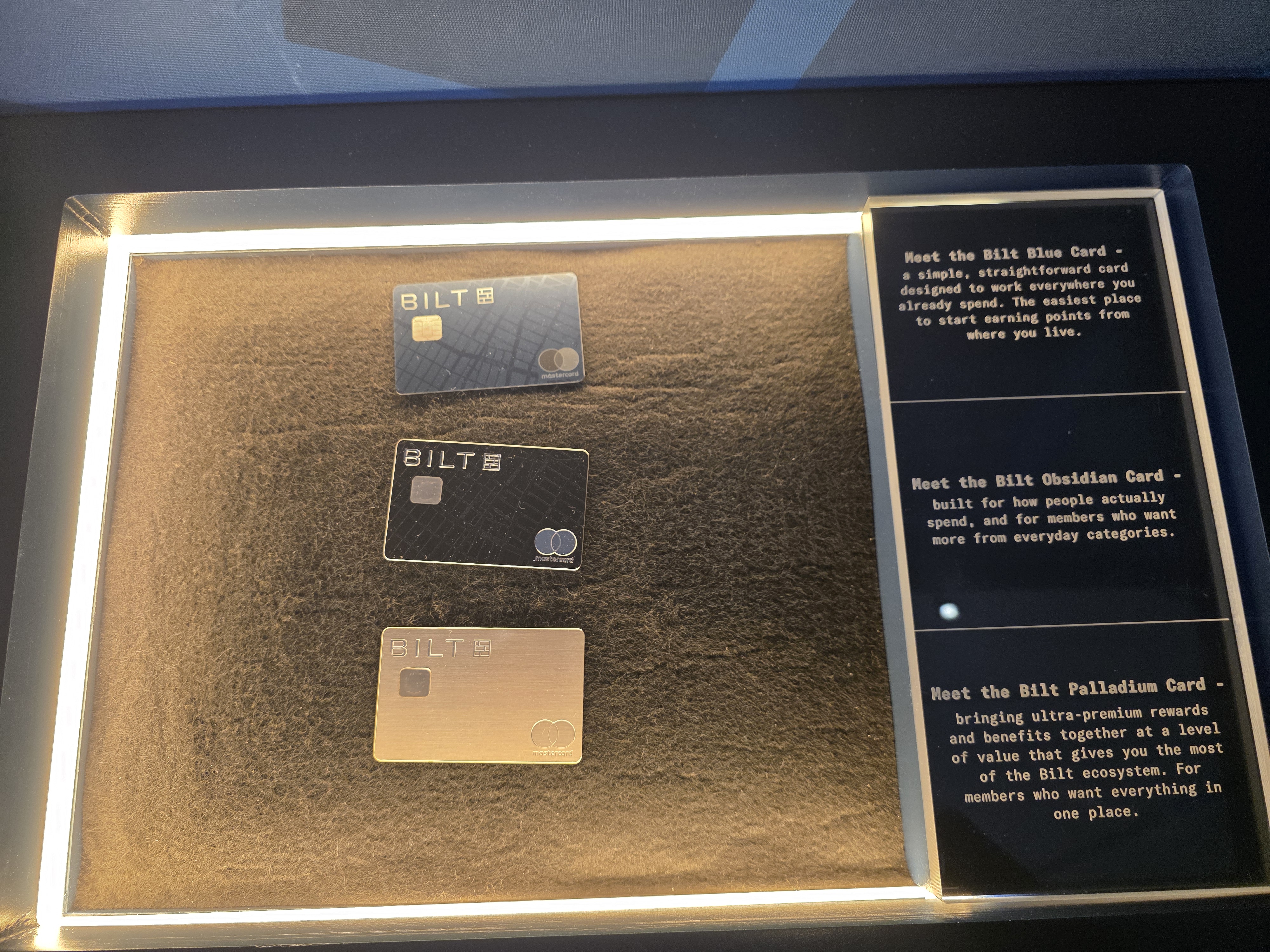
My big takeaway is that,
- Coupon book fatigue is real, but doesn’t matter if the coupon book value is rich enough. It’s when the offers are small, you have to work to use them, or you need to use most of them to justify a card’s fee that it feels like work, like you’re changing your lifestyle for a credit card rather than the card empowering your lifestyle.
- Spend value matters. Benefits are one feature of a card, and a reason to have a card, but not a reason to put spending on the card. Amex Platinum is great to have, not to spend money on (outside of airfare). Sapphire Reserve is great for spending if you can justify its cost. Bilt Palladium is going to get most of my spending that doesn’t earn bigger bonuses elsewhere.
- Specific lounge locations and benefits that align with your lifestyle matter. These hotel credits are right up my alley and not tough to use for me. Chase’s dining credit works for me too, but won’t work for many people in smaller cities. The Equinox credit with Amex just isn’t going to drive my behavior. Specific partners matter. So do lounge locations. If one network has a lounge in your home city, that makes a big difference for your actual use. My number one destination is Washington National airport, so I’m a regular at the Capital One Landing there (which is much better than the Centurion lounge).
I generate a lot of spending. I travel a lot. I want access to all of the lounge networks, to experience them and understand them and report on them. So all of these cards are in my wheelhouse. If only one is going to work best for you that will be the one whose lounges you’ll use most, whose partners align best with your life, and where you can… actually get good value from spending on the card.
For rates and fees of the American Express Platinum Card®, click here.



Excellent article. Thanks for the honest assessment. Some very good advice in this article.
My personal take-
Amex Plat – credits incredibly easy to use, most comprehensive lounge network, put non-airfare spend on another card.
C1VX – $395 but relatively easy to use $300 credit and 10k anniversary miles mean this card nets to $0 and provides C1 lounge access.
Citi Strata Elite – not mentioned(!), no Citi lounges, not really for spend unless you are a heavy Fri/Sat night diner for 6x points, useless if you have an AA Executive Card (other than earning a SUB / double dipping on coupons). (Citi arguably still has the best cards for spending though between DoubleCash / Strata Premier for $95 ($0 if you use that $100 credit), add Strata Regular/CustomCash for even more bonus categories).
Bilt – no Bilt lounges, potentially attractive return on spending if one can have any confidence in them after a train wreck of a launch and once we know more about what Bilt Cash can be used for. Not sure why they didn’t simplify the pitch: (1) Annual Spend / Bilt Cash: spend 75% of your housing payment, get 1x Bilt Points on the payment amount; or (2) Month-to-Month Spend / Points Only: spend 100% of your housing payment, get 1.25x Bilt Points on the payment amount. I do wonder if the assorted Citi bonus categories with Strata Premier/Strata Regular/CustomCash can be the equivalent of the earnings on housing, but it is nice that Bilt provides a one stop shop for a multiplier (at least until you get to the amount of the housing spend).
Chase – very good lounges, excellent travel insurance. But they turned a KISS card into the ultimate PITA. Hard to get $795 of value. $495 after the 300 travel credit. The rest is “chipping away” at it. Personally:
I’ll value the $300 (2x $150) stubhub credits at $150 – i’ll use this at least once in 2026, although stubhub is a ripoff.
I’ll value the $300 (2x $150) opentable Chase tables credits at $150 – i’ll use them and could value this more highly, although only $50 of the $150 I used last year tracked and I am following up about the other $100 – it simply does not work nearly as well as the Resy credit and much more limited in scope.
I’ll value AppleTV at $99 – it’s a service I otherwise would have paid for and that’s what it costs for a year with Apple. (Apple music I value at $0 as I use Spotify).
Yes it’s small dollars but I’ll value the $10 with Lyft a month at $100 – I use a Lyft once a month already, some opportunity cost with not earning points, etc.
So with all of that I can get to $795. And that’s before The Edit. I personally value The Edit at $0 – it’s a terrible program compared to FHR that has wildly inflated pricing. Likewise this year’s IHG credit – if you can use it great, but it’s not a long term part of the program. Likewise Peloton credit, PP, GE credits, etc.
So when I read this article, at least for me (and I suspect for many), the question becomes what to do about Chase. A formerly no-brainer card that many of us have had for a long, long time and are now reevaluating. With all of the lounge options out there, is it just too much effort to hold the CSR?Maybe! I’ll be exploring retention offers for sure. And once C1 opens LGA, C1 will have NY lounges in the exact same terminals as Chase. Food for thought.
YMMV! The choices are yours… and yours alone. Good luck!
I found the AMEX Plat refresh FAR better than the Chase one. Between the Resey credit , the Uber credit the Clear credit and the media credit I have no trouble making back the annual fee.
The refresh for Chase on the other hand is almost worthless. The only value on the Chase card that is worthwhile to me is the PHL Chase lounge which is nice but not worth 1K( including additional user) fee especially when the new AA Admirals club is almost as good and I can get it for free with my 250k loyalty point bonus. I will be downgrading the Chase card this May.
IF you are a Hyatt Globalist, the Edit always includes the destination fee and is more expensive. That alone could eat up the credit on a multinight stay.
Forget about AMEX Platinum. Huge fee, and their lounges are never available in the airports I use. TWO HOUR wait in Denver. I asked to ditch the card but they would not refund my annual fee. Waited a year and said goodbye to them. Chase Sapphire works much better for me.
Let’s face it: The return on investment of your time and mental energy is usually poor with miles and points. We do it because we enjoy the game. Most people don’t. They are more objective.
This goes double for coupon books. Only a small fraction of the public wants to play that game.
Gary, I have been thinking about the glut of flashy “points and miles” advisors on FB and TT and think of you as one of the “Pioneers” of the trade. Your fair and balanced analysis is helpful as I have been thinking exactly about what you addressed for the Chase and AmX cards ,which I got with their high bonuses.
The biggest surprise I got, maybe from my own mis-understanding, is with the seeming intertwined relationship of Chase and United, that my Chase Sapphire Reserve Business Card does not get me into United lounges, (when flying coach) even with the promise of access to thousands.
I will think about having CSR if they come to my house personally to collect the statement balance in 3 installments every month in cash with a monthly statement balance of $60, which would mean they will have to sent someone to my house thrice a month to collect $20 in cash for each trip.
Each trip would cost them more than what I would pay them.
You see how irritating that is, that’s exactly how they made it pretty much for everyone.
I will communicate the same to the cancellation department before downgrading to CSP or outright cancelling it
I somewhat disagree. Yes it can be fun and exciting to use a high value credit one time. OTOH, finding a way to use the 16th credit is a way different story. I’ve been into points and miles since 2010 and I tend to enjoy it but the ongoing enshittification of the platinum card through ever more coupons that may or may not have any real worth to me is stressful and just no fun. The only card that really makes the cut without mental contortions to justify it is the Cap1 VX.
I’m trying to reduce the number of cards I have.
C1VX is a keeper. It pays for itself – at least it does now, until they raise the price.
If you are a serious cruiser then CSR is the card to use. 8x points on cruises booked through their portal, and the markup is minimal, maybe only $25 or $50 more than a discount cruise agency. My parents did an Antarctic cruise and an Arctic cruise, ($60K total for 2 pax each time) and they earned almost a half a million points/miles on CSR.
I feel like the blogs have been quiet about the additional $250 hotel credit at IHG and others. Is there a reason for this? Does it stack?
I live in NYC so using all the credits on both cards is easy. The Uber, Resy and digital entertainment credit pay for my Amex Plat. Everything else is a bonus. As for the CSR, the Lyft, Stubhub (the best place to buy last minute Yankee tickets) and the OpenTable Reserve pay for the card. Again, everything else is a bonus.
We use the Centurion lounge at LGA 3-4 times per year, and the Delta lounge at JFK if we are not riding up front. I transferred some points from CSR to B6 and they were available in under 5 minutes. I will cancel my Amex Gold this time around.
They all have pretty much the same lounges as all have a (duplicative) Priority Pass membership. That is 98.9% of the domestic lounges on the card and virtually 100% internationally. Banks are ‘in the noise’. Even the airlines have stronger lounge networks than the banks.
I had a long comment. But I have reduced it to the following:
“Coupon book fatigue is real”, leave out the prevarication.
I really need to simplify:
Amex Platinum: Had this card forever. Emotionally attached to it. Stupid, but will keep for now.
Venture X: Simple. Keeper.
Chase Reserve: PITB to get value. Not in my wallet. Nix.
BILT: Need a PHD to understand. Unstable. Nix.
I still have too many cards in my wallet.
So what is the value of lounge access? Despite efforts to manage lounge ovecrowding, many remain packed. Recently I encountered a waitlist at the DFW Cap1 club, so I headed to the Centurion club. There was not a single vacant seat to be had. I just gave up, headed to Chili’s, bought a coffee and had plenty of elbow room to work on my laptop. Some people tell you to arrive at certain times of the day to avoid the crowds, but that defeats the alleged “convenience” of a club. I don’t want to waste additional time at an airport or loiter around the concourse waiting for space to open up. Thus, the “value” of lounge access is degraded. At least for me. My home airport is DFW which is now a major global hub, so it is crowded enough at all hours of the day or night.
Many of these cards only work for people that don’t sit down and figure out if they’re getting enough value from them. I get paid a decent hourly rate so the time I waste trying to break even is much better spent actually working instead. For me it’s C1VX for the free lounge and BoA PR for the 2.63% cash back. I rather stay at whatever hotel I want whenever I want with cash and not have to exhaust myself playing a game of transfer partners.
The $250 brand hotel credit isn’t as simple to use as you portray, if the reddit posts are correct. Because there’s timing issues in terms of which gets used first when a hotel is one of those brands and in The Edit.
@Peter gets it.
That said, if you actually use your credits, without having to struggle, it’s still better than breaking even.
Cancelled Sapphire Reserve after they got rid of primary car insurance for people who live in NY (and happily got the big bonus for Sapphire Preferred). Just cancelled Amex Biz Plat because they got rid of the 35% points rebate on 1st class flights on all airlines- this has devalued all my Amex MR points as I see it, and the ‘coupons’ don’t balance the ridiculous fee. The RESY credits are good enough to make Amex Plat worth keeping for now. Bilt is about to go and not interested in Bilt 2.0. Glad that Citi is back in the game…
Gary, if primary want from the CSR is its lounge access, the Ritz card can be much better value. For $450 annual fee I get the same lounges as CSR, add $300 to my United TravelBank, and a 85,000-point certificate redeemed for a room that would cost $1,000+.
Every time I read an article that talks about the amazing value of the AMEX card, I refresh my understanding of the benefits. While I agree that Chase put me to work making the CSR worthwhile, one annual cycle is easier to justify (the 2nd year will be harder) since you get 3x $150 restaurants, at least 3x (4 going forward?) The Edit credits, and 3x StubHub due to the calendar year resets of these credits. In December, I got the $300 travel credit, benefited $150 dining on NYE, $350 hotel for March ($250 Edit + $100 Chase offer) and $150 Stubhub for upcoming Tickets. Annual fee covered and all of these reset for 2026. The $300 restaurants is super easy for me–two nearby are ones I already visited from time to time, and StubHub is easy with all the local sports and music. The Edit prices are ridiculous, but this year with the added $250 IHG and another $100 Chase offer, it will make sense since that’s $600 off of one 2-night stay.
On the other side, pactically none of the AMEX credits work for me. I believe those who calculate person value are sincere, but it shows how personal the math is.
All those understandably cancelling the CSR has led to improved adjustments for those who remain