
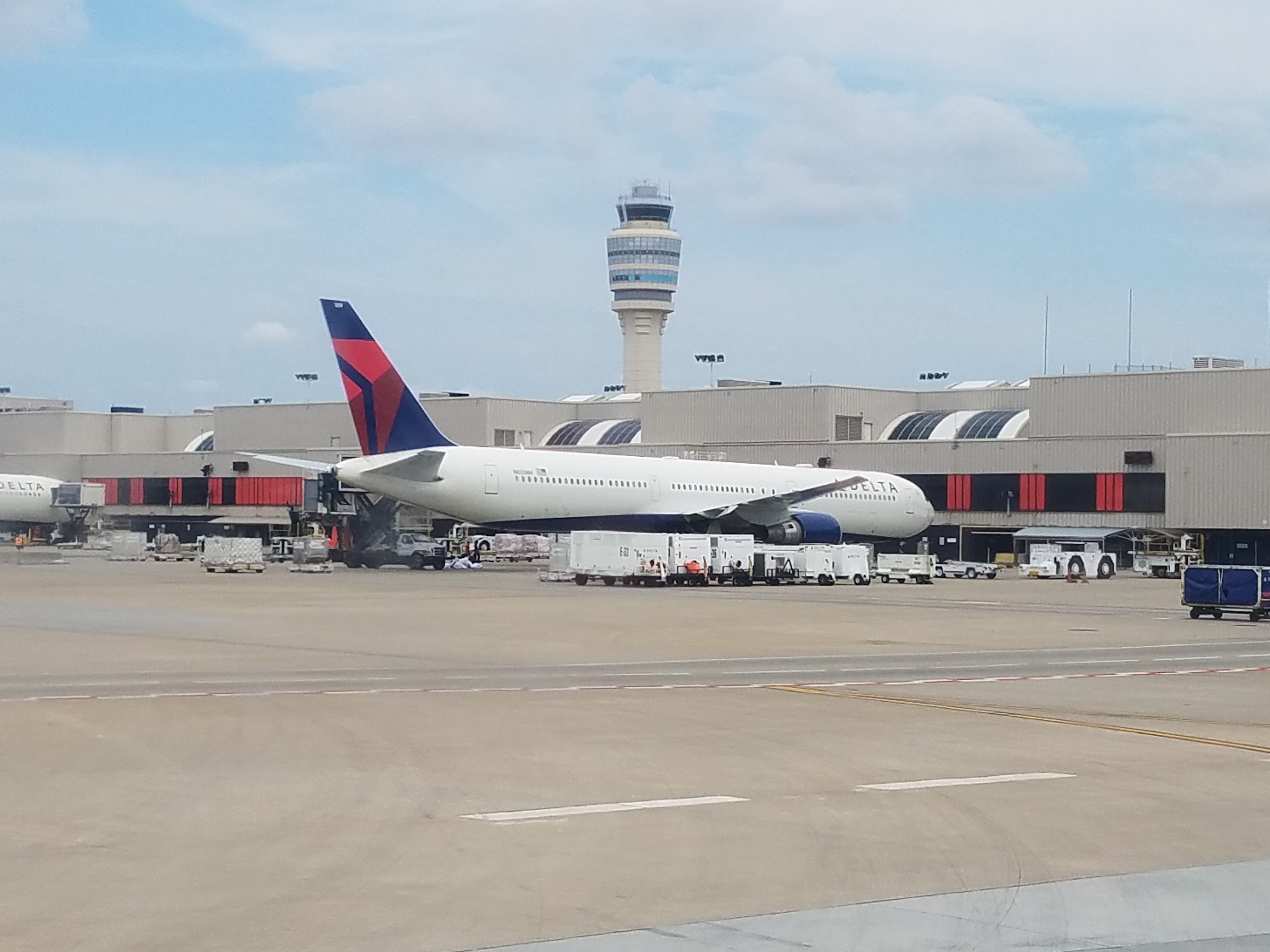
Delta Air Lines is about to gain an even stronger lock on the Atlanta airport, blocking competition there even more than it does today, by buying Spirit Airlines gates there out of bankruptcy.
In a court filing on Wednesday, it emerged that Delta was the high bidder to take over Spirit’s C4 and C6 gates along with ticket counters and support space for $12 million.
Spirit sold Chicago O’Hare gates to American and to United. That at least maintained some competitive balance, and the airline was still operating at the time, shifting flights to common use gates at the airport.
But Delta truly dominates the Atlanta airport already. It has 198 gates (155 domestic and 43 international) according to the airport. The most recent allocation I can find says:
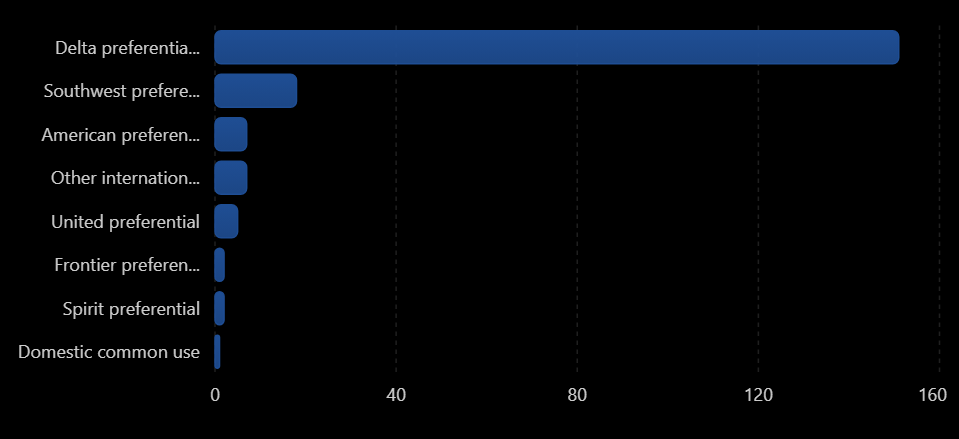
- Delta held 151 of those gates (117 preferential use domestic gates plus priority use at 34 international gates).
- Southwest held 18 gets, American 7, United 5, and Frontier and Spirit 2 each.
- There was only one domestic common use gate, but that’s now four.
Delta is the logical bidder, because gates in Atlanta are more valuable to them than to other competitors:
- Network economics. Delta can generate greater revenue from an incremental gate, because each additional departure connects with hundreds of other flights. That makes flights much easier to fill.
- Blocks competition for existing flights. A gate used by another airline could force Delta to lower fares. They’ll pay to protect revenue on their existing schedules.
They don’t even need to add flights with these new gates. They can move existing flights over and use some of their current gates less. And the airport lease agreement‘s minimum gate usage requirements looks at average gate utilization across all of an airline’s preferential use gates, rather than requiring 600 departing seats at each individual gate. And even if an airline violates that, it’s up to the airport whether to recapture a gate (the airport is in Delta’s pocket), and the contractual cure process can stretch to 450 days.
This gate purchase seems clearly bad for competition and consumers:
- The dominant incumbent obtains scarce capacity that blocks other competitors through at least 2031.
- There’s no requirement for Delta to expand flying, while other airlines would need to fly more to keep the gates.
- Atlanta airport doesn’t provide much common use access, so there really aren’t alternatives. Spirit’s loss in Atlanta really does mean fewer airlines with airport access into the future.
Objections in bankruptcy court are due July 1, with a hearing scheduled for July 8. The court is the immediate decision-maker and the standard is maximizing the value of the bankruptcy estate for creditors, not airline competition.
The lease says that assignment or transfer requires the Aviation General Manager’s written consent. The City of Atlanta certainly won’t object. They generally act in Delta’s interest, because of Delta’s importance to the city and close relationship with its politicians. Delta represents 79.5% of passengers at the airport. Atlanta airport is known to help block competitors.
- Before JetBlue’s 2017 return to Atlanta, it expected to operate from Concourse E. Six weeks before launch, the airport proposed dividing its five daily flights between Concourses D and E. JetBlue complained the airport was doing this intentionally to block competition. When they sought to expand to twelve flights, they had to fight being split across three concourses.
- Spirit complained that it couldn’t expand in Atlanta because of lack of gate availability in 2021. Three years ago the airport actually reduced the number of gates.
- Delta got the city to agree not to build a second airport that would have expanded competition as part of the current lease agreement.
The transfer of these gates doesn’t have to go through advance antitrust approval, since the price is below the current Hart-Scott-Rodino threshold ($133.9 million), although federal regulators could sue to block the transaction under the Sherman Act.
In 2015, the Department of Justice sued to block Delta’s transfer of 24 Newark slots to United because of United’s dominance at that airport. United abandoned the acquisition.
The Department of Transportation could also investigate the assignment as an unfair method of competition under 49 U.S.C. §41712 and order them to cease the practice.
Since Atlanta receives federal subsidies, the related grant assurances require it to operate without discrimination, refrain from granting an exclusive right and provide reasonable access. Large and medium hubs dominated by one or two airlines have to maintain an airline competition plan addressing new entry and expansion access.
The FAA could investigate on its own or through a Part 16 complaint by a directly and substantially affected airline. An airline that’s denied workable gates would make for a strong case. And, indeed, the bankruptcy document says there was another bidder for these gates. This airline could also sue over competition privately under the Clayton Act.
There’s clear regulatory capture of a government-owned asset in Atlanta where Delta is about to increase its concentration and block future competition. That government has even contractually agreed not to expand capacity and competition in the future with another airport. So taking Spirit Airlines gates off the table for another carrier seems like a problem.
(HT: Enilria)



It’s time to blame Southwest. They spent Billions to buy Airtran and then did nothing with them but dissolve them, and shrunk Atlanta to nothing. They put in almost zero effort to make Atlanta work.
Delta loves anything except competition. ATL is Exhibit A, where Ed squats on dozens of unused or mostly idle gates, the airport (also controlled by Delta) looks away and fare prices – even with the drop in oil – have surged by a healthy multiple of whatever Delta bid for the Spirit “Ghost” gates.
I am glad that the Spirit-Jet Blue merger was blocked on competition grounds. /s
Delta GREED on display
show us who else bid for the gates and how their loss of the bid will affect competition
It’s 2 gates out of over 200 and it’s on the half of the C concourse that WN acquired from AirTran but finally realized it has wasted 15 years trying to compete against a legacy carrier – so it is developing BNA as a hub.
DL operates the world’s largest hub at ATL and uses the highest gauge (average aircraft size at ATL. The gates are far from underutilized. Every other US airline would love to have an ATL; ATL was split between DL and Eastern for years but DL outlasted EA. AirTran picked up some of the EA gates but WN couldn’t make ATL or any large operation in any other legacy carrier hub work.
About the only part of a concourse where DL does not have gates is the AA/UA end of T.
Without knowing who else bid for the gates the mere fact that DL is growing ATL doesn’t show that competitors can’t grow at ATL any more than at DEN ORD or DFW where the dominant airlines there are adding gates.
Which other airline would have taken these gates – Breeze? Avelo? Allegiant? – and how would that airline having two gates have significantly affected competition?
Without a northern airport, Atlanta will remain a third tier US metro. Our second tier is Seattle, Bay Area, Dallas, Houston, Miami, DC, Boston.
There was a bid process. DL bid the highest. Clearly Frontier did not think it was profitable to outbid DL for the gates. Nor any other airline. That’s how real life works. I bet none of you have ever turned down a pay raise.
@George Romey — Hey, some of these folks are mere capitalists who just rely on passive income, not wages; they don’t all ‘work for a living,’ like you, our dear resident Concierge Key. Boohoo.
Good ‘ol’ boys looking out for each other.
ATL is only the busiest airport because of DL, the region that it serves rarely has fliers, those types if people have never set foot in an aircraft nor want to leave the country. Its the same people that would want the special edition passport but would never need it since they don’t fly. UA, AA, or other airlines can make their fortress hubs the busiest by increasing number of flights.
@principal lewis
even calling Atlanta 3rd tier is kind. They’re bottom rung of just about everything to me. but top tier in corruption, no doubt.
@ Gary. Good article, more along the lines of what one might expect from a professional publication.
@ Tim Dunn. I remember AA trying to make BNA work as a hub. It didn’t and I suspect it won’t for SWA either. Perhaps good for some point to point traffic and the rare close in international flights. But when you have ATL as a neighbor and connecting flights to the world it may be hard to compete (a situation like AUS/SAT and DFW/IAH).
WN doesn’t build “hubs” near as large as the legacy carriers do.
Nashville is a red hot market and WN is already well on its way to building a 200 flight/day plus operation and possibly larger than that.
WN doesn’t serve as many cities as the big 3 thanks to their mainline only strategy,
BNA’s biggest drawback is that the current terminal configuration is not ideal for a large connecting operation with a a big “circle” between the C and D concourses and a very long walk from the ends of the C to the D concourses.
the bigger point is that WN has figured out that they will succeed best by not trying to compete against legacy carriers which gives DL the strongest position at ATL than it has ever had.
the SE will have 3 large profitable hubs for 3 of the big 4 airlines with UA the odd man out
Like I need another reason to not fly these thieves?
In other news business class Delta award seats went to one million miles each way