
That 28-minute connection you just booked—gate change, terminal hop, boarding already underway—used to be exactly what airlines wanted to sell. For years, shaving minutes off itineraries helped flights float to the top of old-school search displays, where “fastest” often meant “first page” and “first page” meant sales.
Now the ranking game is different, and so is the customer. American Airlines network planning chief Brian Znotins says he has stopped obsessing over one- and two-minute schedule wins, because modern platforms surface “best” tradeoffs instead of simply the shortest elapsed time—and American’s own data suggests travelers are increasingly choosing longer connections on purpose.
Airlines no longer have to be ‘on the first page of the display of flight choices’ in the same way any longer. It used to be that the shortest total travel time options would appear first, and longer connections could get pushed to a second page that nobody would see. But modern systems (like Google) have their own algorithms for what’s best and what comes first.
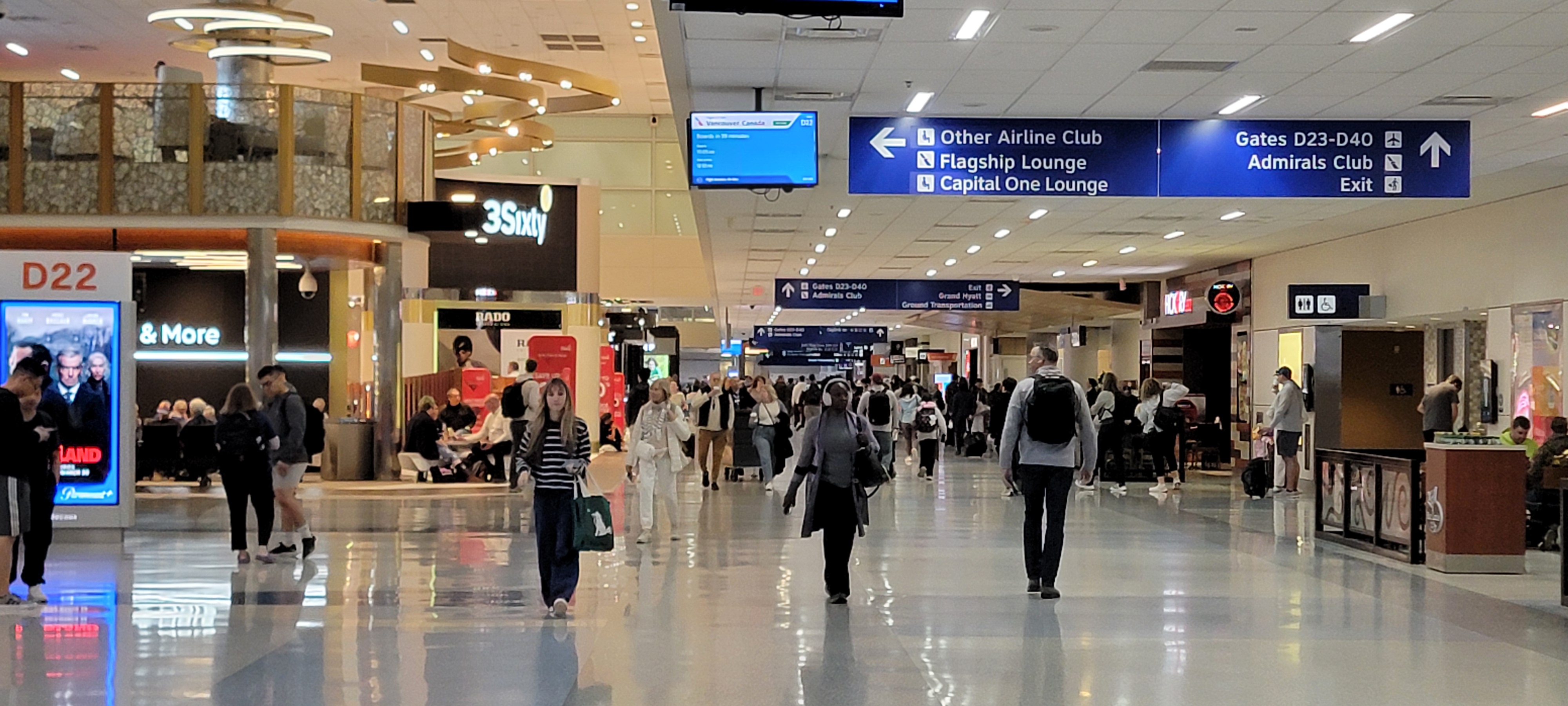
And passengers often no longer want the fastest total travel time. Some customers don’t notice and wind up surprised, stressed (trying to make a connection) and inconvenienced (when they don’t, or when their bags don’t). But others purposely avoid 25 minute connections that involve a change of concourse in Phoenix, knowing that their next flight is already boarding when their inbound lands – if it’s even on time.

The excellent Brian Sumers in his (worthwhile) paid newsletter interviews American Airlines network planning head Brian Znotins about the airline’s reconfiguration of its schedules at Dallas-Fort Worth with a bet that they’ll make more money with a more reliable operation and Znotins actually shares data around customers preferring longer connections than they used to.
“Twenty years years ago, I would have been a zealot about elapsed time and display on GDSs,“ Znotins said. “I would have been like, [it’s] true [that] nobody buys a ticket because one’s six hours and two minutes and the other one is six hours. But if I fall off that first page on the GDS, that was a really big deal.”
Sure, GDS placement still matters. But most modern search platforms employ proprietary algorithms to rank flights. Google Flights, my preferred search site, shows me the “best” options, not the fastest one. “By default, Google shows you the flights that offer the best trade-offs between price, convenience, and ease of booking,” Google explains.
American’s website does something similar. “It comes up with nonstop and fare and time of day — and not elapsed time,” Znotins said. “Everywhere I look, elapsed time doesn’t seem to be the second-most important thing anymore. It’s somewhere in the mix. And so I’m not as hyper-focused on squeezing those one- or two-minute improvements out of my itineraries than I was before.”
Customers may also prefer longer connections. I’ve heard anecdotes about people who book long layovers on purpose, fearing lost bags and misconnections, but Znotins put some data to it, using predictions from American’s model, which looks at the last two decades of passenger data to predict what people will book.
That model calculates that American should have about 9,000 passengers who book a 40-54 minute connection at DFW on an average day. “In reality, when we look at the actual demand we got for our flying versus what the model thought we were going to get, it was 4 percent lower than that, in that window,” Znotins said.
The model also predicted that about 19,000 passengers would book connections between 55 and 84 minutes. That number is 8 percent higher. “So what it says is, when people are buying their tickets, something else is helping to make their decision, not just elapsed time.”

Airlines used to design schedules to win the first page of flight search by minimizing elapsed time. American Airlines data suggests travelers now choose longer connections for reliability—and the Dallas-Fort Worth schedule rebuild is enabled by that shift.



Is saving 15 or 20 minutes on a connection worth the anxiety and rush to make the connection. For me, not at all! I typically will ONLY book where there is at least 1 hour and 10 minutes between connections (or more), and if my incoming flight arrives on time (or a bit early) then I can go to the Admirals Club for a beverage and bite morsel. Yes, I am up in age (86) and walk slow, so that might have something to do with my decision making also. I kinda laugh at the jostling rush of so many discourteous passengers in the concourses. Life is too short to be racing from one corner to another. Stop and take a breath and smell the roses!
For years I have avoided tight connections. This is nothing new, and is especially true if a) I am on AA, and b) especially if I’m routed through either PHX or DFW…or CLT, for that matter. I look at AA’s flight schedules and think, “WTF? Who in their right mind thinks you could make a 25-minute connection @ PHX? Not even O.J. Simpson when he was running through airports for Hertz could make a connection like that!” And I’ve been in DFW too many times when my connection was located in another terminal — over to A, no wait — it’s in D now, oops — back to C… [insert rolling eyes emoji here.]
Just in time delivery is fine for parcels. I know @Gary thinks if you’ve never missed a flight, you’re arriving at the airport too soon, but the only flights I’ve ever missed (two) were both AA and both were on short connections. I’d much rather relax for, say, an hour in the lounge and then stroll to my gate as boarding starts than race through the airport leaping over suitcases and people in wheelchairs trying to make a connection…
Decreased competition. Everything shows up on the first page when there are only 4 airlines.
Thank you for acknowledging this! I hope that Delta, my preferred carrier, takes note. 40 minutes to transit Seattle? 60 minutes Schengen/International at Amsterdam? It’s a total invitation to travel stress, no thanks.
Data always rules.
So glad that AA is building its schedules around what people actually buy and not what they think people will buy.
At one time I was more comfortable with short connections where the airline would adjust timing to make sure most people made their connections and have reasonable fallbacks for those who didn’t. These days, where airlines don’t take responsibility for their shortcomings, I am not comfortable with such short connections. I am more comfortable with a two hour connection than a one hour connection. I am willing to pay a slight premium for the longer connection time. If I have a choice of connecting airports, I also will try to choose the one with more alternate times for fallback situations.
The 30mins you saved by taking the 35min connection instead of the 65min connection will be used up as you wait at the baggage carousel due to boarding too late to fit a carry-on. As a bonus you will be sweating after your run though the airport.
Half the time you will fail to make it and end up being rebooked onto the later flight, so while you will now be in time to fit your bag in the overhead, you will have lost your exit row window seat for a middle seat in the last row. Not for me.
my preferred carrier is Delta so i agree 100% with Richard Voit. my Dad worked for Ozark for 20 yrs and i worked for TWA and Western Pacific in the 90s and all those years around the industry i learned never book a connection under 2 hrs. i prefer 3 hrs myself. Delta actually sells 45 min connections in AMS and CDG. having been to both airports i can not see that happening. better chance at AMS than CDG. they must have to hold the planes since they sold that connection.
Gary, could you help reconcile one point—those short connection itineraries built by AA are in direct violation of the terms in their Contract of Carriage which indicate a pax needs to be at the gate 30 min before departure (with no distinction in terms for first or connecting legs). So how can they market and sell flights that do not meet their own terms?
They act like this is news. Out of touch management waking up about 7 years too late. Frequent flyers have been complaining about the banking at hubs for years.
Tomorrow I’m flying ROA-CAK. I booked a 2 1/2 hour layover at ORD. Given my last three flights have been significantly delayed, I don’t feel comfortable about that. But if it’s on time, it’s at my home airport and I can navigate it blind. Win-win in this instance for UA.
Tight connections are asking for trouble. People are starting to understand how a 45-60 minute connection can slip away in a heartbeat. With banked hubs there’s more tarmac and alley way congestion, far less empty gates and often ground crews stretched thin. You can land early and still arrive late.
Of course!
What good are all the perks and club memberships if you can’t use them?
What is a pisser is that if you don’t buy the run-your-ass-off tight connection, AA will gladly charge you more, calling it two separate flights instead of a connection.
(insert obligatory “that’s how they git cha.”
1:15 is my absolute minimum for USA domestic connex. If I can’t find a connection on one carrier that fits this criteria I’ll fly someone else.
“So what it says is, when people are buying their tickets, something else is helping to make their decision, not just elapsed time.”
That’s because all airlines run sloppy operations typically unless they get a lucky day
so you have to allow extra time.I look for 1 hour to 2 hour layovers on average because what can go wrong does and will go wrong!And good luck trying to get someone to repair the damage
I try to book at least an hour connection if possible.
Last week I managed to make a 15 minute connection in DFW from A to C. First flight was delayed, never in my life would I have thought I’d make that tight of a connection at DFW!
I don’t book flights with less than an hour for connections. 1-2hrs is the sweet spot. I’m young and can run through a terminal no problem, but my concern is an overall decline in *competency* – especially since Covid. Customer service. The ground crew. Security. Maintenance. A failure at any level causes a delay, and those little irksome delays add up and cause missed connections. I personally don’t think it is responsible for airlines to craft itineraries with connections under an hour.
Same with CLT. I don’t want a 40 minute connection with a probable 20 minute walk. There’s just too much to go wrong. I’d much rather have a 90 minute connection time.
Just flew America round trip twice in January. Each time had 1 hour to change planes in Dallas and Charlotte, with American. Had checked a bag, unusual for me. Bag made the change on 1 connection but not the other. From now on, if checking a bag will ensure 1 and 1/2 hours between connections.
With American, no connection less than 3 hours has at least a 95% chance of making your connection. That’s why I try never to take a connecting flight on AA, and then only if using miles.
But when are they going to change the PHX 25 minute insane connections?
Unfortunately, some corporate travel software seems optimized for picking shortest connections. My favorite is the Tokyo to Denver with 45 minutes to clear customs, recheck your bag, go back through security again. I tried explaining this to our HR team and they still make us do it because it is the “optimized route” per the software
IMHO, airlines should not offer connections under 60 minutes….. it’s essentially false advertising. I can’t even remember the last time I had connecting flights on the same concourse. Airports keep getting bigger, while I keep getting older. I’m often amazed at the number of steps I accumulate just getting to the gate in airports like Atlanta, Dallas, and Phoenix.
If they sell tickets beyond minimum connection time limits, and actually keep the schedules, then sure, 34 minutes at CLT, running from one end of the terminal to the other sounds like free ‘exercise’ to me.
However, perhaps, what would be better is if we had an EU-261-style rule in the US, where airlines had to compensate us when they significantly delay; so, when that first segment is inevitably late, and you miss the second segment, and the best next flight they can provide is four hours later, you at least get a few hundred dollars for your troubles. Watch how quickly 34 minutes connections disappear from sales…
I don’t book connections period unless I have no choice. Then I’ll only book with over a hour layover.
Fortunately I live in Chicago which pretty much allows me to nonstop to just about every major northern hemisphere city in the world.
There is not such thing as a 45 min connection at PHL CLT or ORD it just does not happen. There is always the Karen in the front that takes forever go to get off the plane. They they switch terminals on you. Do you really thing i can get from PHL B to PHL F in 45 min without being a 18r Track Star?
I was cross referencing a list of largest cities in China. They are all in the northern hemisphere and I doubt that there are nonstop flights from Chicago to more than a few of them. All of them were larger than Chicago. All of mainland India is north of the equator and India has a lot of large cities without nonstop flights from Chicago. Many other countries in Asia have cities larger than Chicago without nonstop flights to Chicago.
@Vince. The AA website:
“You must be at the gate and ready to board the plane:
15 minutes before departure on domestic flights
30 minutes before departure for international flights”
@O’Hare Is My Second Home. I sure hope you were not scheduled on the ROA-ORD flight with a listed >7 hour delay on the 22nd.
I could have flown out to DFW and have a 59-minute connection to AKL. Could have had 3.5 hours, but it was an E175 (like the thrown in F, but it feels cramped). Instead, I left 4.5 hours earlier than “necessary” to give a 5.5-hour connection and an A320 to DFW.
I will fly out at noon, have 3+ hour layover in US, before flying to CDG where I have 6 hours. And, if I miss my CDG flight, I have two more from that airport that lets me on the last leg. I could have had 1-hour layovers in US and CDG, with the first leg at 5pm.
In both cases, I left 5 hours earlier, but still no later than noon, and get there as early as I can. I get AA Flagship, D1, or AF lounges while waiting. As a pensioner, I’ve got all the time I want. Why risk problems? (And for us seniors, a 5-hour layover feels a lot shorter than it used to.)
@Zebraitis. Interesting, I look for longer connecting times and have never seen it priced as separate tickets by any airline. Of course, I imagine it could occur if you arrive at XYZ Tuesday at 5pm and Wednesday morning at 10am.
Ideally, this trend has or will cut down on the frequency of post-arrival “remain seated” announcements to accommodate tight connections. That practice makes sense after extended weather-related delays that cascade through the network, but it is far less justifiable, and understandably aggravating for customers, when a delay is the result of controllable factors like aircraft swaps, maintenance, or other airline-caused disruptions.
American has regularly made me miss hour connections. They take no responsibility for getting in late, practically. And though they will book you on the next available flight, that’s often the next day. Not kidding.
Even an hour is too tight in most places these days. It leaves very little room for error.
I have far too often gotten “boarding is now closed” messages on my phone while getting off the previous flight. Even if you can get to the gate on time, nominally, it doesn’t matter
I usually book for 1 hour connections, but now American has shifted their schedule around mid-February where I’ll have all 3 hour connections for the same route. Currently looking at other airline options. I don’t want to sit in PHX for 3 hours. I’ll take running to my gate over that.
Guilty as charged. Most often the cheapest fares are the ones with the tightest connections. I have ABSOLUTELY NO FAITH IN AA SCHEDULES. So the trade-off is save a few bucks ($50 to $75 on average) and risk a missed connection or take the 1.5 to 3 hour layover at hub and waste my time in the lounge getting watered down drinks (or cheap wine). There is a cause and effect here with the overcrowded lounges now. Everyone knows they can’t make a tight connection, so like me they are chilling in the lounge and there is no room for everyone waiting hours for a connection. BAD OPTICS all around. AA screws everyone equally, bad lounge experience, bad connection experience, more expensive flights.
My two cents….
Over the yrs airliners have added delay buffers to flight times.
Factors in commenting times
1. What airportam I connecting thru
2.Am I changing between j737/321 or targets to a crop duster
3. Is thus the last connection of the day
4.if bag nisses flight, how does thst affect my ttavel
This reflects my booking behavior (for several years).
Another factor not mentioned here is how boarding times have changed in recent years (as flights have more seats and, thus, more passengers to board). It used to be that boarding started 25-30 min. before departure, and you could board up to 10 min. before departure time. Now boarding (even for narrowbodies) starts 45-50 min. before departure, and they are closing the door 15 min. out. That makes short connections even less tenable, especially with carry-ons. So I see this as the connection times catching-up with the realities of how the airlines are actually running their operations.
I still see plenty of 30 minute connections being offered. Even from regional to mainline at CLT which involves a huge distance between terminals.
Yes, I also notice that these impossible connections are cheaper. ..
Also, as AA apparently continues to reduce service overall, connection options get worse. I often see a choice between a 30 minute connection and a 5 hour connection.
It is really a shame that AA.com won’t provide a connection time filter like google flights has. Being able to exclude specific connecting airports (like ORD in February) would also be helpful.
I guess it’s good that AA eliminated loyalty, so going with DL or UA is a much easier option now for very frequent travelers.