
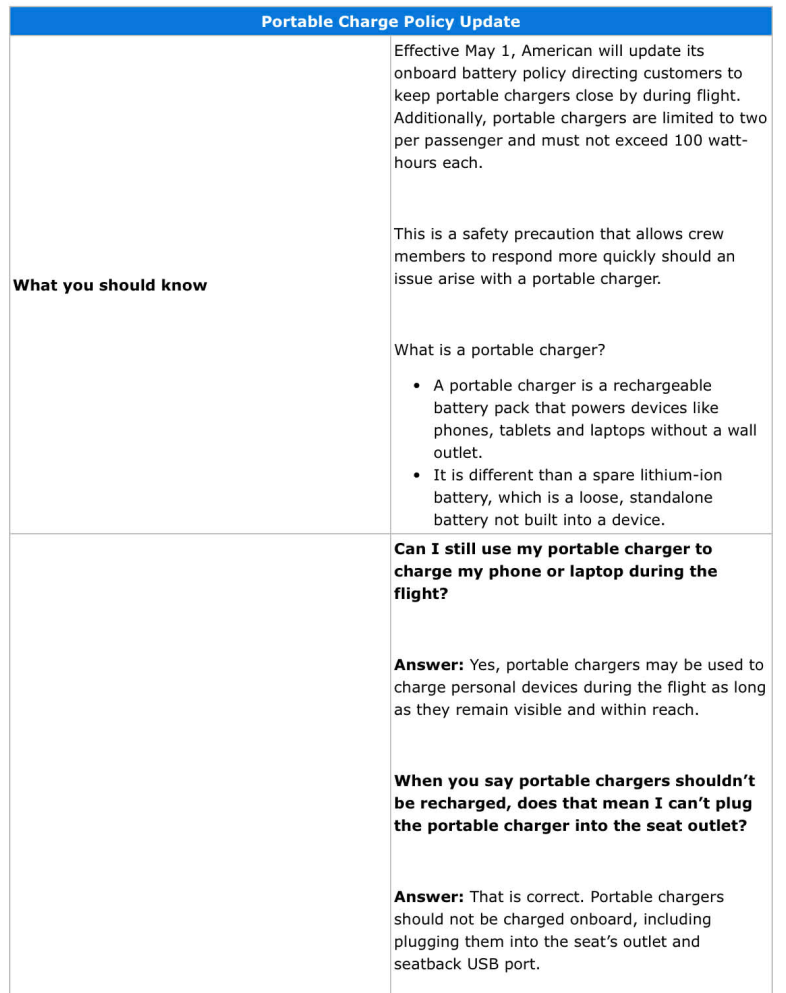
Starting Friday May 1, American Airlines will banning charging a portable power bank onboard and having it hidden or out of reach during flight. It is also limiting passengers to two power banks apiece, not more than 100Wh each.
- Two portable chargers per passenger max.
- 100 watt-hours each max.
- They must be visible and within reach during flight.
- You may use a portable charger to charge your phone/laptop, but only if it stays visible and reachable.
- You may not recharge the portable charger from the seat outlet or seatback USB port.
- You may still charge phones, laptops, and other items directly from aircraft seat power.
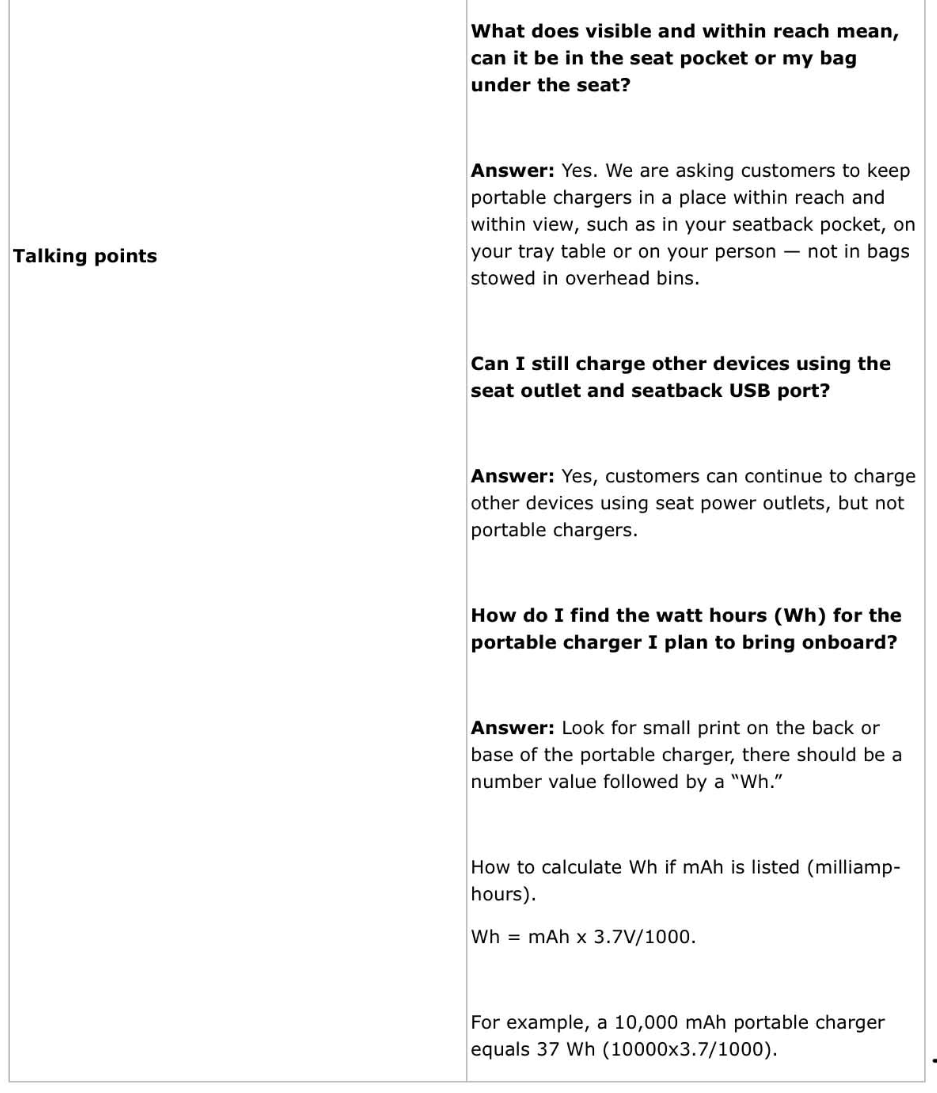
“Visible and within reach” means in the seatback pocket, on the tray table, on your body or otherwise accessible. In other words, it can’t be buried in a bag in the overhead bin.
Current policy on the American Airlines website shows four lithium ion batteries under 100Wh allowed in carry-on bags, and 2 that are 100–160Wh “with airline approval.”
The concern is thermal runaway in a place crew can’t see a fire or react quickly. The FAA put out a safety alert last year saying portable chargers can ignite onboard, and batteries in overhead bins or carry-on bags can be hard to access and not readily monitored, delaying firefighting.
- Halon suppresses flames but does not stop thermal runaway
- The best approach is cooling with large amounts of water.
Battery fire forced #AirChina flight #CA139 (#Hangzhou–#Incheon) to make emergency landing in #Shanghai today. The flight diverted to Pudong Airport after a lithium battery in overhead luggage self-ignited. No injuries reported. pic.twitter.com/nwQdEnEt6H
— Shanghai Daily (@shanghaidaily) October 18, 2025
Breaking ! เที่ยวบิน CA139 ของ Air China เส้นทางหางโจว-โซล เกิดไฟลุกไหม้ในที่เก็บสัมภาระเหนือศีรษะ
นักบินต้องตัดสินใจลงจอดฉุกเฉินที่สนามบินเซี่ยงไฮ้ ผู่ตง ท่ามกลางความตกใจของผู้โดยสารบนเครื่อง
ล่าสุด สายการบินชี้แจง ต้นเพลิงมาจากพาวเวอร์แบงค์ที่อยู่ในสัมภาระของผู้โดยสาร pic.twitter.com/IUCM4AGFgY
— ️ CHERSAN SRISATJANG ✈️ (@RonallChersan) October 18, 2025
None of this is new. The FAA reported 97 battery incidents involving smoke, fire, or extreme heat in 2025 and 89 in 2024.
This is why it was such a dangerous idea when the federal government sought to ban electronics in the passenger cabin in 2017, requiring customers to check them as baggage instead. Those fires might not get contained.
However, there’s no FAA mandate on this. ICAO announced power bank limits to two per passenger and prohibiting passengers from recharging them during flights. IATA this year offered guidance saying power banks should be carry-on only, must not be recharged onboard, no more than two per person, and should not be used to recharge a portable electronic device onboard.
This woman’s charger during a 6+ hour red eye flight. pic.twitter.com/Ks8LyoRKjz
— non aesthetic things (@PicturesFoIder) January 6, 2024
American’s rule tracks this on two per passenger and no onboard recharging, but it is less strict than the IATA recommendation because American still permits using the power bank to charge a device if it stays visible and within reach.
Southwest is stricter than American. Since April 20, Southwest limits passengers to one lithium portable charger, bans overhead bin stowage, and bans recharging it with in-seat power (to the extent Southwest even offers this). Southwest had already required power banks to be visible while in use since May 2025.
Internationally some airlines are stricter still – for instance Lufthansa does not permit power bricks to be used onboard, allows carrying two per passenger, and may only be stored in the seat pocket, on a passenger, or under seat (not in the overhead). Singapore Airlines limits to two power bricks, bans them in overhead bins, doesn’t permit charging them onboard and says they cannot be used inflight. Emirates says passengers can bring only one – under 100Wh – and cannot use them inflight. Qantas won’t allow them to be used inflight, either.
U.S. airlines board fire containment bags and heat resistant gloves on aircraft. That way when electronic devices catch fire they can deal with it. Once the electronics that caught fire is isolated, the fire containment bag gets stored in a metal cart in the galley, to be retrieved when the aircraft lands. Several world airlines, including Southwest Airlines, now requires that passengers keep portable charging devices in plain sight.



1990-tier stupidity. Unenforceable and no one will bother to comply.
The IATA guidance makes sense. People have died because of power pack fires starting in inaccessible places. AA and Southwest are doing the right thing.
@Coolio — Where’ve you been? Don’t hold back. Tell us how you really feel!
Stupid, trying to distinguish power banks from other devices–lots of PD-capable devices are designed to deliver power as well as store it for their own use.
Requiring them to be visible is fine, though.
I agree with the ban on charging from power banks, during flight, as I’ve had my share of power banks that think they are a griddle whilst charging devices… (yes, personally, I get a new one power bank when that happens!)
However, there are numerous other devices which have lithium, laptops you mentioned – a decade ago a former ThinkPad running Windows decided to awaken from sleep in my backpack that was above my head. Now I power the laptop du jour off… Every time – and I can’t see every bag being checked in detail for a lithium device
I suspect incidences will continue to happen, airlines will ensure they have burn bags, and both phone manufacturers and laptop manufacturers will hope their name doesn’t appear on the naughty list (formally known as the Samsung Note list, for some reason)
Reasons we have this problem:
1. Ubiquity of Amazon.
2. Amazon’s lax standards for product safety. Traditional retail stores (even Walmart!) only sell electronics that have UL or ETL certification. Amazon doesn’t give a shit.
3. Impotence of legislators to enforce product liability upon Amazon.
UL (and ETL, which adheres to the UL spec) actually matters. We as consumers never had to think about this in the past because retailers did the work for us. Now? Jeff Bezos laughs while our flights burn.
Sensible policy. Can’t wait for all of this to be completely ignored!
Air France had this rule posted onboard when I just flew back from CDG to ATL. Delta had nothing posted when I previously flew over to France. Wonder 1) Is it a rule from whoever runs EU flights or just an AF rule? and 2) How long till the FAA requires the same ?
We just flew 5 domestic Turkish Air segments, and any time they saw a passenger with a charging cable, they asked them to show them any power banks they had with them and then said they had to be visible whenever in use. British Airways said the same on a domestic flight recently, but not on the long haul BA flights we were on.
In 2026, most planes have on-board power. Battery life has improved on newer phones, tablets and laptops. Carrying a separate power bank is entirely unnecessary.
“In 2026, most planes have on-board power.”
And after I land…?
@Mike P — Can you blame ‘govmint’ or whatever you usually do?
Morons are plugging in batteries to a phone or something and then stuffing them inside a suitcase? That’s crazy,
If so, this rule change is extremely reasonable.
This is somewhat safety theater. If power banks are low on charge, they are not likely to go into thermal runaway. When I looked at the 2023 statistics (the FAA link had a Reuters paywall), there were three main categories that had problems: power banks, e-cigarettes and cellphones with a fourth category of laptops. All of the first three should have similar restraints. All should be brought onboard with half power or less. Before power banks became more popular, cellphones were the greatest worry. What should happen is that all devices of the first three types should be inspected for any bulging. Personally I have powerbanks and cellphones with me and they don’t go in the overhead bin nor are they checked.
Always the laggard, even with safety.
Amazing it took them so long, but I guess it’s never for safety: the bean counters saw the costs of losing an entire airplane to a powerbank fire https://www.livemint.com/science/power-bank-behind-massive-fire-that-burned-down-aircraft-roof-check-how-to-ensure-your-device-is-safe-11738401959305.html
Is it all the cheap ones? I have a 26,000 mah from Anker for years and never any problems.
@Chris – yes; see @Manhattan West (EWR)’s comment.
For the past few years, fire risk has been increasing in the United States, after 50+ years of declines. It is not only portable batteries, but anything using electricity that is not tested/listed/approved by a Nationally Recognized Testing Laboratory (NRTL). Anything that plugs in (battery or not) can be dangerous without certain safety features. Our only hope is that eventually the U.S. Supreme Court finds Amazon liable for what it facilitates.
This talks about lithium batteries but the policy is confusing. When I go on long vacations, I carry 10 or so 2000mAh Nikon EN-EL15 batteries in the carry-on camera bag for my Nikon Z8 camera, and the batteries are capped to avoid any possibility of shorting the recessed terminals. While checking in the last time, I noticed that British Airways now limits passengers to two 100wh batteries — at 5v, 100wh is about 20,000mAh so my 10 little rechargeable batteries add up to about one powerbank. The policy just says lithium batteries, not portable chargers. I ignored it, figuring they didn’t really think this through — is a photographer supposed to ship their batteries ahead to the destination?
@InvaderZim — Now, THAT’s a reference I haven’t seen in a while…
@Chris – i’ve also had 10k Anker’s that were recalled by Anker. So it’s not just the cheap ones, although it’s mostly the cheap ones, and I doubt the cheap ones are bothering to do a recall campaign.
We had a scourge of cheap e-bike batteries in NYC a few years ago – cracked down on them and now it’s better.