
United Airlines has announced ten new international destinations for 2027, and eight of them will be out of Newark. In typical United fashion, there’s nonstop service to places no U.S. carrier currently serves including Okinawa, Toulouse, Luxembourg, Marseille, Ibiza, Valencia, Terceira and Ljubljana — while challenging Delta to Sardinia and Sicily.
United has built the broadest international network of any U.S. airline by connecting its hubs with places other carriers make passengers reach through London, Paris, Frankfurt or Madrid. And its new Airbus A321XLR opens up more of these type of destinations.
United’s 10 New International Routes
United will add the following destinations beginning in March 2027:
| Route | Starts | |
|---|---|---|
| San Francisco – Okinawa, Japan | March 27, 2027 | |
| Newark – Luxembourg | April 2, 2027 | |
| Washington Dulles – Toulouse, France | April 26, 2027 | |
| Newark – Ljubljana, Slovenia | May 12, 2027 | |
| Newark – Olbia, Sardinia | May 27, 2027 | |
| Newark – Catania, Sicily | May 28, 2027 | |
| Newark – Ibiza, Spain | May 31, 2027 | |
| Newark – Valencia, Spain | June 2, 2027 | |
| Newark – Marseille, France | June 4, 2027 | |
| Newark – Terceira, Portugal | June 8, 2027 |
United will be the only U.S. airline serving eight of these ten destinations. (Azores Airlines does fly from Terceira to Boston and New York.) Olbia and Catania are the exceptions because Delta already serves both from New York JFK.
The Airbus A321XLR Makes Five Of These Routes Possible
United will use its new Airbus A321XLR for Washington Dulles – Toulouse and Newark service to Luxembourg, Marseille, Ibiza and Valencia.
United is replacing aging Boeing 757s with a premium-heavy 150-seat aircraft that costs less to operate on a trip than a widebody but has enough range to reach much of Europe from Newark and Washington Dulles.
The plane has:
- 20 business class suites with direct aisle access and doors
- 12 premium economy seats
- 34 economy plus extra legroom seats
- 84 standard coach seats
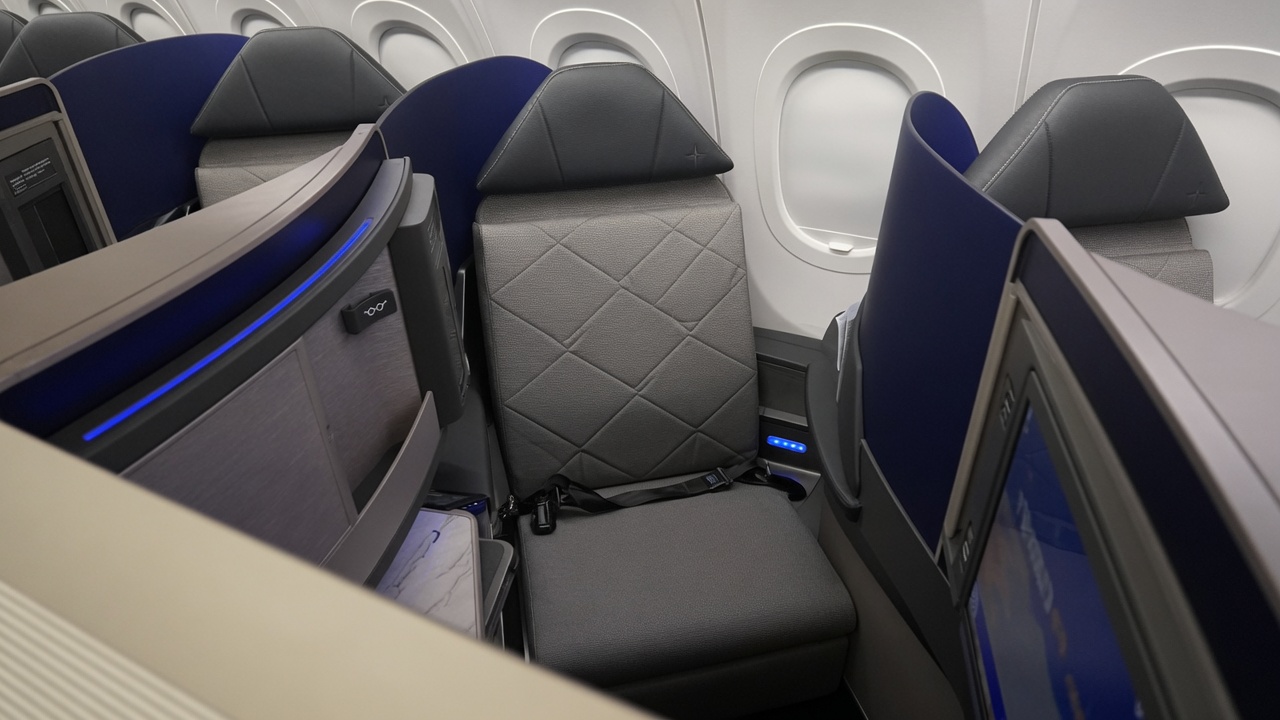
United has even turned two coach middle seats into tables, keeping the aircraft at 150 passengers and avoiding the cost of another flight attendant.
The XLR doesn’t make a narrowbody as comfortable as a widebody with fewer lavatories, a single aisle and less room for passengers to move around. But it makes routes work that would be too risky with widebody that has a higher trip cost and carries more passengers. The cost per seat mile can still be higher so needs to earn a revenue premium. That’s a big bet a lot of airlines are making but still hasn’t been proven out at scale for transatlantic flying.

Okinawa!
San Francisco – Okinawa is surprising, since there’s no scheduled U.S. flight to Okinawa, not even from Honolulu. Passengers now connect in Tokyo, Osaka, Seoul or Taipei. United will eliminate that connection while drawing passengers from throughout its western U.S. network over San Francisco.
Okinawa is an interesting leisure route and will pick up military business. It adds to already-announced San Francisco – Sapporo.
United Is Going After Affluent Leisure Travelers
Six of the ten destinations are in southern Europe or on Mediterranean and Atlantic islands: Marseille, Ibiza, Valencia, Terceira, Olbia and Catania. That’s a bet that affluent Americans will pay for nonstop flights to the places they want to vacation rather than connecting through a European hub. And it should earn corresponding cobrand credit card business.
Ibiza gets its first scheduled nonstop from the United States. Valencia is regaining U.S. service after Delta ended New York flights in 2012. Marseille provides direct access to Provence, while Ljubljana can serve not just Slovenia but also Croatia, Austria and northeastern Italy.
Luxembourg and Toulouse are potentially stornger business markets with finance and other corporate traffic for the former and the European aerospace industry in the latter. D.C.’s government, defense and connecting traffic help these make sense.
United Is Adding More Than These 10 Destinations
The headline is ten new destinations, but the full announcement includes four other flights:
- New Los Angeles – Osaka Kansai service
- Three weekly Washington Dulles – Milan Malpensa flights
- New Denver – Paris Charles de Gaulle service
- Resumption of San Francisco – Tel Aviv three times weekly in March 2027
Los Angeles – Osaka will compete with Japan Airlines, currently the only airline flying nonstop between the two airports. Denver – Paris (called by JonNYC) puts United directly against Air France. San Francisco – Tel Aviv is a restoration rather than a new route.
United says all four destinations it added for summer 2026— will return for 2027. We’ll see! They also report Nuuk, Greenland doing well. Non-daily 737 service was a cheap add. United also calls this its largest international expansion. That’s true by destinations, not clearly by seats.



Newark to Sicily ? stinky salad with cheese and anchovies ?
@Albert Wonders — United’s shot-across-the-bow at Delta, which flies JFK-CTA already.
And, I know it was a long-shot, but I was really hoping for EWR-MLE… onemileatatime.com/community-stories/male-velana-airport-new-terminal-1-international-arrivals/
*wink*
And when you fly United, they will also Break your Guitar.
Was wondering if they were going to do Budapest from Newark and Saigon or Bangkok from Los Angeles.
Very ambitious for sure. American can’t hold a candle to this stuff. You never see them expanding their network in a serious way like this.
Interested to see what United do at JFK with 2027 slots. Maybe LA + SF transcon + London + Tokyo with ANA JV.
@Will — You mentioned BUD, but ironically, AA is currently the only US carrier flying nonstop to Budapest (out of PHL), along with other secondary European markets that UA won’t touch.
Fine, UA wins the PR battle with flashy, niche long-haul routes (Ulaanbaatar on a 737 from Tokyo!), but AA’s network is focused on other regions. Look at Latin America and the Caribbean; when I was based in FL, MIA was the gateway to everywhere down there. Nobody wants to backtrack up through IAH or ATL just to head south or east.
So, while UA (and Kirby, specifically) love to make headlines (and are indeed number #1 for ASM/RPM thanks to these long-haul routes), and DL may be #1 in market cap, AA is still the largest US carrier for overall passenger volume. The US ‘Big 3’ global legacy carriers (AA, DL, UA) are a category to themselves (no, Tim, #4, WN, really isn’t even playing the same game.)
Where’s Tim Dunn? United isn’t growing very quickly right? Also tell me more about how this benefits Delta?
TAP also flies to TER from SFO (one stop service to Lisbon)
I love when I am summoned to the conversation even before I decide to post.
WN DOES serve the domestic market, 1990, but they have long lagged AA and DL in domestic revenue because they fly shorter flights and fewer connections. and, as WN has not grown its capacity much while it has rebuilt its product, AA has handedly become the largest domestic airline by passengers carried including on regional jets while AA and DL consistently generate about the same amount of domestic revenue – well above UA and even more above WN.
and Andy, the benefit to DL from UA’s announcement is that UA continues to prioritize adding dots to its route map even on a seasonal basis while UA is doing nothing to challenge DL’s growth in major domestic markets such as LAX-EWR and LAX-ORD and its TPAC additions are only to Japan, leaving DL’s TPAC expansion up and down the Pacific Rim unchallenged.
While alot of people love to see an intense and endless fight between DL and UA, DL and UA are clearly going in very different and complimentary directions with their growth.
@Tim Dunn — “Look! It’s moving… IT’S ALIVE!” (Where’s your pitch on WN going TATL?)
Many of these splashy routes actually make sense and some are geared toward corporate travel, like IAD-TLS, which is really about connecting Airbus in Herndon, VA and the mother ship. That said, almost all will rely on US-POS and with a shaky, inflation-laden economy, an ever growing risk of a partial or complete debt default hanging over the US economy, slowing job creation, and a general disdain for America around the world, one has to wonder at what point the rich will stop flying and fueling some of these routes. The average American isn’t flying to Olbia, and likely has no clue where it is.
@1990 Right but I would argue, per some of Gary’s other writing, PHL just is not a market where American will ever get the kind of credit card revenue they can from New York. I just don’t see American ever being serious about New York as long as they keep adding most new transatlantic and A321XLR routes from Philly. Eventually, they will have to figure out what they are doing on the East Coast as the current system is redundant and does not make much sense. AA still does not have the operating margins UA and DL do. Part of that is product, but a lot of that is they are way too focused on DFW and CLT and have neglected markets like JFK and LAX (though they are starting to make a comeback at ORD).
1990
this announcement is about international growth for 2027 – at least through the summer.
WN won’t be announcing anything more than Iceland, at best, for 2027 and there are still alot of issues that they have to work out in order for that to happen.
AA and DL have yet to announce their summer 2027 growth plan although DL has provided their TPAC growth for 2027, or at least part of it.
will,
PHL is a viable hub and AA might figure out how to use it including with the XLR to do things that DL and UA can do from NYC and BOS.
larry,
americans are still traveling in large numbers to Europe which is why there will continue to be demand esp. from older Americans that are seeing very strong returns from the stock market.
The US is very much in a K shaped economy and that is likely to grow further regardless of who is in charge in Washington
@Will — PHL isn’t the liability people claim. Sure, as a passenger experience, navigating those terminals isn’t luxury, and the new Flagship lounge could definitely use some extra space. But, strategically? AA owns that market. Squeezing more into JFK, or burning cash at EWR, doesn’t make sense when PHL plus the XLR lets them funnel mid-Atlantic traffic to secondary Europe at a fraction of the operating cost. Heck, for a solid business class deal, I’d catch the next Acela down to PHL in 90 minutes over dealing with NYC airport traffic any day. (Now, if Blade could make it profitable, some Manhattanites would gleefully burn their Bilt Cash on a chopper down there, too!)
@Tim Dunn — So, when are you going to submit your own ‘Community Story’ over at OMAAT? I assume the title will be: “Top 10 Reasons Delta is Flawless, United is Defective, and American Doesn’t Even Exist.” Believe me, I’ll read every single word (with fresh popcorn on the ready!)
Just what EWR needs is more flights. Their operations are already a disgrace.
“the benefit to DL from UA’s announcement is that UA continues to prioritize adding dots to its route map even on a seasonal basis while UA is doing nothing to challenge DL’s growth in major domestic markets such as LAX-EWR and LAX-ORD and its TPAC additions are only to Japan, leaving DL’s TPAC expansion up and down the Pacific Rim unchallenged.”
So 1. It is literally their international route announcement, they were not announcing domestic routes, if they did they’d call it a domestic route announcement. They have “nothing to challenge DL’s growth on LAX-EWR and LAX-ORD” – first they can add capacity whenever they want on these. Second they are literally the biggest carrier on both of these routes, they are already challenging DL. DL is not “unchallenged”
2. on the TPAC Expansion – they are expanding faster than DL TPAC and they challenge DL in every market they are expanding to or considering, MNL, SIN, HKG – United doesn’t need to launch routes to these places, they already fly to them and will have more capacity on them than when DL launches their flights. Your point literally makes no sense – United is already challenging DL on everything you mention in your post. You clearly don’t know the meaning of unchallenged.
Tim Dunn and 1990
I dont think these two markets are the same really, particularly for credit card business. I think the two are zero sum from perspective of capital and fleet allocation. The A321XLR is a limited resource and would best be deployed offering point-to-point routes from JFK that cannot be served from LaGuardia. AA should wind down JFK routes that can be served from LGA given slot constraints. JFK probably wont be much of a connecting hub.
What you are saying about operating PHL for a fraction of operating costs sounds kind of like the Doug Parker strategy of competing against low cost carriers. I just don’t think this is where the industry has gone.
It is fine if American wants to on the margin focus resources on Philadelphia and not JFK but it will just be less of an airline that serves New Yorkers.
@Will — AA is already using the XLR for premium point-to-point out of New York (like, JFK-EDI launched this past spring, and JFK-BCN is lined up for winter), alongside transcon Flagship suites to LAX/SFO. JFK will never be a massive connecting hub again mostly because of slot constraints. PHL enables AA to pull traffic from across the East Coast and Midwest and throw it across the Atlantic without wasting those precious JFK slots on 150-seat narrowbodies to niche destinations. If AA built its international strategy around trying to out-NYC United at EWR, they’d be burning cash just to prove a silly point (and they clearly don’t have much excess cash to burn right now).
Andy,
DL announced LAX-HKG, LAX-ORD and LAX-EWR months ago and are flying some of it already. UA announced nothing. These are UA strength markets and if a carrier is not happy, they announce something in another carrier’s strength markets. UA is not adding capacity in these markets anywhere close to offsetting what DL is adding which means that DL’s share of these markets will go up much faster. I can assure you these 3 markets combined are worth far more than all of the TATL routes UA announced.
as for TPAC, no, UA did not grow faster than DL in the 2nd quarter. DL grew TPAC by 8% which is twice the rate of TPAC growth for UA. Given that DL’s TPAC network is currently about half the size of UA’s, the absolute amount of capacity added by the two is about equal.
UA has not added any new capacity to MNL or HKG since DL announced them.
and if DL is growing at a faster rate, then they will take share from other players.
Newark to Ibiza might just be worth it for the people watching.
United does an amazing job with its international routes. Compared to AA and Delta, United is the most ambitious in terms of international routes. Luxembourg!
@ Tim I think you’re drawing too much from the fact that UA hasn’t announced a direct response.
DL’s LAX-HKG, LAX-ORD and LAX-EWR additions are meaningful, and DL’s share in those markets should rise. But “UA announced nothing” does not prove UA is unhappy or strategically weak. UA already has substantial positions in those markets, and airlines do not need to respond flight-for-flight every time a competitor adds capacity. If UA thinks its existing schedule produces the best return, adding more seats just to make a statement would be irrational.
I also don’t buy the claim that those three DL additions are “worth far more” than UA’s entire TATL announcement. On a basic deployment basis, DL is adding 42 weekly departures: 7 widebody to HKG and 35 domestic narrowbody departures to ORD/EWR. UA’s Europe announcement is roughly 52 weekly departures, including about 21 widebody and 28 XLR departures, before even counting SFO-TLV. That is plainly a larger long-haul aircraft commitment.
You can argue that LAX-HKG, ORD and EWR are larger underlying markets, but that is not the same as saying DL’s incremental flights are more valuable. DL gets only a slice of heavily competitive markets, while UA is adding a broad portfolio of long-haul routes, several with limited nonstop competition. Without actual route-revenue data, “worth far more” is just an assertion.
On TPAC, yes, DL grew about 8% in Q2 versus roughly 4% for UA, and because DL is about half UA’s size the absolute amount of capacity added may have been similar. But one quarter of percentage growth does not establish a structural share trend, especially after UA had already gone through a much larger Pacific build-out and then moderated growth.
And UA not adding more capacity to HKG or MNL after DL announced service proves very little. UA already serves those markets and does not need to add seats simply to demonstrate that it is “responding.” Competitive strength is not measured by reflexively matching every new entrant.
DL is clearly making an aggressive push. What is not clear is why UA’s failure to mirror that push should be treated as evidence of weakness, or why three DL additions should simply be declared more valuable than a much larger package of new long-haul flying.
Andy
I did not say that UA is weak for not responding.
domestically, DL has a far greater track record of growing into other carriers’ strength markets than any other airline. DL has shifted its focus on taking share from AA’s top markets to UA even as it continues to grow its share relative to B6 in NYC and BOS.
I do think – my opinion – that UA knows it is not going to stop DL’s TPAC growth esp. since DL is doing it wiht even greater cost efficiency due to its more fuel efficient TPAC fleet and lower fuel costs and so that is why UA is not responding.
and not only are HKG, LAX-ORD and LAX-EWR higher revenue markets but DL gets a far greater advantage entering those competitive markets than UA does in adding multiple heavily seasonal, less than daily routes to secondary and tertiary markets in Europe. That will be just as true if AA, as expected, opens service to cities that DL and UA serve in Europe but AA does not.
and, again, AA and DL have not announced their complete international 2027 summer new routes while UA just did. DL might add more TPAC routes but they are certainly going to announce more TATL besides AUS-CDG.
@1990 Fair enough. I just see reports that Scott Kirby is actively searching to buy JFK slots for United beyond the 7 they will receive in 2027. I don’t see reports that American is actively looking to acquire JFK slots from other airlines in a similar way and cannot help but wonder if Philadelphia success is making them complacent at JFK and about the importance of competing in the New York market in general.