
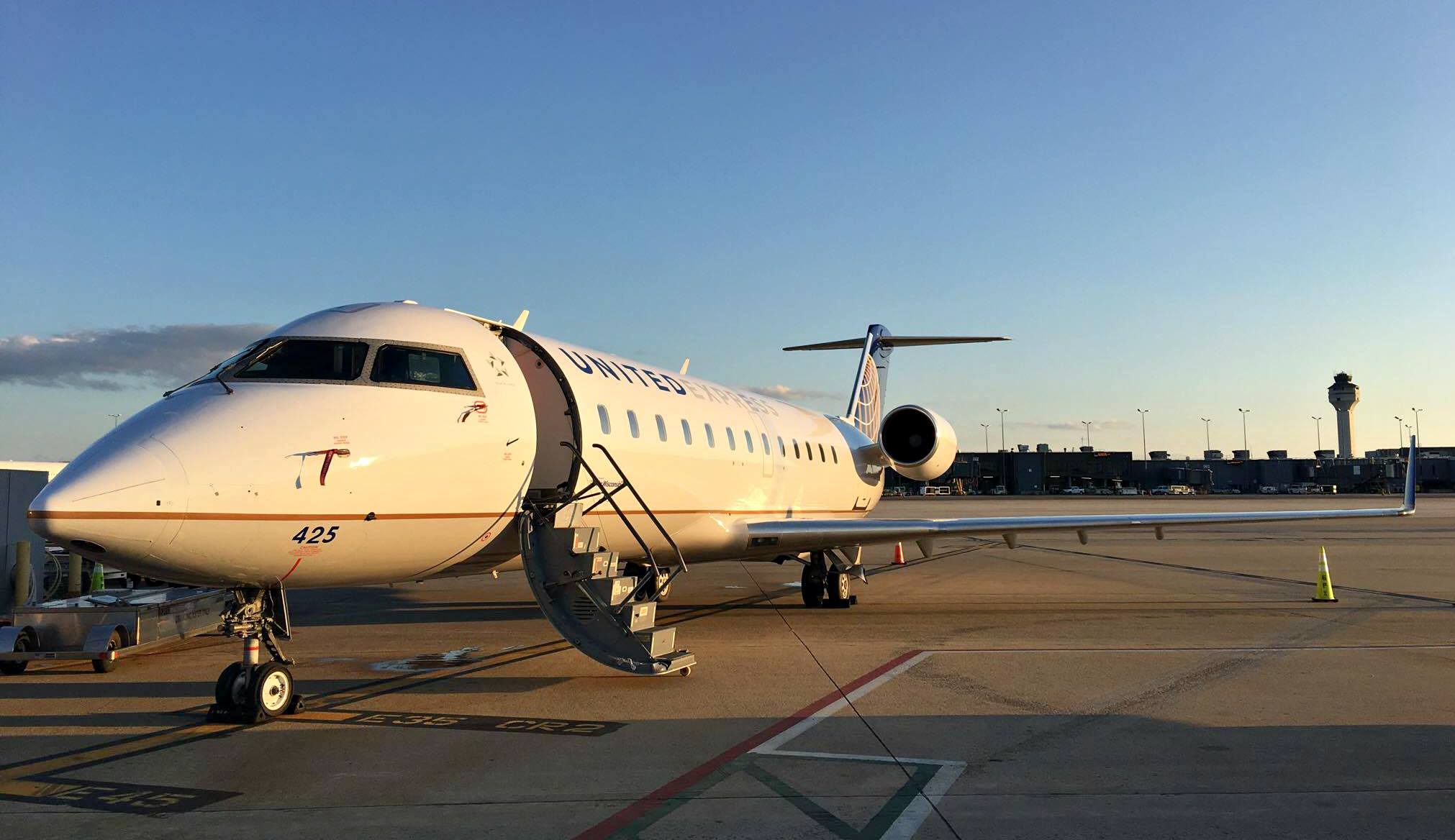
Enilria flags an offer in Victoria, Texas where each resident booking a roundtrip flight from their airport received $100 in order to bolster their subsidized United Express regional jet service to Houston. SkyWest receives “nearly $7 million for the service.”
Victoria, Texas has had one of the highest subsidies per passenger in the Essential Air Service program. It’s only about 100 miles from Austin and also from San Antonio. It’s just 110 miles from Houston Hobby and 120 miles from Houston Intercontinental. (It’s also 83 miles from Corpus Christi.) While some people like the convenience of flying in and out of Victoria on a small regional jet, those connections add travel time and connecting risk, and many residents just prefer to drive somewhere else to start their flight. They have options.
Essential Air Service was created by the 1978 Airline Deregulation Act as a temporary measure to soften the blow of deregulation. It provided for a ’10 year transition’ period in which small community service could receive subsidies. The program was supposed to end in 1988. In Tyranny of the Status Quo (1984), Milton Friedman wrote “Nothing is so permanent as a temporary government program.”
- About 175 communities have been receiving subsidies. More than a quarter of those are in Alaska.
- Subsidized cities are supposed to have at least 10 passengers per day, though this requirement can be waived. Many of the planes fly largely empty.
- Airports within 210 miles of a medium hub or larger used to be capped at a subsidy of $200 per passenger. However, Congress more than tripled this in 2024 to $650 per passenger for airports within 175 miles of the larger facility.
2024’s FAA reauthorization more than doubled funding for the program, with promised increases in future years. Not only didn’t the program die in 1988, it grew to $22 million in 1998 and to a discretionary $155 million in 2018. It was authorized at:
- $340 million for fiscal year 2025
- $342 million for fiscal year 2026 and 2027
- $350 million for fiscal year 2028
People choose to live far away from an airport. And for many of these airports there’s just no justification for subsidies at all.
- When they’re within reasonable driving distance of another airport
- Many of these flights don’t even connect to hubs, so driving and picking up a non-stop is more convenient anyway.
- The average airline passenger has a six figure income, making this reverse Robin Hood
- And flying empty, inefficient planes raises environmental concerns
If you’re traveling out of Pueblo, Colorado you could just as easily drive to Colorado Springs to start your journey. Hot Springs, Arkansas is less than an hour from Little Rock. Decatur, Illinois is less than an hour from both Champaign and Springfield. Why subsidize service 110 miles away to St. Louis?
The new law did at least restrict subsidies to airports in the contiguous 48 states that are “at least 75 miles from the nearest medium or large hub airport.” But the distance shouldn’t be measured from a medium hub!
- Lancaster, Pennsylvania is about half an hour from Harrisburg
- Muskegon County Airport is less than an hour from Grand Rapids
- Owensboro-Daviess County, Kentucky is under an hour from Evansville, Indiana
I genuinely don’t know why taxpayers are on the hook for over $200 per passenger to subsidize air service from Lancaster, Pennsylvania when the airport there is 59 miles from Philadelphia.
The reason this program lasts is concentrated benefits and dispersed costs. Members of Congress and constituents in districts receiving these subsidies care a great deal about them and are willing to exert muscle and treasure to keep them, while the public at large cares very little about the program. At less than $2 per person per year, there’s little incentive for the median American to learn about the program let alone oppose it. But Members of Congress whose districts benefit get onto House and Senate committees responsible for the funds.
Spending on the program had already quintupled over the past 25 years before being almost tripled in this new legislation. It’s grown under both Republican and Democrat-controlled Congresses and administrations.



Gary, you’re doing good work shining a light on examples of this program getting misused and abused…
I fly out of EAU. It’s incredibly convenient. But it’s 75 minutes to Minneapolis, and anything further from Minneapolis is closer to CWA, LSE, DUL.
The planes are also full, so it should be commercially viable on its own, especially the current service to ORD which offers much better connectivity than the drive/shuttle to MSP.
@Christopher J Raehl – never assume that load = profitability. Also, ever assume that EAS operators are being honest in the costs structure to operate EAS flights.
I understand the purpose of EAS but, like most programs, it needs to evolve over time as circumstances change. Let’s take LNS as an example.
LNS sits 32 miles by car from MDT…a 12-gate airport that, this year, will serve over 1.6 million passengers on five airlines with 17 nonstop destinations, including the major hubs of PHL, IAD, CLT, ATL, DFW, ORD, DFW and MCO.. Within a 1-hour drive of MDT there are approximately 1.7 million people, 550K of which are in Lancaster County, PA. South Central PA operates as one region. People move around this area with absolutely no difficulty. People in Harrisburg drive to Lancaster for shopping, dining, etc., and the people from Lancaster drive to Harrisburg for the same. Almost like a (very) mini-DFW where the cities haven’t grown together yet.
ANY subsidies to fly people from LNS to PIT or IAD (via EAS) or MCO on Breeze makes ZERO sense. PIT is no longer a hub and IAD is already served from MDT (far more reliably) via UA. If you live in LNS and you cannot drive, uber or train it to MDT, seems like that’s a bigger problem.
I am not suggesting we eliminate EAS…there are communities that need it. But, there are communities, like LNS and Victoria that are using it as an ATM. Personally, I’d rather see subsidies go to MDT to add service other major hubs such as JFK/LGA/EWR (used to have this service) or DEN and LAS. Would yield a much better ROI in terms of overall global connectivity in the region.
I don’t understand this statement:
“The new law did at least restrict subsidies to airports in the contiguous 48 states that are ‘at least 75 miles from the nearest medium or large hub airport.’ But the distance shouldn’t be measured from a medium hub!”
If, in order to be subsidized for EAS, an airport had to be at least 75 miles from the nearest “large hub” (with medium hubs not included), then *more* airports would be eligible for EAS, not fewer.
Passengers don’t literally receive a Benjamin… it’s a subsidy. Please, by all means, refer to all public funding in these terms, such as, the billions in subsidies for oil and gas industries… it’s like giving motorists $20 every time they fill up their tank!
Typical government waste. A machete should be taken to all, and force each program to re-justify itself.
Maybe there was a large local junket during the time that the offer was in effect and this was a “legal” way of providing a subsidy to the people on it.
ESA another fraud that the sheep are willing to pay for. If being near an airport is that important to you then move to a city with an airport with regular commercial service.
If you look at the link given, it seems like it is being done as a rebate. People have to apply with documentation. Then they most likely would get a check. Not a Benjamín but it could be turned into one at the bank.
@DFWSteve — Really? A machete? You going full-Rwanda 1994 on us?
@1990 you know some people do not distinguish between the baby and the bath water.
@DFWSteve maybe instead of blowing everything up and then watching chaos ensue, maybe we revisit what EAS service should accomplish in the next 29 years and make targeted adjustments.
Gary leaves out most of the pertinent information which Enilria did correct much of…. it was a local funding program via the county to use leftover funds for promoting local spend. You had to be a resident of the county to partake and had to fly a round trip from Victoria, returning to Victoria, within December (with return by January 7 or something).
The airport had its commercial runway closed for most of August due to pavement construction. This used additional local county dollars that would have gone into nothingness to one, give people a reward for flying from there, and two, to insulate the enplanement hit from not having airline service for a month.
Following up to my previous comment, maybe Gary meant that EAS service should be limited to airports that are more than 75 miles from an airport classified as a large, medium, *or small* hub. That should cut down on the number of airports eligible.
@Parker — Yup.
“Some men just want to watch the world burn.” — Alfred Pennyworth in The Dark Knight (2008).
Gary, you weaken your argument when you significantly understate the distance to drive from Victoria to IAH (146 miles), HOU (138 miles), AUS (120 miles) and SAT (121 miles). No interstate highway goes to Victoria. The County wisely keeps its airport viable because it’s important for economic growth. And the Victoria program worked….emplanements doubled. I respect your views but support the EAS program for rural America.
@JW – those are air distances
Forget the distance, how about the time it takes to get to side of these bigger “hub” cities. It takes about 2+ hours to get to IAH from VCT by car. And at least 2hrs to AUS. No one flys out of SAT oR CRP so no need to include them as alrernatives. So i can see why there is service there somewhat. I think they could use a portion of that money for the other aviation priorities currently causing issues like…hmmmm , ATC updates to equipment and personnel.
Another way of looking at EAS would be to determine if bus service would be more economical than air service. Would anyone think that subsidizing Greyhound (or anyone if it’s competitors) is less viable than air service?
Many times, we look at air subsidies as a sink cost, federal dollars having been spent to build a passenger terminal. I don’t begrudge rural America for the opportunity to get to a larger city for services such as a better medical center. But it would be worthwhile to compare ride-share with bus and air service to identify the most cost effective approach. Ride-share provides the most time-sensitive approach, but at a high per-passenger cost. Shared ride-share is slightly more cost effective.
My city is having a referendum on public transport in May. I can walk about 300 feet today to a bus which takes be to a train station to DFW airport, or downtown Dallas. The bus, running ever 20 minutes, is lightly used, but may be less than subsidizing ride-share. No one really knows. Most of the subsidy goes from my suburb to service within Dallas itself. This is a microcosm of public transport and EAS. How much do we want to pay to enable workers to get to their jobs which don’t pay enough to privately pay for private autos, and how much should we pay for rural community residents to get to another community with better medical care and other services, and what’s the most cost effective way of doing so? Urban transit is frequently subsidized by federal tax dollars, should rural residents not get some of that largess?
It is almost as if at times, the argument is that low numbers proves they are remote, so really need the help. The problem is very simple, it is easy for a minority (meant only in terms of numbers) to exploit the majority. We pay (these numbers may be a bit old and low) $2 billion extra as consumers so U.S. sugar producers can make a billion more (the other half is lost economic efficiency). So, a family of four pays $24/year. It’s hard to get them vocal about eliminating a program. It’s easy to get the sugar producers (and their employees, who really don’t share the largesse) to make waves. In the US, there are many more non-farmers than farmers. Ag legislation “helps” farmers by pushing up prices. In some African countries, farmers outnumber non-farmers. Ag legislation there keeps prices down.
Michael Cloud (R) represents TX 27th, lives in Victoria, and sits of the Appropriations Committee. He wins his district by 32 points. Still, if I was in the House (don’t worry, make believe), do you think I could get him to vote against EAS even if he, in his heart, thinks it is wrong? Nope. Wonder if he uses those flights? The only hope might be to do a modern equivalent of the base closure commission.
I was born and raised 20 min from Victoria, TX and my elderly parents still live there. I’ve lived 25 min from AUS and/or DFW in adulthood for 15+ years now and can compare and contrast the rural/urban experience and share more context about the region. The Crossroads region of South Texas where Victoria, TX is located is a hub for industrial activity related to petrochemicals (take with that what you will). While I’m certain there are instances of abuse with these subsidies, I can see a number of real use cases for subsidizing rural ‘dead’ zones connecting them to the rest of the world. I’d liken it to subsidizing healthcare access to these same areas so people have urgent, emergency care, obstetrics, etc. within survivable distances (a ton in this area have been purchased by private equity and closed in recent years). It is SO rural in much of this region it’s difficult to comprehend. Port Lavaca and Victoria are the ‘big’ towns in the area. Even now, internet there can be spotty and inconsistent–it’s much less reliable than we’re used to in urban areas like DFW.
Take as one example case for connecting to large hubs: this region (Port Lavaca in particular) has a much higher percentage of Asians than the rest of Texas. It’s mostly a mix of Taiwanese/Chinese highly skilled immigrants working in these petrochemical industries (for one, Formosa Plastics is a Taiwanese company; my parents fall in this camp but think Dow, Exxon, Chevron, etc ) and refugees from Southeast Asia (e.g. the region accepted a large number of refugees from Vietnam following the war many of whom contribute greatly to local businesses/vibrancy and more). Houston is the nearest large, diverse hub where these people can find community. IAH is also where you will find all the long haul flights to Taipei and connecting to Southeast Asia (think EVA Air).
With Houston traffic, it is EASILY often 3.5 hrs to get to IAH from places like Port Lavaca and Victoria. I’ve seen worse many times too.
Growing up there, it was not uncommon to drive to Houston weekly for access to groceries specific to our culture. Many in our community including ourselves trekked to IAH to fly and visit family regularly. It is NOT a fun drive. When my now 65+ retired mother was flying to and from Taipei (TPE) very frequently the last 1.5 year to see out grandmother’s last days on Earth while my father was still working in Port Lavaca, the Victoria connection was an absolute lifesaver. They’re at the age where I really worry about them on the road and they just can’t road trip like they used to. There were the occasional flight delays/cancellations that led to my dad driving alone to IAH to drop off/pickup my mother in pitch black at night/early AM (it’s that rural) and I can’t tell you how stressful it is to sit with your phone and worry the entire time. Similarly, when my sister living near LGA had a newborn 2 years ago, overlapping with my grandmother’s last days, the Victoria connection to IAH – LGA was an absolute lifesaver for my mom to go stay and help my sister for periods. My grandmother and my sister/baby’s situation were both very up and down and unpredictable. There were times my mom would get home and quickly need to get on a flight to TPE/LGA again. My dad would have just spent days on end driving if he had to drive back and forth to IAH each time and he was still working full time.
I’m certain there are a lot of factors related to corporate interest also as to why Victoria continues to be subsidized also, many of which are likely bad for the average consumer but I won’t get into that here. These petrochemical corporations generate enormous amounts of revenue and have ridiculous influence over the local and state government.
This brings me to the the Robinhood situation though. This article portrays the Robinhood effect as though Victoria and the region are the recipients of Robinhood but I’d argue, and there’s quite a bit of evidence, to the contrary. Texas literally has a Robinhood law, or ‘recapture’ law requiring “property-wealthy” areas to redistribute large portions of their local property tax revenue to other districts considered in need. In places where “property-wealth” comes from high value homes, I can’t argue with this. However, the law disproportionately affects rural places like Victoria, Port Lavaca, and the surrounding region where “property-wealth” comes from the taxes these petrochemical companies pay and not from high home values. These regions get mis-classified as ‘property-wealthy” under this law. My family was part of the lucky small percentage there educated with decent incomes but the vast majority of this community and the other kids I saw growing up lived in abject poverty. The state of public education, healthcare, and circumstances of others I witnessed growing up and more is an absolute contrast to say, my husband’s childhood in a wealthy part of Austin. These regions absolutely need more funding and support.
Obviously there’s a much bigger picture here I won’t get into and there are serious flaws with the government and economic structure including the free for all reign petrochemical companies have and much more, but subsidizing connectivity to the outside world is I think one of the lesser issues. I shared my personal experiences of why the VCT connection is important to me, but I admit my privilege with the circumstances too. For most people in this region, connectivity to hubs is their only path leading away from abject poverty. The airport and related industry there supports jobs and connects people who would seriously struggle and be so cut off from the outside world otherwise. Think of the underprivileged kid whose parents don’t have a reliable car or can’t take off work to drive them, worry about attending university in a big city far away for fear of not being able to be there for or help support their family, being able to attend college because this rural connection gives them the physical ability to get back home easily without it costing an arm and a leg or losing another working day to driving.
We all benefit when more of the community flourishes. There are many many issues in all of this, but I strongly disagree with ending subsidies connecting rural regions to hubs. Perhaps it needs to be reshaped, and many factors outside of it need to be changed, but making these connections expensive and unfeasibly difficult is not the answer.
@Crossroads born and raised — Thank you for taking the time to draft and share your thoughts here, especially as someone from and still connected to this area. I tend to agree that subsidies for those in-need are still helpful and often necessary. Unfortunately, you may find there are a lot of libertarians on here who think they’re cowboys, yet, they, too, often receive assistance, one way or another. We are a community, large and small; wish we’d act more like it.
I’m from Alaska, and 75% of our towns can only be reached by plane or boat. Some folks in the lower 48 don’t have the luxury of traveling to other towns to get to an airport. Get over it.
As political lean continues to further split on geographic locale with sparsely populated districts trending more republican and more densely populated districts trending democrat, it shouldn’t surprise anyone to find EAS on a chopping block of a future democrat administration and congress. Look at the voting trends – does anyone really think that there’s more than a handful of democrat reps reliant on EAS voters? Think of it like the inverse SALT cap, another reverse robin hood benefit but one that instead benefited mostly democrat district residents. EAS’s best shot at continued robust existence in a democrat-led period can be summed up in four words: Alaska Senator Mary Peltola.
It’s worth pointing out also that the petroleum and petrochemical industry that the Crossroads region Victoria anchor is a massive contributor to all the jetfuel used in the US. It’s difficult to pin down exact numbers but it’s something like 1/3 – 1/2 of the nation’s output coming out of these refineries that wouldn’t exist at that level without the population of various labor and technical expertise who choose to live here. You want people to choose to live here and support your flying habits and ability to have this site as a platform. It’s in your best interests.