
A reader spotted the Hyatt Place Phoenix Mesa with a housekeeping cart with bulk toiletries “in condiment containers.”
Hyatt Place hotels normally feature KenetMD, which was a line Hyatt Regency properties used to feature (it replaced Portico White Ginger in late 2012). Hyatt featured it before there was a consumer-facing retail product.
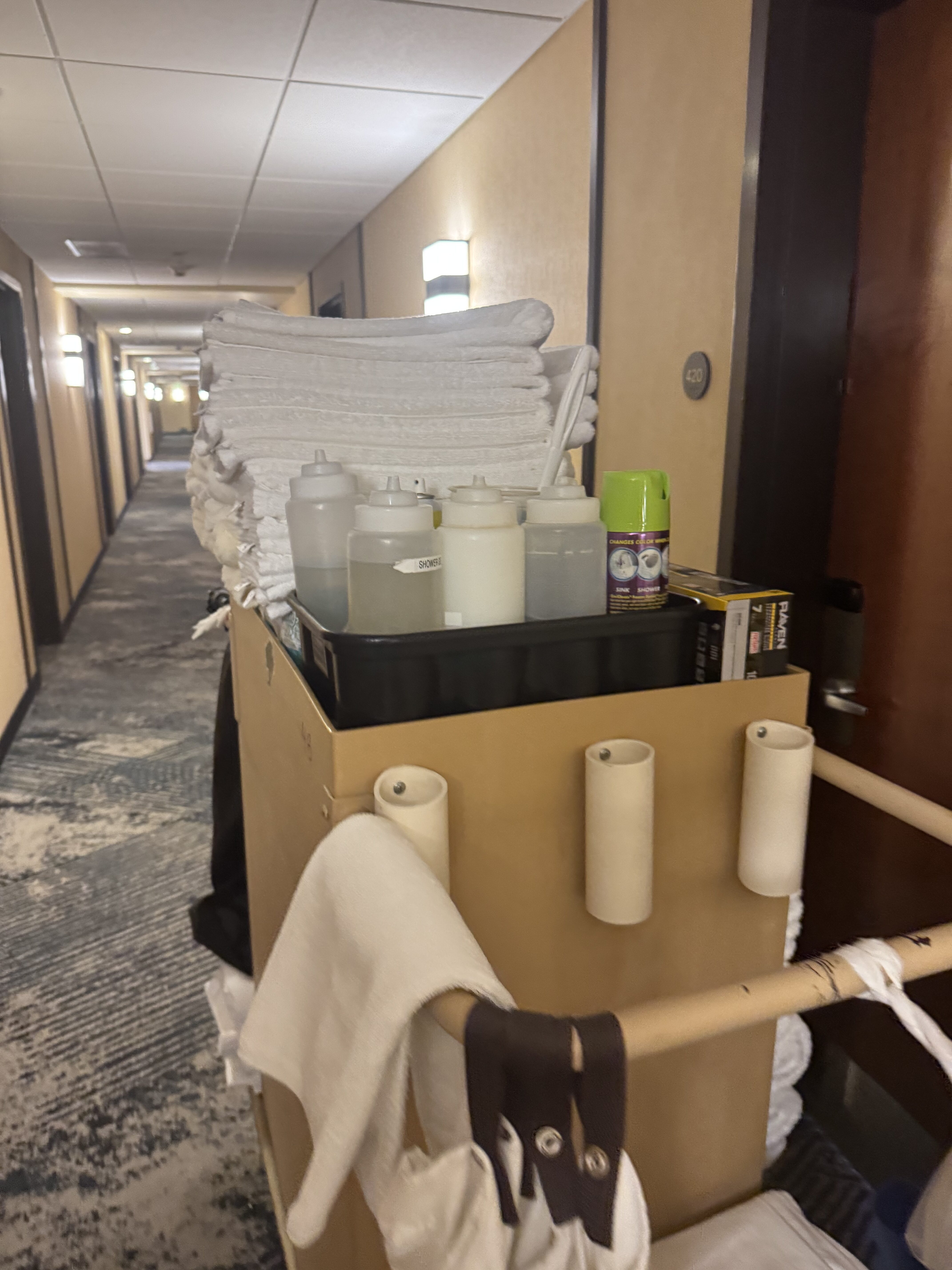
The reader also notes that “the toilet bowl brush is next to fresh towels too” on the cart.
It seems to me that,
- The Food, Drug, and Cosmetic Act governs cosmetics sold or distributed. This includes soaps, shampoos, and lotions used in hotels.
- The FDA resulates this under 21 CFR 701. Products must carry proper labeling: product identity, net contents, manufacturer or distributor name and address, etc. A container without any labeling typically qualifies as “misbranded.”
- The fact that the hotel is providing the product (versus selling in a store) would not exempt it — the law applies to any distribution in commerce, including hotel amenities.
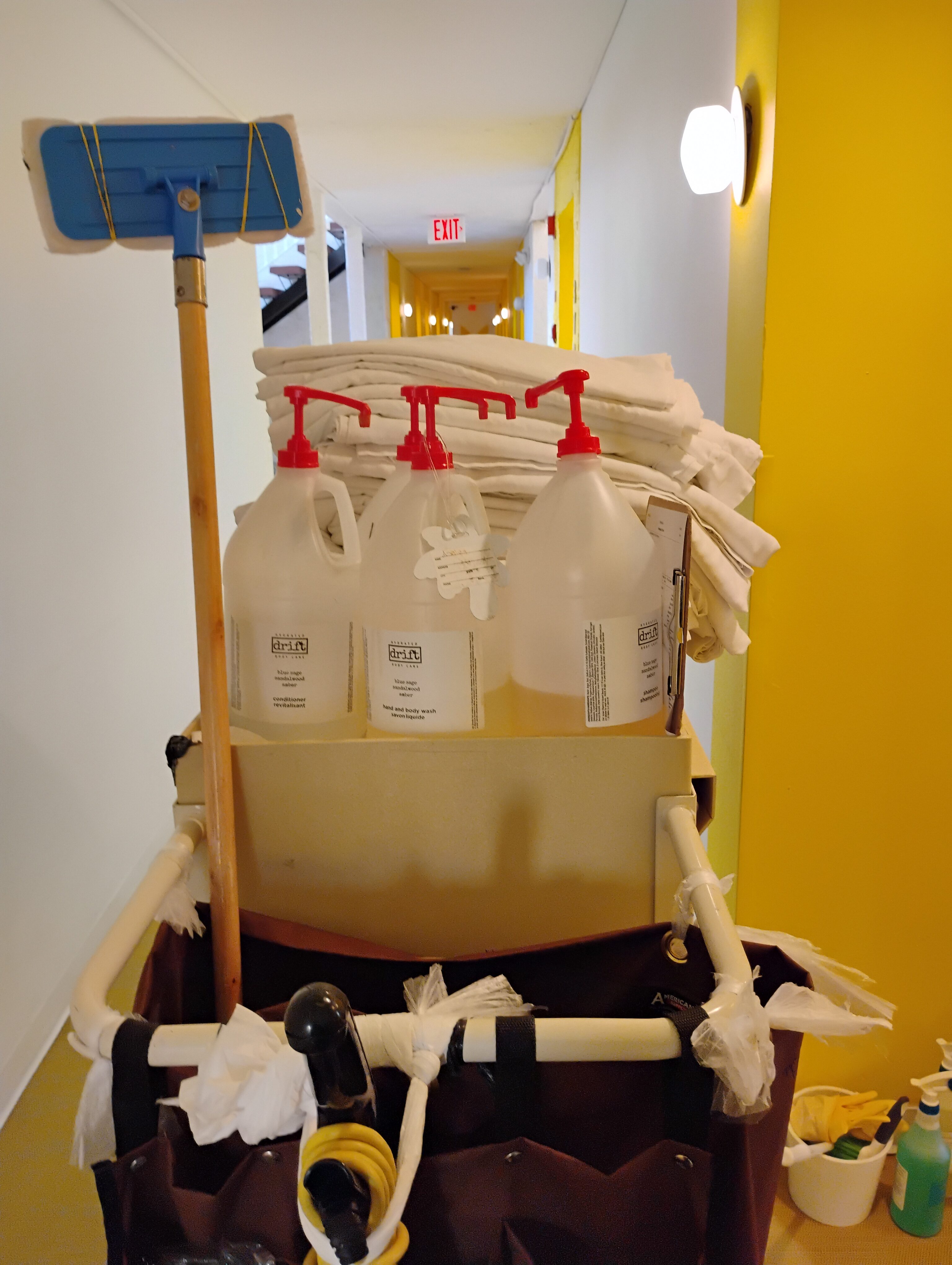
Last month I wrote about the Wild Palms Hotel in Sunnyvale, California, which is part of Hyatt’s JdV brand, appearing to be using JdV standard amenities in guest bathrooms – Jonathan Adler brand – while stocking housekeeping carts with “bulk, industrial service jugs of DRIFT Hydrated Body Care.”
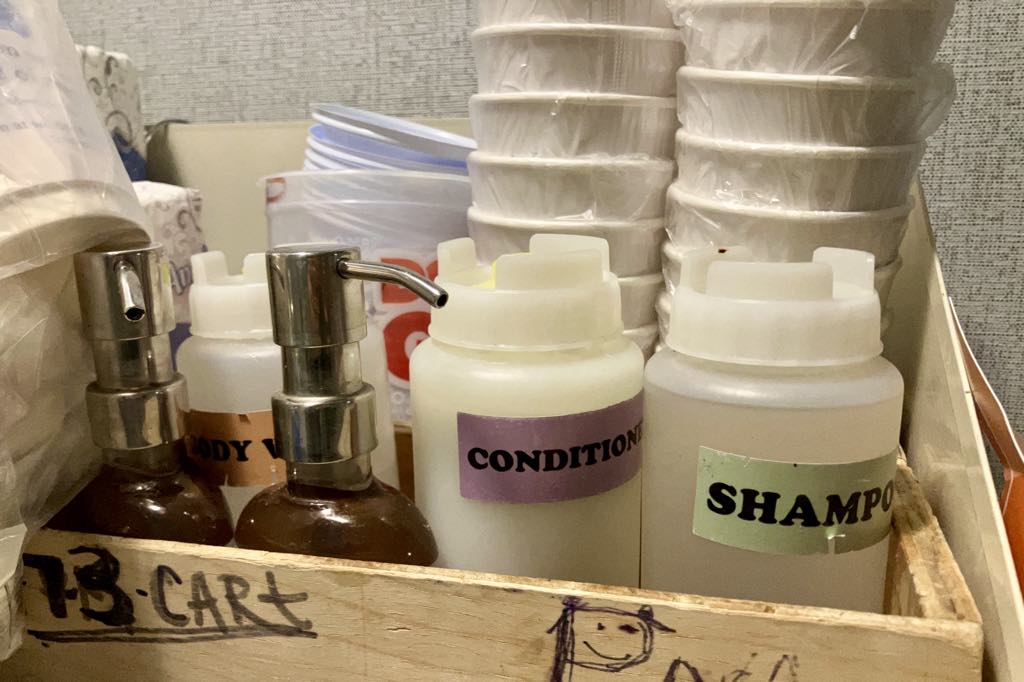
Earlier this year I wrote about Hyatt Regency San Francisco appearing to refill bulk shower toiletries in guest rooms with ‘mystery goop from a commercial ketchup jug’.
In addition to FDA rules, California has its Safe Cosmetics Act requiring disclosure of listed chemicals and clear identification of cosmetic products. An unlabeled bottle cannot meet this requirement. The California Fair Packaging and Labeling Act further requires an identity statement, manufacturer or responsible party, and net contents. Unlabeled containers fail all three of these requirements.
I have been concerned about these bulk dispensers in rooms replacing individual toiletry bottles to save money for a long time. There are 5 issues with them.
- Authenticity While some upscale hotels in China have been known to distribute counterfeit branded toiletries even in individual bottles to save money, it’s far more likely that you’re getting what’s on the bottle when it’s in the bottle versus just refilled into a branded package on the wall. You don’t know what you’re really getting when you don’t see the package.
- Security Previous hotel guests might find it funny to put something other than shampoo or bath gel in the bottles, or to mix them up. For instance, someone replaced the soap in dispensers at the Detroit airport with bodily fluid and you don’t know who was staying in your room before you. Some hotels use tamper proof mounting on the walls. Many don’t. Or the mounting is left unlocked.
- Germs You should not believe that the dispensers themselves get thoroughly cleaned and sterilized between guests. Here’s a National Institutes of Health study on bacterial contamination of bulk-soap-refillable dispensers.
- Availability Housekeeping just doesn’t refill these, the way it’s obvious when a bottle has been opened or is missing.
I stayed at the same Marriott Courtyard two weeks in a row where I was assigned the same room both times. My bath gel was empty throughout my first stay, and it was still empty a week later.
- Experience. It’s not a premium experience. There’s no ‘take away’ to remember the stay.
Indeed I use shampoo and bath gel at home that I discovered at a hotel, I imagine many of you do too.
Readers sometimes question whether I’m too cynical, thinking that hotels would refill these branded bottles with something cheaper. Do you?



While I recognize this as one of your idiosyncrasies, it’s one I agree with wholeheartedly.
More evidence that getting rid of small soap and shampoo bottles had nothing to do with the environment and everything to do with the continued enshittification of basically everything run by big business.
Thank you for trying to keep the hotels honest on this.
Oh, Gary, it’s December 5! Y’all gettin’ Zork’d yet? @C.D. Bradley, @Boraxo, @Ken A?
Gary, I think you need to modify your approach to stories that call out the outrageous behavior of many, many hotels. Instead of shining the spotlight on the hotel brand such as Hyatt in this case, you need to start calling out the actual property owners.
The hotel industry has changed. Many properties, cutting across multiple brands, are now owned by large hotel management companies. This is where the bad actors reside. We need to start calling them out specifically or things will never improve.
Forgetting all the questions and concerns about germs, counterfeit products, etc., who’s to say a housekeeper who may not even speak English pours the right product into the dispenser?
Since hotels have cut over to the name brand bulk toiletries, Ive often wondered when they refill them , are they being refilled with the authentic brand or some generic inside a name brand bottle.
Several things I check when I first enter a room.
1 AC
2 Shower
3 hot water
4 toilet
5 filled toiletry bottles
6 Bed cleanliness
7 no connecting door
This is an Aimbridge Hospitality hotel.
I guess the old getting pregnant from a toilet seat myth can be replaced by getting pregnant from the unknown liquid in the hotel body wash bottle.
@David P — It sure is the owner/operators; however, the brand can enforce, so, it’s both, really. Gotta go for the deep pockets if you ever want anything to be done anyway.
I never use hotel shampoo, conditioner or lotion. I will use the wrapped bars of soap to wash my hands. Other than that, I bring my own toiletries.
Gross at the toilet brush stuck in with clean towels!
Housekeepers only get a certain amount of time to clean a room, too, so you don’t think your room is really clean, do you?
My god what a bunch of germaphobes. Please quit clutching your pearls over stuff like this. There is a reason I like Ben’s blog, Award Wallet and even TPG over Gary’s (and it used to be my favorite). I am SO sick of the endless stories people send him regarding dirty planes or hotel issues plus his pursuit of stories on Reddit and Tik Tok. Then we have the endless shilling for the Citi Strata Elite card.
Really losing any benefit and very little REAL aviation news I haven’t already seen on another site. Keep meaning to drop it but just lazy I guess.
“It sure is the owner/operators; however, the brand can enforce, so, it’s both, really. Gotta go for the deep pockets if you ever want anything to be done anyway.”
Enforce what? The parent company usually puts boots on the ground for a QA audit once a year and during that audit, things will be done as close to “by the book” as the property can fake. The parent brand has no clue what goes on the other 364 days a year. How could they? Before you say guest reviews or feedback surveys, the percentage of guests that actually do post stay surveys is very low (single digit percentage low) and is notoriously unreliable (i.e. lying-embellishing BS which is largely ignored).
The North American hospitality industry is basically an episode of Hogan’s Heroes where the parent company are Schultz (we know nothing and we see nothing) and Klink (clueless and ignorant) while properties are digging tunnels under the fence and engaging in sabotage at will.
The health studies around refillable soap containers have been batted around for a while now, with many saying that, given who funded the initial studies, it’s just an attempt to lock customers into one vendor’s sealed soap containers. I’ve looked at the studies, and it seems settled science now that once a refillable container has become contaminated, there’s no practical way to decontaminate it, no matter how much fresh soap product you put in there. What’s lacking in the hotel industry is a premium product and form factor for refillable cartridges that make sense. Most of the products are harsher soap/shampoo combos that are tamper-proof, but definitely not premium; more mid-scale at best.
Requiring hotel websites to explicitly show the ownership of particular properties would go a long way towards fixing the “bad actor” problem, which is why it will never happen.
Thanks to VFTW and the community I bring my own toiletries on travel now. Very nice piece of mind to have.
@1990 — I hope @Ken A gives us live updates from the lunch tomorrow in his usual unique style!
Really @Diane? REAALLY Diane?? (@L737, just for you.)
Given that most hotels are owned by franchisee and hire at least in the US people not here legally for housekeeping, or at least do not ask too many questions you’re a fool if you think said workers won’t do things like put the toilet brush next to the stack of clean towels. You expected what for $8.50 an hour?
I always bring a bar of soap from home with me. I know it is safe
A health care co-worker of mine on assignment accidentally washed her face with a wash cloth containing cleaning chemicals left on the hotel bathroom sink. With Housekeeping personnel like everything else, you get what you pay for. American corporations don’t want to pay, the profits float to the very top and we put up with it.
@1990 — Bah! “Okay, I get it.”
You should flag that Marriotts just throw out the bottles.
@Retired Gambler — “even TPG over Gary’s”… take. It. BACK! Those corporate shills over at TPG can’t even handle comments. I don’t mind these clean-your-hotel or clean-your-planes stories, so much as I appreciate the sense of community here and at Ben’s, Matt’s, and a few others’ sites. TPG has none of that; they just hawk lower-than-public-offers on cards, and over-value SUBs and benefits, like, to an absurd degree.
Greetings from Zorkfest. I am staying in the new tower at the upscale M Resort-Spa-Casino in Las Vegas. This hotel uses bulk toiletries like shampoo, conditioner, and body wash, which are affixed to the wall in the guest room shower.
@Ken A — Thank you for the wonderful update, have a fun time and keep us posted!
Why do they put the brooms facing up on the cart so when you are walking by in a narrow corridor your face and/or clothes can rub against what was just wiped up from the floor?
@Ken A — Mah man! Zork it up!!
The CDC is clear in that linked report: “Do not add soap to a partially empty soap dispenser. This practice of ‘topping off’ dispensers can lead to bacterial contamination of soap”.
Later: “Recent studies conducted in the United States demonstrated that 25% of bulk-soap-refillable dispensers in public restrooms were excessively contaminated (8). Bacterial loads averaged more than 106 CFU/ml of soap, and 16% of the samples contained coliform bacteria.”
We have also noticed moldy smells emanating from bottles more than once.