
American Airlines has a new internal playbook for oversold flights — and it changes how you should think about taking a voluntary bump. A leaked memo lays out two rules that matter to passengers: everyone is supposed to be paid the highest offer the gate makes, and the third offer is usually the ceiling unless managers approve more. If you want the most compensation, that inside detail is now part of the strategy.
The carrier solicits passengers to take a voluntary bump in advance of travel. Customers may receive an offer to move to another flight (sometimes on a different day) for no compensation. Perhaps some people agree. And during check-in passengers are asked for the minimum amount they’d take for a bump. Those customers get first dibs on lowball compensation.
After working through customers that may have raised their hands for compensation through the app, the gate will start making offers to passengers. This is a game theory exercise.
- There’s a limited number of passengers that need to be bumped.
- If you really want compensation, you want to take the offer before others do, and that means agreeing to a lower offer.
- But if you hold out, you can get more compensation – if other passengers don’t take the lower offers first.
Passengers can rarely cooperate and enforce a cartel to drive up how much money gate agents will offer for a bump. But there are a couple of things to know about American’s new compensation process, as outlined in an internal airline memo.
- Everyone who takes a bump will get the highest amount offered by the gate. You can have confidence accepting an offer early that if the offer goes up you’re supposed to get that. (But everyone trusting that, and accepting an offer early, encourages more people to accept early and receive lower offers overall.)
- American won’t keep raising the offer indefinitely. While the offer amount to take a later flight will vary for each flight, the third offer made by the gate is the highest they will go in most cases, since the gate needs outside approval to make another offer after that.
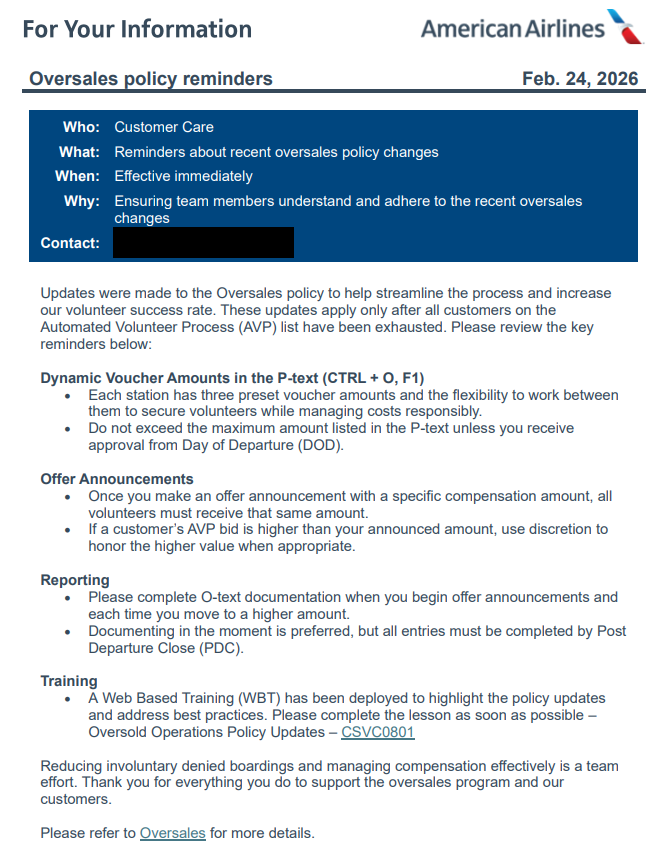
While this policy is framed at “reducing involuntary denied boardings” the emphasis here is also on “managing compensation effectively” and “managing costs responsibly” which is why American Airlines involuntarily denies boarding to more passengers than any other airline. In contrast, Delta almost never involuntarily bumps anyone.
There are quarters were Delta won’t deny boarding involuntarily to a single passenger, while American will turn away over 7,000 passengers – more than the rest of the industry combined.
When Delta oversells a flight, they realize that they have to make customers whole so that whomever they sold a ticket to that wants to travel can do so – and that means offering enough compensation so that passengers are willing to take a different flight voluntarily. American Airlines takes no such approach.
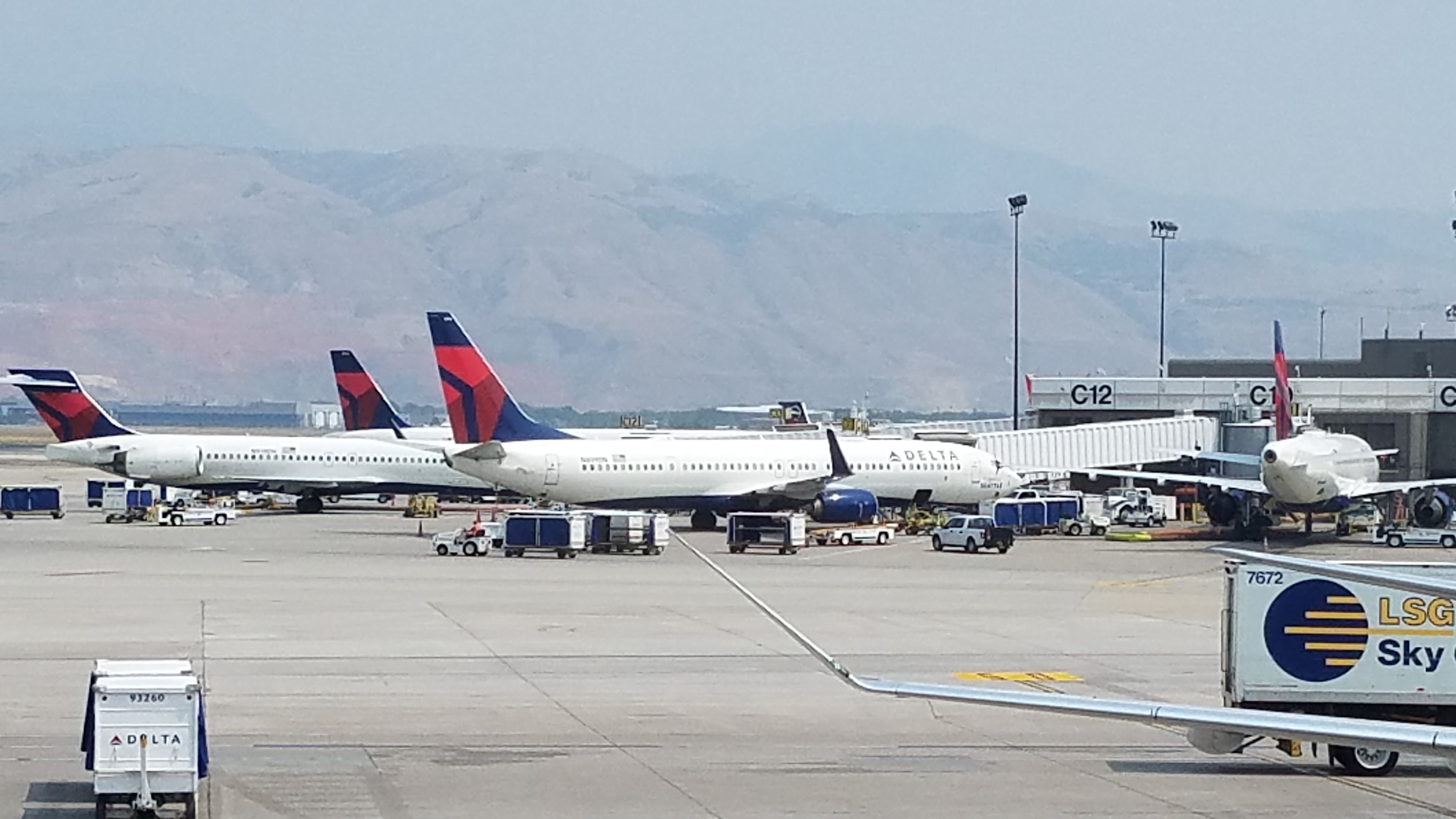
Here’s a flight where Delta handed out over $43,000 in compensation. Here’s one where they paid out $63,000. One Delta passenger last year paid off their car by taking a bump off of a Delta flight.



Instead of having to play such games… sure would be nice if we had a baseline compensation for all affected passengers… like EU261, Canada’s APPR, etc.
Maybe I’m just not smart enough to understand ( I’m ready for the flaming ) but why don’t the airlines take the opposite approach. Instead of overselling flights, slightly undersell them and then utilize the standby list. I’ve never ever flown and not seen a standby list. No one gets bumped…no negative press…no payouts in the thousands…everyone is happy(ier).
Once again, people need to read up on the “Prisoner’s Dilemma” in game theory, especially the notions of “cooperate” versus “defect.”
@ 1990 — Instead of American playing such games, maybe they should just be generous like Delta. Get bumped at American and it leaves you furious. Get bumped at Delta and it makes your day. Why must American always suck so bad?
@Gene — When things go wrong, I’m not sure American, United, Delta, or any US carriers ever do the ‘right thing,’ and if they do, it’s rare. That’s why, yet again, we need better regulations to enforce a baseline for all affected passengers. Something is better than nothing at this point.
My flight via DXB was cancelled yesterday. UA rebooked me on a direct flight on their own metal. I’m pleased with UA.
Delta would likely have rebooked me via Riyadh, and asked me to pay 500K skypesos for the privilege
@Jon F — You are extremely fortunate. Were you flying US-India, by chance? If so, I doubt DL would’ve even offered anything, because, well, you know… they don’t fly to India anymore… *cough*
What Robert said. Why not underbook a bit and then just fill up with standbys?
Robert and Patrick,
The airlines want every seat full if single, if possible. There are frequently people who no show for various reasons, so the airlines use statistics and game theory to try to fill every last seat they can.
Overselling of flights has been around for decades (I’m not sure might even date back to CAB days) and isn’t going anywhere. With improved technology the odds are against you and what will likely happen is you end up boarding at the end and no place for your bag(s) around you. The juice is rarely worth the squeeze.
The exception may be flights to popular seasonal destinations. If you have that one flight to Hawaii you are going to make sure to get to the airport in time. (Granted common sense has been waning over the years.) The other situation is the rare must ride for crew but there’s no way to predict that occurring.
IDBs are exceptionally rare. I fly AA at least weekly and I can state I haven’t seen an IVB situation in well over a decade. Even the VDBs have been far and few.
How do the airlines choose which passenger is denied boarding if nobody else takes the offer?
I have same question as Brent. I booked months in advance and wife and I were bumped while daughter and grandkids, who booked week before, made the flight to our vacation. Should be illegal.
Go first class and never get bumped.
This is really costly for the airlines that already operate on very slim margins. Great that they offer compensation but gone are the days when they offer ridiculous amounts to be voluntarily bumped. I don’t understand why they do it (offer extraordinary amounts) in the first place. Great for the receiver, bad for the airlines. .
@1990 – Well said.
Why is American continually allowed to be such a bad actor? They’re obviously a repeat offender taking advantage of the system. They should be investigated for not only this, but the 40% reimbursement policy for being involuntarily downgraded. Along with canceling lightly booked flights and their notoriously infamous and ridiculous practice of 15 minute rolling delays. Someone is not playing fAAir in this industry and I know who it is!
@1990
The other way around, but yes.
Helps to have an airline with a robust international network and strong partners!
I haven’t taken the AA offer to take a later flight in probably 10 years. Simply put, I don’t hear announcements about flights being oversold, whether for a flight I’m about to board or at an adjacent gate. So, this article sort of surprises me.
Greedy is evil of all
AA delayed our flight 7 times for 9 hours – kept stringing us along every hour that a “crew was en route”. They held our bags hostage and wouldn’t guarantee they would make it to our destination without us so we couldn’t switch flights. The front desk attendants employed us to email customer service with our experience for compensation. We did. The compensation offered. 40 bucks to be used on aa flight within one year. That’s it. I told them that was insulting and they told me too bad that’s all we’re offering. F American. Never again. Worst airline on earth.
@george
Usually based on whomever it costs the least to bump. The formula is based on multiple of fare paid. Often the people who booked farthest out paid the lowest fare vs someone who booked closer in.
There are many other factors, but this is a good guideline.
AA paid me $2500 plus 2x nights hotel uber and meals to bump my flight one extra night to Brazil. Now I see where their profit share is going lol