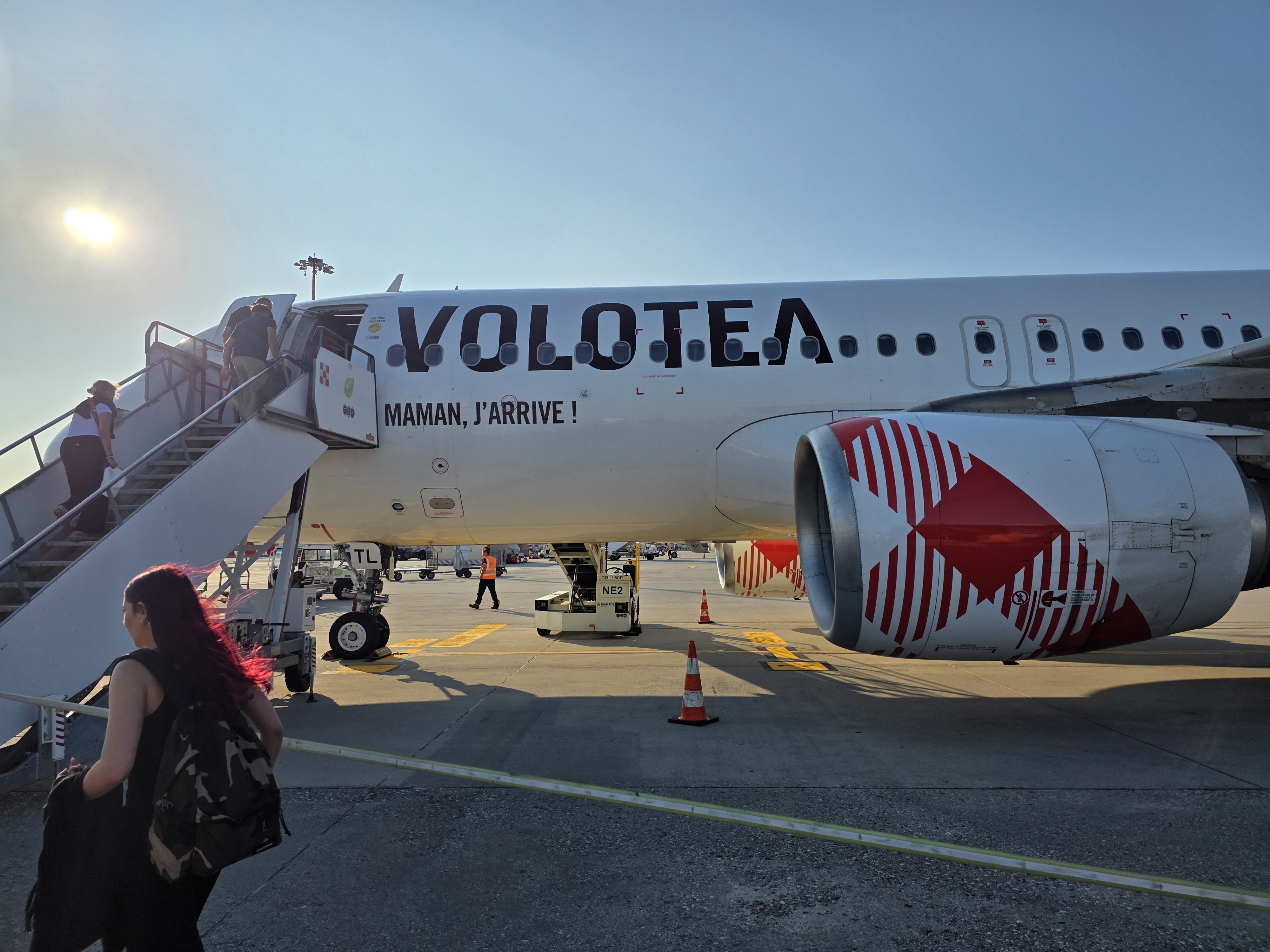
European low cost airline Volotea has crossed a line I’ve never seen from a commercial carrier before. They’re trying to charge customers extra for fuel that already bought their tickets. They say they’ll deny boarding to anyone that doesn’t pay an extra €7 to fly because the cost of jet fuel has gone up so much.
And their contract of carriage says they can do it. Is that even legal?
We’re seeing airlines all over the world try to raise fares, add fuel surcharges to new ticket purchases (including award tickets) and raise bag fees – but those are for future travel, not already purchased itineraries.
- Volotea’s terms say that, in the event of “extraordinary” fuel price variation, it can apply a limited and temporary adjustment before departure.
- Passengers are supposed to have been informed of this during booking.
- The amount can go up or down (they have never refunded a customer because fuel got cheaper)
- This cuts against their standard terms that fares are changeable only until booking confirmation and that the ticket price is paid in full when the booking is confirmed.
Here’s a message sent to customers that have already purchased tickets:
Augmentation du prix de billet d’avion après achat
by
u/Separate_Plenty8428 in
conseiljuridique
Some people discussing this seem to say that ‘it’s in the terms, you agreed to it’ while others feel that ‘a final ticket price is supposed to be final’ and terms and conditions are abusive.
I much like flying Volotea. They’re a low cost carrier but they really lean into it. And they have interesting routes that get you places you might not otherwise be able to fly. For instance last summer I used them to go from Venice to Nice. That’s just a 283 mile flight, but no one else was scheduled on the route, and a train runs over 8 hours (which isn’t ideal with a then-barely one year old). But I would have felt that this was extremely abusive.
This Is Not Something Airlines Do
Airlines will more often say that increases in taxes after purchase can be collected from a customer. For instance,
- Ryanair’s terms say a government tax increase before departure may have to be paid or the passenger can opt not to travel and get a refund.
- easyJet says it may require payment if government tax increases after booking
- Wizz Air’s conditions say taxes, charges or fees imposed by governments or airport operators between itinerary issuance and travel can be collected even on already purchased tickets, and that non-payment can lead to refusal of carriage.
- Volotea also has an airport fee and tax clause.
What I don’t think I’ve ever seen is retroactive fuel cost passthrough on already purchased tickets. In the U.S., the Department of Transportation generally bans post-purchase price increases.
This Probably Isn’t Legal
The notice above is in French, I flew Volotea last summer to France, and for French consumers local law seems pretty clearly against this.
Under French law, a fuel surcharge is not a tax (obviously) so it’s part of the ticket price, and that for a standalone flight, if there is a fuel surcharge, it is applied at the moment of purchase and no later price revision can occur. That’s in contrast to package travel, where price revision can happen subject to the Tourism Code’s rules.
It also seems to violate European Union price transparency rules. EU passenger rights say that the published price must include all unavoidable and foreseeable taxes, charges, surcharges and fees and that the passenger should not later discover further charges added to a chosen flight.
Volotea’s position is going to be that it’s governed by Spanish law, except where explicitly overide laws and treaties apply. Spain’s Supreme Court upheld a Volotea clause last year allowing post-booking adjustment for airport tax changes before departure. The court said that clause was not abusive because the change depended on an objective external fact, not Volotea’s unilateral will, and because it was reciprocal — it worked for increases and decreases.
However, airport taxes are third-party levies. Fuel cost is one of the most significant costs an airline always bears in providing transportation. And charging consumers for changes in airport fees and taxes is standard, while fuel price passthroughs are not.
Moreover, the cost of an airport fee is often per-passenger and so directly identifiable and incurred with each ticket. No attempt is being made here to allocate the actual fuel price increase paid by Volotea to each individual consumer. I think they lose here.
Moreover, Volotea’s contract of carriage clause that this rests on requires passengers to have been informed of the possibility during booking – including the methodology applicable to increases or decreases. It certainly does not clearly show that (and there’s no meaningful discussion of methodology for this purpose, let alone ‘thresholds’ and ‘limits’) so I don’t see how this survives the courts, but I’m certainly not an expert of European law. I’d love to hear more from readers familiar with this area of law in Europe, especially Spain.
What Would Make This Acceptable?
One Mile at a Time thinks this is ok, as long as it’s done clearly and fairly.
So if an airline wants to tell passengers that their ticket cost will be based on the cost of providing the service, there’s nothing wrong with that, in theory. The question is, how is this really being measured? Up to €9 can be added per flight, but what is the exact amount based on? What price of oil per barrel is included with the “standard” fare?
I love the suggestion that the airline can adjust fares up or down based on oil prices — I’d be curious to know how often the airline has proactively emailed customers to offer them a refund a week out, due to falling oil prices. 😉
I agree that the trigger is unclear, and that the airline isn’t likely to actually reduce prices when costs fall! But I don’t quite agree that addressing those alone would make it ok. This isn’t a group charter. These aren’t negotiated terms. They’re legal language we do not see exercised frequently buried in a dense contract that consumers aren’t generally aware of.
- This is generally not the deal with a scheduled commercial airline, so no one should be expected to assume that it is.
- It’s generally a business’s responsibility to deliver the product they’ve sold. If they’re making sales in advance and don’t want to assume the risk of variable costs, they can hedge those.
- Shifting the risks onto the passenger seems inefficient. The airline is in a better position to know and judge the risks as well as hedge them.
- If the airline wants to shift that burden, or charge a fee to the consumer to avoid variable pricing risk, that ought to be done in a clear, conspicuous and legal manner.
- And any post-purchase price increase – which the consumer knowingly assumed – should come with the option to decline and receive a full refund.
There’s a reason that airlines don’t do this, and it’s not because they are trying to do right by customers (even if there are some who are). It’s a bad practice that most wouldn’t get away with, regardless of jurisdiciton. Nonetheless, it’s fascinating to watch one try.
(HT: Paddle Your Own Kanoo)



I’m completely OK with this type of deal. The add-on is capped at a trivial-for-me amount. Pay $X for sure or $Y plus/minus 9€ would likely be the same in expectation.
Each person has it in their personal power to put these dirty SOB’s out of business. Just do it! Refuse to fly them, period. They need you much more than you need them. Bankrupt them NOW. Or bend over and brave for your no lube reaming they will continue to give you.
They may be the first airline to do so, but will not be the last.
I have no doubt Spirit, Frontier and Southwest are all watching with considerable interest.
That’s not how this is supposed to work, but… the contract of carriage is so lopsided to the benefit of the airline and against the passengers, they can nearly do whatever they want and there’s limited recourse. I wish EU261 would apply here, because it’s basically akin to the airline cancelling and these affected passengers having to rebook at a higher rate.
@This comes to mind — Is there something in the water in Ohio that made you become a bootlicking shill? You should know better… today it’s €9, tomorrow it’s €99, and so on. The price at purchase should be it; this is not an ancillary add-on like an extra checked bag. This is the core ticket price.
At least they are honest about it and don’t hide it in the $55 checked-bag fee.
I went to their website and started a booking. Many flights were crazy low, 29€ or less. There was a clear and impossible to miss warning that they may charge up to 9€ based on the price of fuel 7 days before the flight. You can also get a refund of up to 9€. So, would I have a problem with this policy? Hell, no. And. I don’t get the online outrage at all. So, my 29€ flight might cost me 38€. I would know up front that could happen. And since 38€ is a great fare, why would I not take the gamble? I don’t get the uproar.
@This comes to mind — “I don’t get the online outrage at all.” Wait, you’re not here for the outrage?? It’s all we got!
Airlines have fixed price fuel contracts , they don’t pay daily prices. It’s Also a violation of contract law.
@Someone Important — Sounds fair. Time to sue.
There haven’t been enough dog poop stories lately.
When they add the surcharge am I allowed to cancel my flight and get a full refund. If not, this is extortion and certainly isn’t legal in CA.
You read about stuff like this from these ultra low cost carriers on a daily basis. I personally believe it’s worth the extra cost (and it often works out to not be extra) to just fly a good airline.
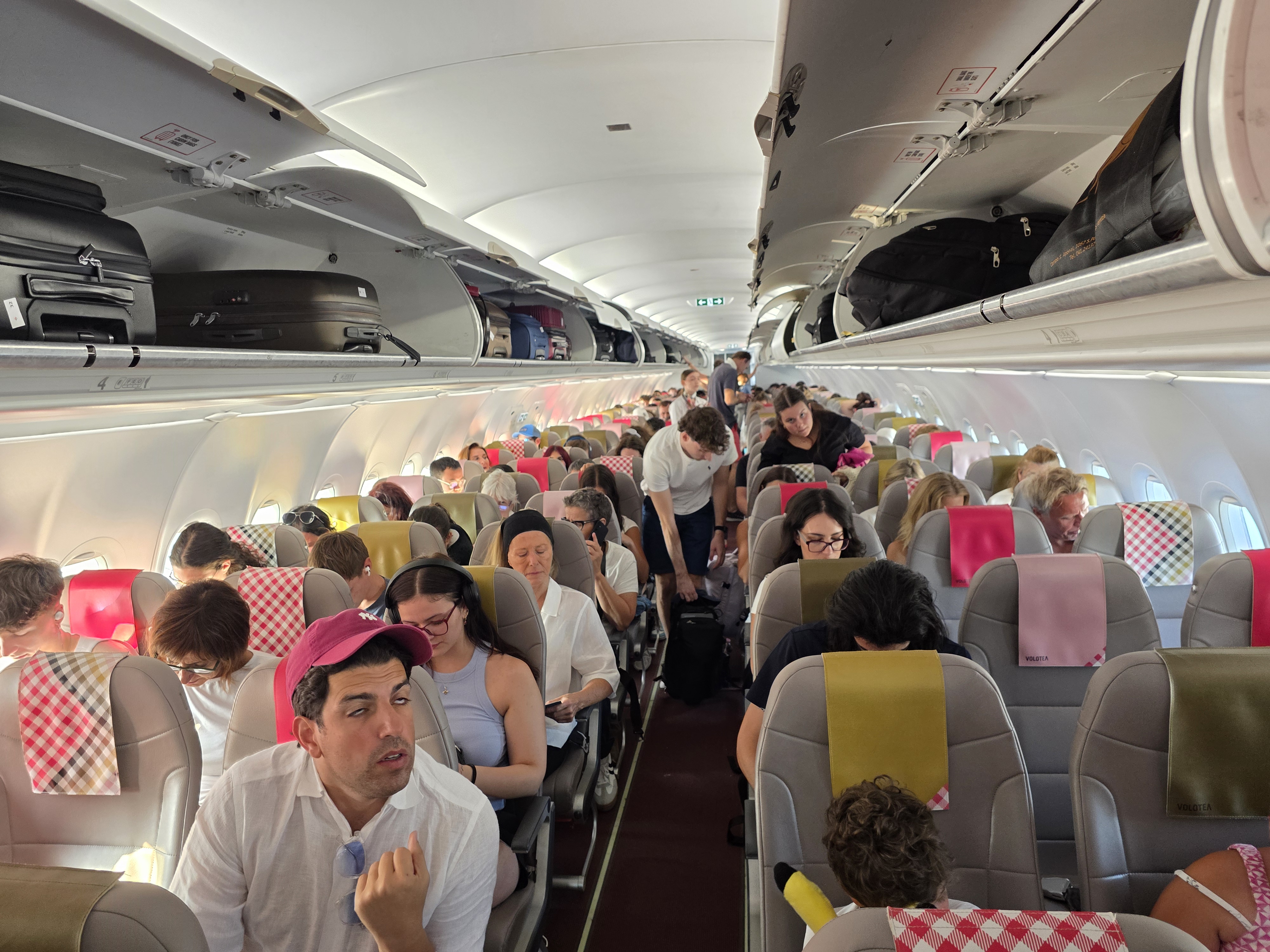
The guy in the red baseball cap in the front row of your picture looks like he’s about to go all World War Z.
@Randy Potter — Extortion (wrongful use of actual or threatened force, violence, or fear to compel a victim to comply with demands), also referred to as ‘blackmail’? Uh, ok, so I know the word is being thrown around a lot lately (within the context of the Iran-Hormuz blockade and $2 million fees for passage, for instance.) But, no, this is not literally extortion; it’s just an unfair and deceptive practice.
If in the US, such an after the fact mandatory charge would likely violate DOT rules like 14 CFR § 399.88, which bans post-purchase price increases, and 14 CFR § 399.89, which governs fuel surcharge notifications.
However, I thought this airline is in Europe, so it would violate similarly worded EU price transparency rules, specifically Regulation (EC) No 1008/2008. This regulation requires that the final price shown at the time of booking must include all unavoidable and foreseeable taxes, fees, and surcharges. Yeah, this is unfair and violates rules, but it’s not extortion. Oh, were you doing a hyperbole? Love it!
@Rover D Dog — “Leave it…” If you want a Greenie, you’re gonna need to sit. “Sit.” *hands over treat* “Good boi.”
While legality and illegality fall under loopholes and small print, there are very disturbing trends here. Boats trying to just downplay and overwhelm the issue, while the issue is one of many symptoms of systematic unfair competition and breach of contract flowering in airline’s practices with growing ruthless and , yes, active usage of extortion. Downplay on ground of low fare /fee is a trick. 9€/$ surcharge at 29 fare is actually close to 30% . Will you be this dismissive, if realtor, a car diller, a gas station, a store put 30% on top of an agreement or an advertised price? Second, this is not first wave of abuse. Airlines started systematically strip carryon at front of the gates. It’s the same tactic in use : comply or be kicked off the flight.
I’m not supposed to dig out and read all disclosures every time I buy a ticket. There is a declaration : seat, personal item, carry on, check in luggage, connection, price. Any possibility of changes to this must be in big red right here in declaration. I will see this red warning and move over to other offers. Any changes not reflected in the declaration are unfair completion, false advertisement and breach of contract.
Placing passengers in position facing choice comply or be denied boarding while already in front of the gate (or upon arrival to the airport port, or within a week before the flihgt date) IS extortion, no less.
On top of this cabin crew becomes more and more unprofessional, rude, aggressive and prone to brutal confrontation, I guess those are symptoms of cuts on staff as well. And lazy. Many times just been stripped of carry on at gates I seen empty carryon bins, stewardess harring to close them before passengers are in, instead of managing filling up the bins properly. So this is not an isolated issue. It’s another manifestation of systematic organized ruthless advancing and aggressive manipulation on passengers and on consumer protection.
(And , boats, no, no shortage of seats. I observe last minute grouping together frights even from different airlines into one airplane , and filling up cabins to the last seat this way on regular basis.)
Wow, the over burdening of businesses is amazing. Why wouldn’t it be “legal” for them to charge additional money if it’s in the contract of carriage.
Thank goodness Americans voted to get rid of this over-regulation.
Businesses should be free to do whatever they want, consumers are just tools of Capitalism!!