
American is installing turnstiles at new gates on the Dallas – Fort Worth C concourse expansion pier. They’re calling it reinventing boarding. I don’t think it’s actually good for passengers or for society.
American Airlines is advancing the future of air travel with the official launch of electronic boarding gates at Dallas Fort Worth International Airport (DFW) beginning this summer. Following a successful pilot in November 2025, and strong customer feedback, American is now deploying the technology at scale at its largest hub, reinforcing the airline’s commitment to a more seamless, user-friendly and consistent boarding experience.
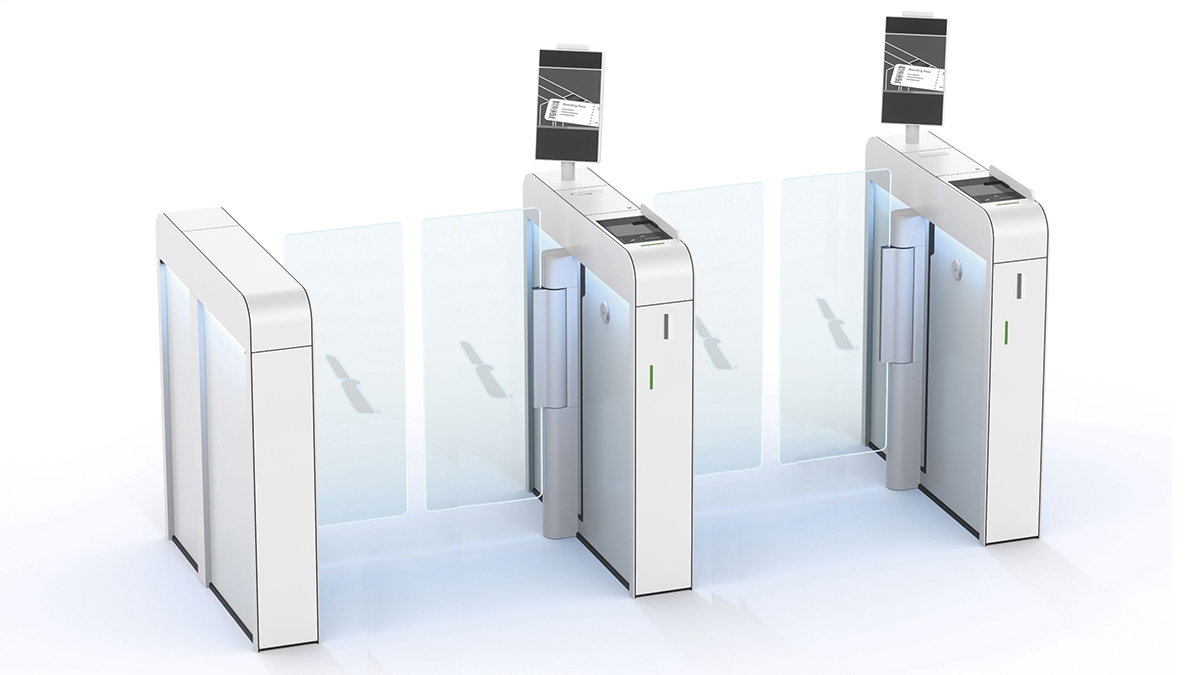
Courtesy: American Airlines
American says this will creat value by:
- Streamlining manual tasks for American’s team members during boarding, allowing them more time to provide exceptional customer service and operationally critical tasks
- Providing clear, American-branded touchscreen instructions so customers know exactly what to expect
- Automatically validating boarding passes before opening, allowing customers to proceed smoothly to the aircraft
- Regulating the pace of boarding to reduce congestion and improve jet bridge flow
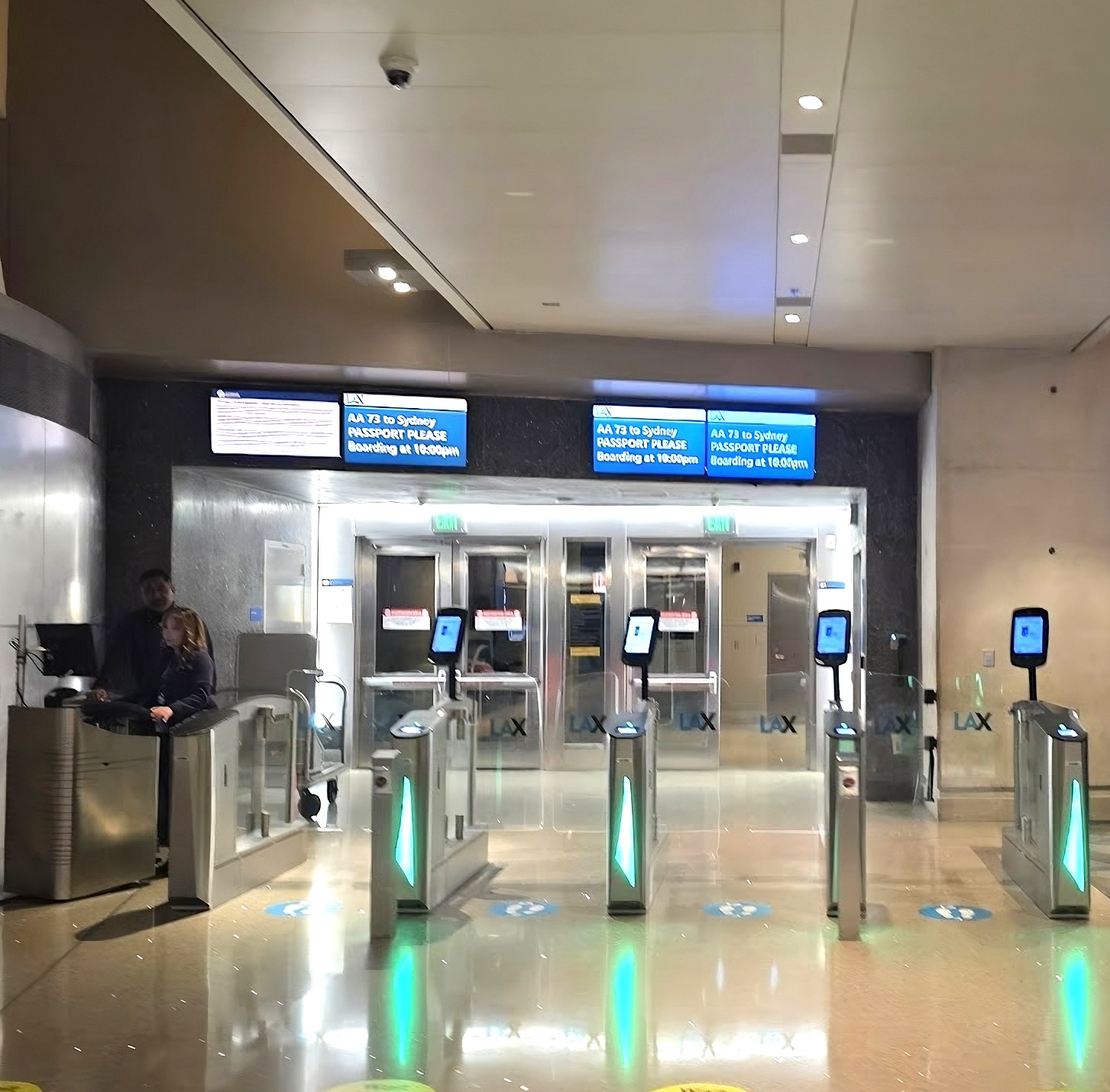
Airports are increasingly moving to e-gates, where facial recognition is used to confirm identity. So far this has mostly been used for international departures. The government wants more than a person looking at you and confirming it against the photo in your passport.
At many international departure gates, a camera is mounted at the gate or held by a government customs officer or airline staff member, to take a live photo of each passenger during boarding.
That image is sent to the Customs and Border Protection cloud-based Traveler Verification Service, which compares each person’s mugshot to a gallery built from your passport or visa photo and compares it to the flight manifest. The government has already checked the flight manifest and decided who can travel and who can’t. Now they want to match people against the manifest. If there’s a match, you’re allowed to depart the country. If there’s no match, you get a manual document check.
American doesn’t say whether these boarding gates will use the optional photo add-on. The rendering makes it appear so, but shows a boarding pass rather than passenger’s face. I’ve inquired, and have not received a response.
The airline says they will validate boarding passes automatically at these gates and regulate the pace of boarding to reduce congestion and improve jet bridge flow. They’ll back people up in the queue to the gates, rather than in the jetway.
I wonder how this is going to work with passengers traveling as a group, in different boarding groups. American has moved to automatically deny boarding to passengers boarding before their group is called, but says that families can travel together with the highest priority group member. An Executive Platinum gets to board their family with group 1, rather than waiting for their child’s basic economy group 9 boarding number to be called. It’s not clear how this works with an e-gate, though.
And the biggest boarding bottlenecks aren’t actually the act of scanning a barcode. In fact, without human assistance each passenger may take longer to scan and wait for the gate to open.
Too many carry-ons, limited overhead bin space, gate-checking bags, families bunching up during preboarding and standby processing at the gate seem to be bigger issues. These gates do not solve any of that – just queue management and access control.
When the hardware, integration, or network hiccups, you’ve created a new failure point into the departure process. Boarding always has exception handling, like people pulling out the boarding pass for their connecting flight, a boarding pass that won’t scan, or a boarding pass that hasn’t been updated for a seat change or upgrade. So you still need gate staffing.
I’d expect American to use this as more support for fewer gate agents, and that can mean worse reliability and customer experience. The idea of “freeing employees to deliver better service” usually cashes out in practice as making agents harder to find.
It seems to me that what’s needed here are:
- staffing to allow non-automated boarding
- no mandatory biometrics
- prominent disclosure if cameras are active
- a published retention and deletion policy
- no secondary use of images for marketing or profiling, or at least clear opt out
- not punishing passengers with slower service or extra hassle for opting out of use
Unfortunately my view is likely on the losing side of this. I’m an old line civil libertarian and I was largely made into a dinosaur post-9/11.



I’m sure within 5-10 years they’ll be trialing robotic flight attendants – who knows, it might actually improve service. Or- pick your convenient time to go to the new “AAutomat” at the back of the plane to pick up your microwaved meal.
…”,more time to provide EXCEPtIONAL customer service…” LOL… sounds like Delta’s usual corporate spin hyperbole of peeing on one’s leg while telling them it’s raining !
Goal is to have 1 agent working 2 simultaneous flights as airlines continue to enshitify & descend to the bottom !
As a travel blog, you seem pretty uninformed. This is how boarding is done as many European airports. For instance, Americans OneWorld partner, British Airways use this at almost all of its gates in London.
WAY more efficient then having one agent scan every boarding pass.
Aer Lingus use these in their busy Heathrow > Dublin market. But I usually see minimum 3 agents assisting. 1 managing queue entrance, 2nd overseeing machines and guiding people to open kiosk (4) and 1 watching bags and printing bag tags. US gates are never manned sufficiently.
@JB “Europeans do it” is not the same thing as “better” – Delta launched this in 2018. European data protections are also different.
All Schengen departures are with NO BIOMETRICS, scan the BP and go. In fact, there is no formal ID check when traveling within that zone either. So you can enter security, get screened and go. No ID or photo checks. Domestic flight here in the USA (or anywhere) should be this way. All generally get screened the same way. This is just another way to enforce other mandates (like Canada with vaccine passports and saying you need to be vaccinated to fly).
I think is how it normally should be; there is no way that a terrorist is going to use their own name. When was the last person on a terror list actually caught this way?
This is just to build a database of information on people needlessly.
International, its only a manual check in the EU anyway after seeing an exit officer. Whether a camera does it at the gate or border control is where the hacking and data privacy comes in…..
Completely with you on this.
These are common in Europe. What’s the big deal American Airlines ? Yawn.
We know that no one ever seizes power with the intention of relinquishing it. Power is not a means; it is an end. –George Orwell, “1984”
This is the norm for domestic flights in Japan. Works fine.
@drrichard: I like your quote. 1984 was an amazing book. However, it is kindergarten compared what is being done now.
My girlfriend and I went throw one of these gates in CLT last week on an international trip. It was strange, the gate agents did not look at our passports or tickets. The machine scanned our faces and we were good to go. I was not entirely sure I had been checked in and would get my miles. But I was checked and I did get my miles.
Good. Maybe now they can fire all those NASTY employees .
Asiana uses this system at LAX to fill the A380. Surprisingly quick. They have enough agents at the gate to do it. All boarding passes have been checked prior to going through the gate. There doesn’t seem to be a slow down because the overhead bins will be full. If they need space, they ask customers to gate check roller bags before boarding but there is usually enough bin space. All gate checking is voluntary as far as I know. This type of system could have problems on narrow body airplanes that have a lot of forced gate checking and too few gate agents.
Yeah, not a fan of the surveillance state. No one should be cool with that. As for e-gates without biometrics (scan and go); honestly, that seems fine. No biggie.
Jetblue’s been doing this for a while.
Gary, I like your posts, but you missed this one. I’m a baseball umpire and I know, lol. 🙂 Seriously, as an AA EP member, I would LOVE to have this option for only 1-4 on AA so I just walk up, scan, and go.
-Jon
Will this prevent AA agents from pulling people out of their exit row seat to accommodate a stand by passenger and then telling the displaced passenger he didn’t check in?
Of course not, clown shows are clown shows.
@JB nailed it. Changi put these things in nearly a decade ago in T4. They made the boarding process *much* faster and less stressful. If there were special exceptions to be made (such as the family example cited in the article), there were gate agents who could still manually verify and allow gate entry at the appropriate time. It was (and is) an enormous net improvement. And yes, they have also been successfully deployed in Europe for years.
Gary, I respectfully suspect that in another 5-7 years you will look back on this article and realize your entire take on the matter was way off.
You raise some valid concerns. I suspect that at least some of them will be addressed once the system adjusts after the inevitable startup glitches.
This feels like one of those “sounds good in a press release, questionable in real life” innovations. I get the intent—automating boarding pass checks and regulating flow—but as you point out, scanning isn’t really the bottleneck. It’s everything after that: carry-on chaos, bin space battles, and people clustering at the jet bridge.
The idea of pushing congestion back into the gate area instead of the jetway might just shift the problem rather than solve it. And I’m especially curious how this works with families or mixed boarding groups—that’s already messy with human agents, let alone a rigid system.
It feels like airlines are optimizing the easiest part of the process instead of tackling the hardest one. Interested to see if this actually improves on-time departures—or just makes boarding feel more like going through a subway turnstile.
@Mike Hunt — Which @JB? @Jim Beam (glug glug) or @Jon Biedermann? Naw, clearly the latter. Anyway, there you go again with SIN T4. Speaking of Changi, when I was there in February, oof, so much construction at T2; like, that must really reduce capacity (for SQ at least). Oh, one more thing, could you call me a silly name please?
The same people that find boarding a plane, finding their seat and stowing their bag the intellectual challenge of their life, I can only imagine them at these readers trying to scan their boarding pass. There’s a segment of our society that can’t deal with the simplest of technology, they’re not all over age 70 and they do fly.
Not to mention with no human the people in Group 9 that will try to board with first class.
Don’t get me wrong in theory I like the idea. But then there’s reality of the US public.
@George Romey – Part of the point here is that the machines will not allow the people in Group 9 to board with first class. The gates make a loud embarrassing noise and simply won’t open, forcing the gate lice offender to wait his or her turn.
I disagree with the writer. The airline and our government need to know who’s flying today and that they are legal to fly. Safer for everyone.
So far, my experience with the system when going through international customs has been a dream. The line moves MUCH faster, the system instantly IDs you and you’re on you way!
The writer here must think that next “they” will be wanting your ID to vote!
@George Romey — Why are you pretending to be dumb on here again. You’ve said ad nauseam how you’re an American Airlines Concierge Key… you must know that AA’s new-ish boarding system no longer allows anything other than the eligible group(s) to board when it’s their time. So, fine, Group 9 wants to attempt Group 3, but too bad… *beep beep beep* DENIED!
we have used the scanners in Europe and Asia and have never had a problem
way to go
They use this in Malaysia (KUL) as well. I have no problem with it.
There’s only one reason for this: to reduce labor cost. Watch for a layoffs announcement soon.
Throwback to Southwest “shoot boarding.” Can’t wait to see the mess it will create as queues flow back into the passenger passageways.