
I was supposed to fly to D.C. for work this week. Storms blanketed D.C. and Sunday nearly all flights into National airport were cancelled. The storm stretched to Texas and here in Austin roads were blanketed in ice. It got neither sunny nor warm enough to melt, and I wasn’t going to be able to fly out Monday morning.
Initially I moved my outbound to Monday late afternoon. There was a travel waiver in place, but American still wanted… $0.20 to change my flight.
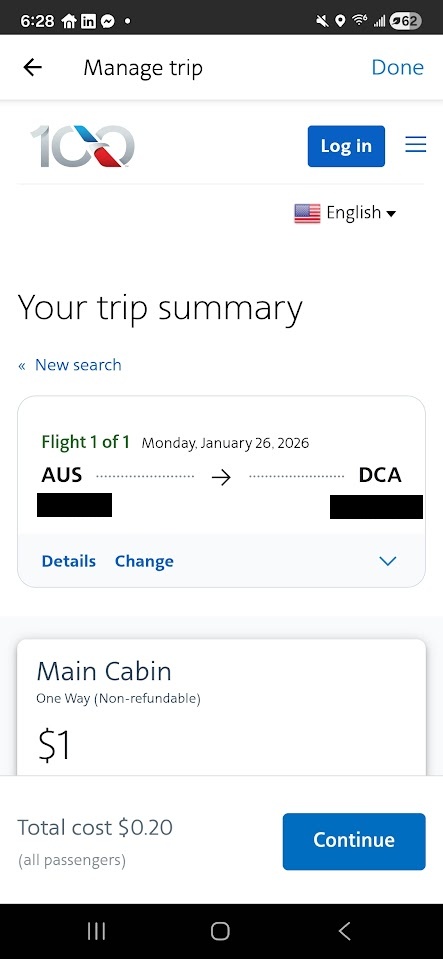
Initially I saw a $150 upcharge for discounted upgrade on the longer segment out of Austin – that’s because about 30 hours out the first class cabin was half empty, and my upgrade cleared within a few hours. The shorter connecting flight was $88, and I judged that complimentary upgrade as less likely. I was tempted.
- In irregular ops-likely situations I’d never buy one of these in the past. The first class buy ups used to be non-refundable. In the event of cancellation, I didn’t want to have to chase the refund to make sure it happened (though it probably would). More importantly, there’s always the chance that I decide to bag the trip. Fortunately, now at least, American will issue credit on these upgrades.
- Still, it’s a non-meal flight and during weather events flights cancel and get rebooked, I just didn’t bother.
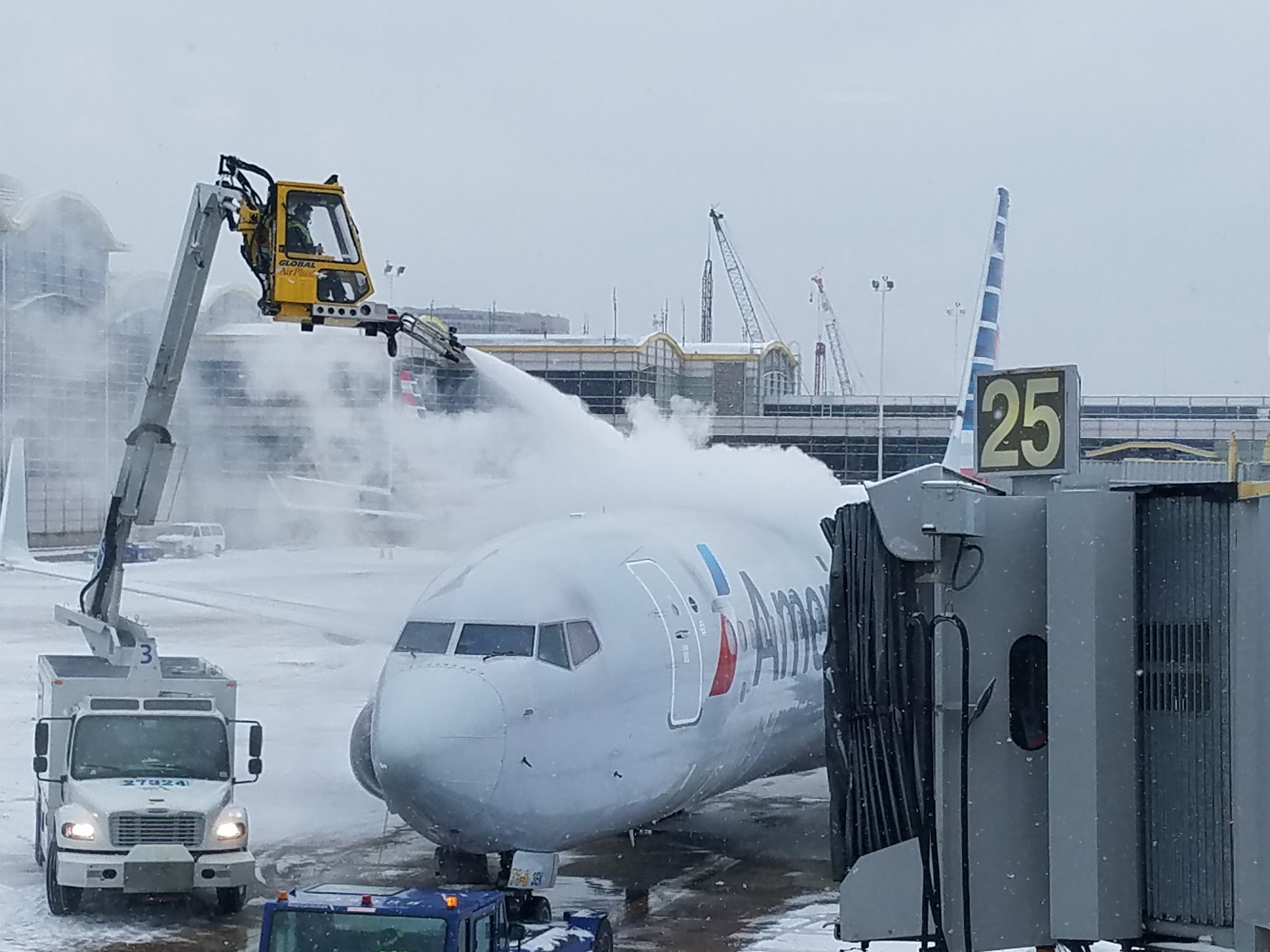
I figured that by Monday evening flights would be running more normally. However, an evening flight means greater risk of delays especially as operations recover. There were still going to be planes and crews out of position, since this storm affected multiple hubs – New York, Charlotte, Washington National, Dallas.
So it didn’t really surprise me that one of my segments cancelled about 24 hours out. I selected a new itinerary, and one segment cancelled 24 hours out again.
What was interesting was that the update to American’s website and app, intended to make things clearer and easier for flight recovery, just made things worse.
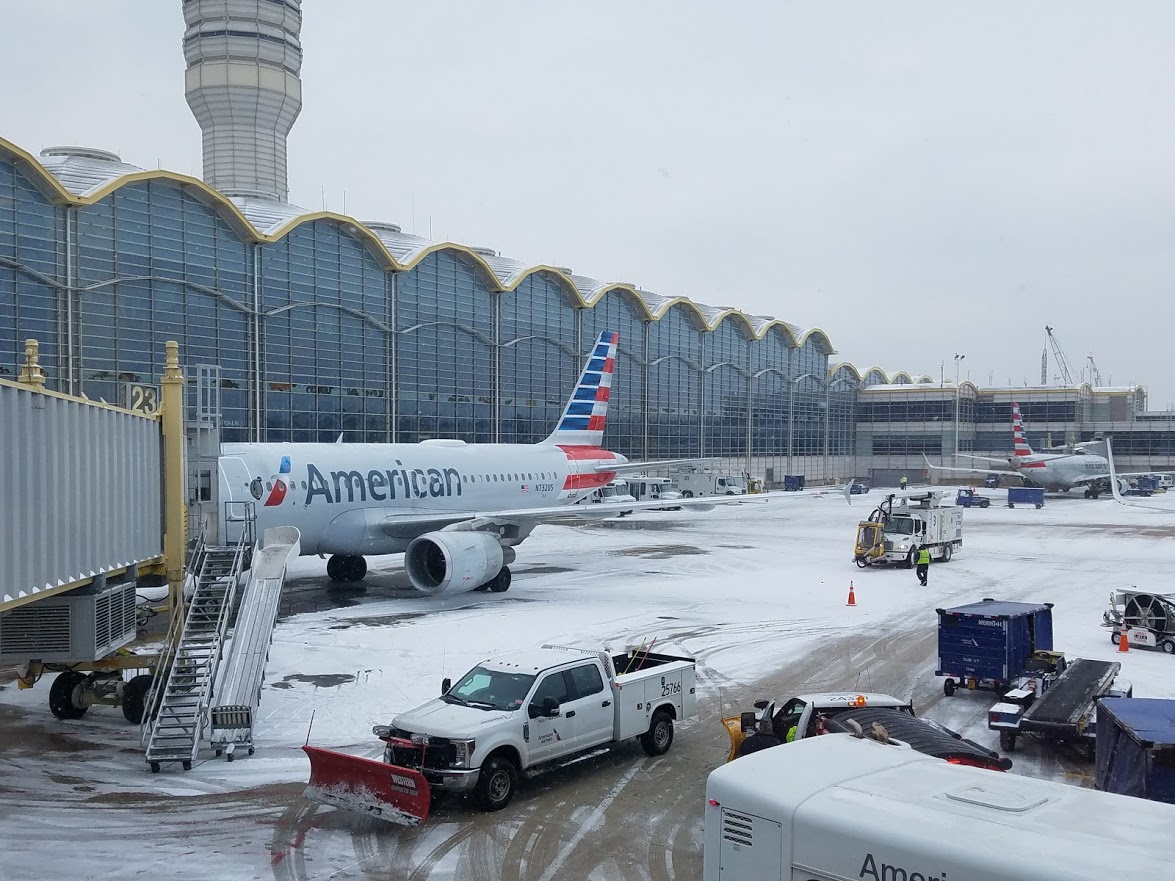
A week ago American Airlines introduced new color-coded banners and made other changes to its app and website.
Orange: Flight delayed
Red: Flight canceled
Green: Self-service rebooking available
Blue: We’re already working on your next flight with automatic reaccommodation or agent-assisted rebooking
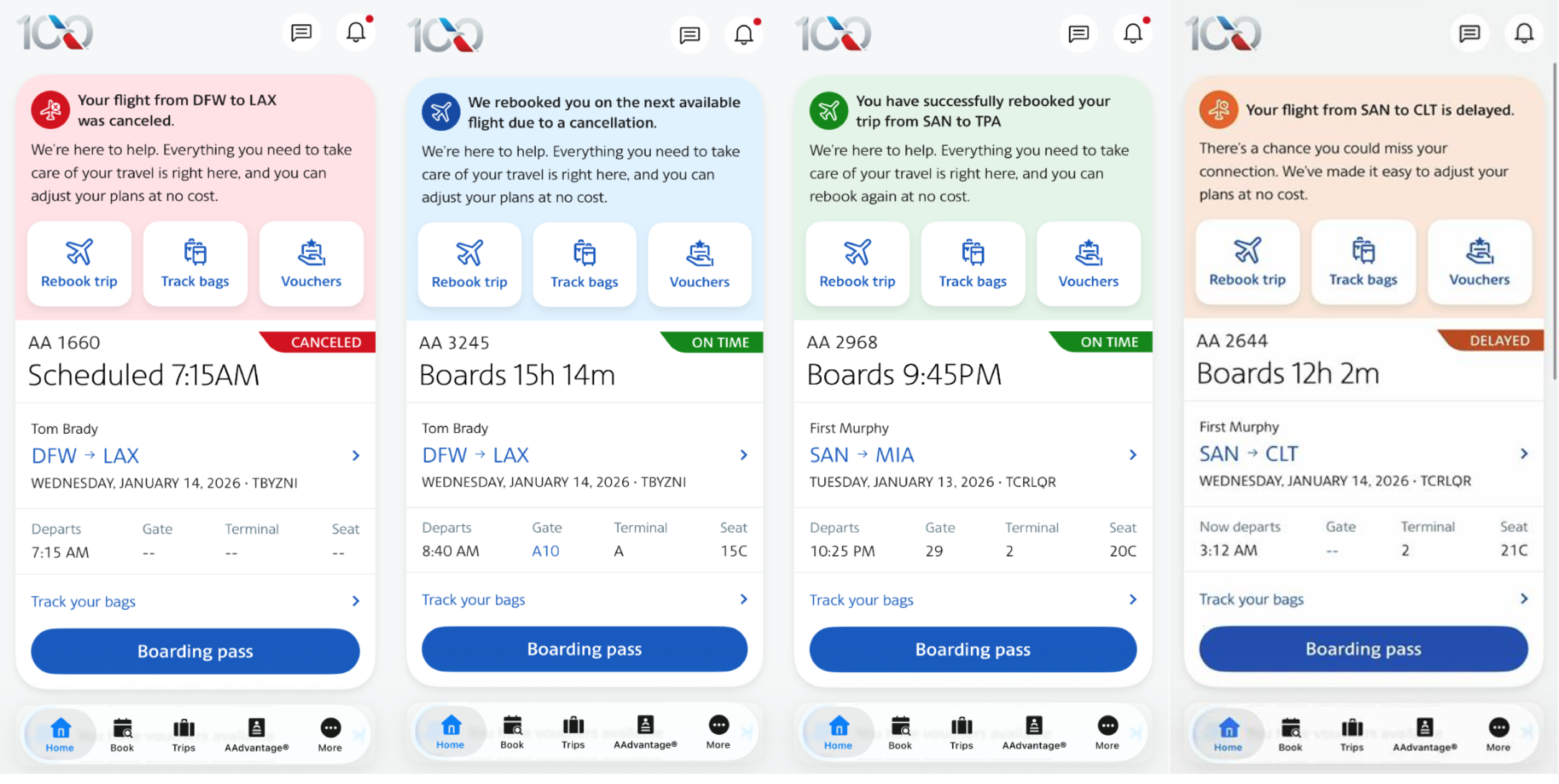
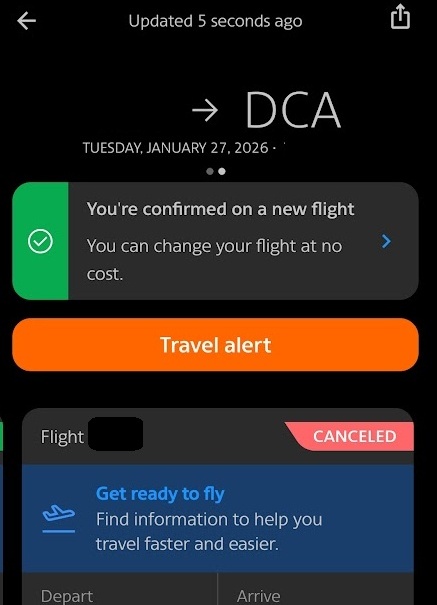
They did not think through what happens when you’ve got successive cancellations. Up at the top, the app shows green. I’m rebooked! And there’s a green bar beside my… cancelled flight.
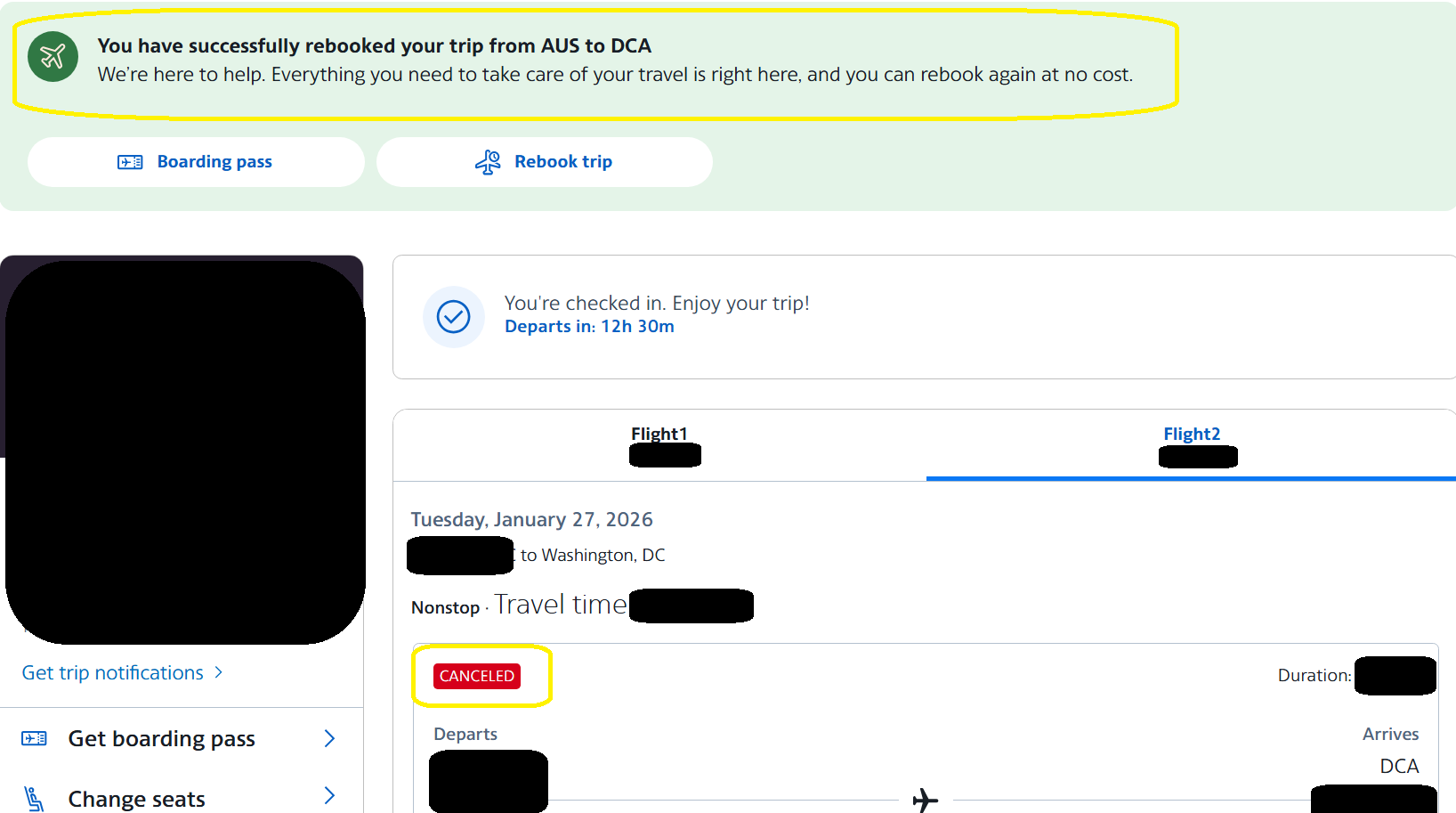
The website, too, shows ‘all green’ even though the flight that’s supposed to get me to my destination has been cancelled.
There are all sorts of complaints about American and other airlines on social media right now, but that’s not really fair. Flight delays and cancellations are the fault of weather, mostly. How they communicate with customers during these challenges is on them, however.
I’m glad to see updates to the app because even as an Executive Platinum I was facing two hour phone hold times. But there’s plenty of improvements still needed to the app. For instance, rebooking doesn’t give me the ability to hold onto my current first flight segment and choose only a new itinerary from the connecting point forward. I was only given the option to rebook the entire trip, which requires inventory for all flights to be available. I might even be willing to overnight along the way, but that’s not an option.
At simplest, though, it seems like when flights cancel the app and website should do what American says, and… turn red?



It’s green because at least you didn’t have to get on an AA flight and be scolded by some old hag entitled FA. I’d call that green status.
We’re American Airlines something special in the air.
New tech bugs. They didn’t test for edge cases like this (though I would argue this isn’t really an edge case). Remember, the people building this tech are not road warriors. Many of them rarely fly compared to a lot of us, and when they do it’s usually VFR.
It’ll get sorted out over time with app upgrades.
@Mantis — You’ve admitted before on here than you now live in Asia, so, quit whining about American workers, since you gave up on us.
Technology has been AA’s weak link for at least a decade.
this is a continuation of the pending united ‘upgrade from flat files’
“the website” and “the app” are not standalone entities in a box
they are both visual representations of HUNDREDS of subsystems, some larger and more important than others, some older than others, some less ‘accessible’ than others
these subsystems have been written in various programming languages on various platforms since the mid-80s
they may be the 3rd-generation of a unix system written by sabre in the mid-90s today running on aws or azure or google or orcl “in the cloud” but that doesn’t change anything with respect to the architecture or capability of the system to receive inputs and generate outputs, i.e. “read and write” to any of the other hundreds of systems that have been cobbled together over time
the functionality gary wants requires complex if/then/else logic that would have to be written in to “the app” and “the website” AND all of the subsystems that enable or deliver that functionality
think of it this way: the logic to choose and change “1 flight at a time” is a search for the next available seat that matches the pnr conditions (segment, fare (c/f/y, etc)
that is a 1:1 function, i.e. black and white tv (this is a metaphor, nothing to do with the color-coding of the ‘app upgrade’)
now consider gary’s problem: he wants a 1:many function, i.e. color tv where the successful delivery of a ‘complete’ solution requires an infinitely more complex set of interactions between disparate systems; the logic and computing power to do this is 100x ‘heavier’ than the simple 1:1 functionality for a single segment
they will cobble together bridge code which ties together a series of 1:1 segment fixes but this shows the limitations of AI which can today only execute repetitive tasks that it is taught through “prompts” which are the ‘business rules’ of the systems it is trying to automate; the fix will not be a 1:many solution because the underlying system architecture complexity prevents it
tim dunn will love this and run with it for years:
the secret sauce that has kept american IT in the gutter is sabre
american was sabre’s first customer for everything it wrote on top of the big iron bunker in tulsa; consequently, the underlying number of systems and complexity of their ‘integration’ has become a cancer that is now impossible to cure
delta and united have been doing chemo on various organs over the past 10 years
american has bone cancer of the entire skeleton
their best solution is to be ‘acquired’ by an airline with modern 2020s infotech
the credit card business may drive all of the profit, but without a break-even airline attached the bank has no reason to exist, and at some point the bank would be best served by funding the $1 Trillion (yes, T) needed to write a 2030s IT capability from the ground up
for tim’s sake let’s hope the nAAtionAAl bAAnk of AAmericAAn AAirlines never does that
What’s worse is they keep showing “on-time” status for a flight UNTIL IT’S NOT! Repeatedly I have complained to AA that the app shows my flight “on-time” even when the inbound flight is delayed arrival of over an hour past the departure time of my flight.
I know that ‘hope springs eternal’ at AA scheduling for mechanical delays where they push the delay 15 to 20 minutes at a time until you are 3 hours or more delayed and missed any chance of bailing on the flight. But during this past meltdown the APP was the worst with shown flight “on-time” even though there was no chance and then either cancelling or delaying the flight within 10 to 15 minutes of boarding time. I know the name of the AA ops scheduler…Wei Li
@Woofie – I actually think the real downward technology trend was when AA lost CIO Maya Leibman in 2022. She was the legacy AA holdover that really brought institutional knowledge (including from AAdvantage – back in the good days in the late aughts), brought project management and data-driven intelligence with the chops to execute, and led the smoothest PSS merge/transition/cutover (no cancellations, IIRC) that I’ve seen from the majors. Once she left, the technology appears to have gone downhill, and the ship has seemed rudderless. She would have been a better CEO than Parker or Isom (not saying much, I know).
@DGO24:
ontime status at american is not a data element where the truth has any automation in or around it
someone at gsw has to have the authority or be given the approval to make a flight not ontime before delayed status is triggered when certain things don’t happen at certain milestones, which as you mentioned are often at T-15, because those phases of flight loading for departure require a hard-coded X amount of time before Y scheduled/predicted departure time can occur
authority/approval are ‘easier’ when a meltdown doesn’t outstrip the staffing volume at gsw
i’m not sure where the threshold is at, but obviously this last event crossed it and with 110% all hands on deck they still had zero bandwidth to proactively deal with the value of customer time
customer time value might increase if isom’s base were only a million instead of 13, but that’s not how late-stage capitalism works at too-big-to-fail components of NATIONAL SECURITY
there are 2 ‘categories’ for delayed status and new departure time – the value that rolls forward automatically when certain things DO NOT happen in other ‘systems’ related to departure and the truth value set by gsw once certain predeparture activities have occurred or gsw is reasonably sure they will occur – note that said truth value used to be in control of the station
when you get a new departure time that is not an ordinal multiple of the original departure that indicates gsw actually believes something like that new time is possible
pushing back every 15 minutes re: a mechanical is the auto-programmed behavior to keep you from pursuing other options, i.e. revenue lock for them; pushing back an hour at a time is atc or crew, but again when they don’t have an answer and know the probability is they won’t have an answer, the value of your time recedes to zero
The problem with American is during a cancellation event, they turn off the phones. I can almost always find an alternative flight to a nearby airport that I can live with. A live agent could easily rebook my flight quickly. The AI cannot. Buying a new ticket at the last moment is prohibitively expensive.
American could easily fix this by giving phone priority to people being cancelled or by allocating additional agents when they project problems.
So Americans’s brand new untested software turned out to have big problems during a huge meltdown? I am shocked!
@Other Just Saying — Until we actually regulate airlines to treat passengers better, they’re gonna keep not-helping, outsourcing to AI, and basically screwing us over, without much recourse. So, maybe, when the adults are back in-charge, they can actually work on air passenger rights legislation that would maintain a baseline of support for affected passengers. I’d love to see an EU261 compensation structure, personally. Restoring of the old Rule 240, where the airline would need to help you get to your destination even if booking on another carrier. We deserve better, dudes.
How long has this been a problem?
Does this appear to be fixed yet?