
United reportedly may use European-style business class for a row of coach in its new Airbus A321XLRs, in order to reduce the number of flight attendants they have to pay on each flight. And this could also give the opportunity to monetize the four adjacent seats that won’t have anyone seated in the middle.
What’s shown in this photo appears to be United is working on an Economy seat row where the middle seat is physically blocked by a fixed tray table, creating a 3-3 row that sells as 2-2, with the A and C and the D and F seats usable, while the B and E middle seats are blocked.
There’s also speculation that this could be sued on the new Airbus A321neo ‘Coastliner’ planes that United plans to use for premium cross-country flights.
United exploring new Economy seat type with blocked middle seat
by
u/Floppy-Over-Drive in
unitedairlines
Specifically, the suggestion is that this is row 32 with 32B and 32E blocked. This diagram, showing a passenger layout for the United Airbus A321NY, shows the expected 20 business class, 12 premium economy, and 118 coach seats for 150 total passengers. But the diagram also shows ‘FAA minimum crew 4’ meaning four flight attendants. This could be part of the plan for how they get this down to three.
UA: XLR layout pic.twitter.com/BHXyAhHmPk
— JonNYC (@xJonNYC) September 5, 2025
These are ordinary United-style economy seats, not a wider seat. The center seat is still there, but a table module covers the center cushion area. The idea is to render the seats unusable. United has said that the Airbus A321XLR will feature 150 seats. That’s an intentional number – it means only 3 flight attendants would be required if they can get it certified by the FAA that way. And this could be part of the plan for how they do that.
For the A321neo Coastliner, this seems much harder. That plan has been announced at 161 seats (20 Polaris, 12 Premium Plus, 129 economy) and they would therefore need to block 11 seats, not just one row with two middle seats blocked.
Under 14 CFR §121.391, for airplanes with more than 100 seats, the carrier needs two flight attendants plus one additional flight attendant for each unit of 50 passenger seats above 100. A plane with 150 seats needs 3 flight attendants, while a plane wiht 151 – 200 needs four.
However, a plane’s evacuation demonstration and the carrier’s operations specifications can require more flight attendants than this minimum seat count. The FAA wanted more flight attendants on some JetBlue planes because of the business class doors and so JetBlue locked those doors open.
To get to 150 seats and 3 flight crew, it makes sense on the A321XLR to block two middle seats. The last two seats sold on a plane are generally the lowest-priced tickets (as in, United would just sell two fewer cheap seats). They don’t sell every seat on every flight, but the flight attendants have to be staffed based on seating capacity, not passenger count.
Saving a flight attendant could work, especially if they can sell the adjacent seats at a premium. Flight attendants just got big raises at United up to industry standard and cost the airline far more now.
But things get much harder for the 161-seat Coastliner to drop to 150 seats, giving up 11 seats on a premium transcon flight. It could make sense at off-peak times, but it’s not clear whether a convertible seat where that blocker could be removed would get certified by the FAA at the lower seat count while giving United the flexibility to add back those seats. This isn’t a new idea, though.
- Prior to US Airways management taking over, American Airlines Boeing 737s had 154 seats – but four middles were blocked (in rows 16 and 17) to bring the seat count to 150 and save a flight attendant. US Airways leadership immediately added a row of seats, bringing the total to 160, and then eventually adding two more rows to get to 172.
- European short-haul business class differentiates the premium cabin from coach by blocking the middle seats up front. Those are generally convertible cabins, where they can move the curtain from flight to flight based on premium demand and remove those center seat tables as-needed.
- Frontier Airlines ‘UpFront Plus’ sells blocked middle seats in the first two rows. Spirit tried something similar called ‘Go Comfy’.
- Airlines used to block middle seats next to elite frequent flyers, releasing them to other passengers only when needed on full flights. This was a benefit at United Airlines until the end of 2007. It wasn’t a physical block, though, and didn’t affect flight attendant count.
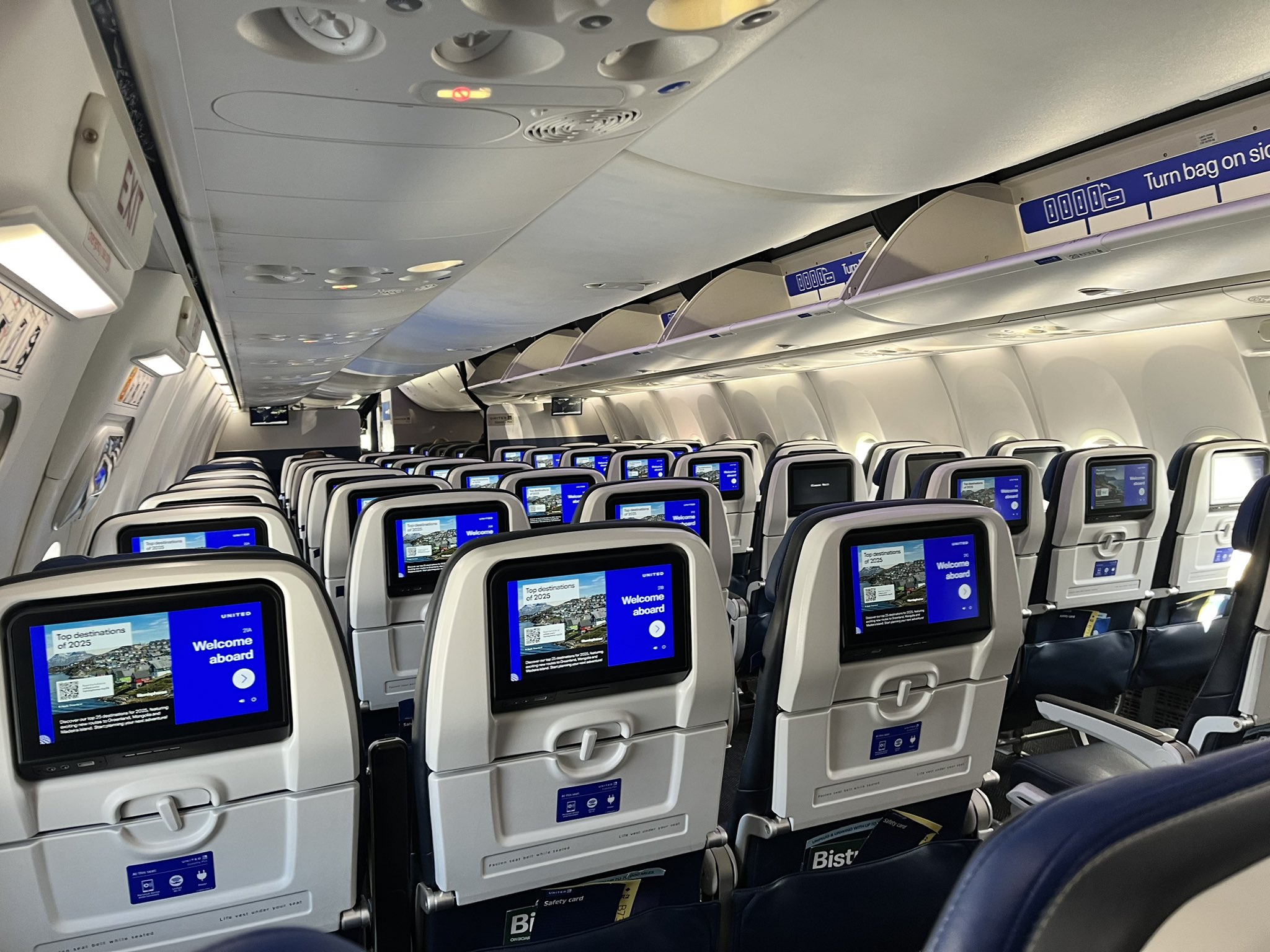
It seems highly likely that United has been working on this idea and mocked up this seat. The photo looks real and the logic for doing so makes sense. It’s been done before. Whether or not the FAA buys it, I can see work on blocking seats 32B and 32E on the A321XLR. The publicly-announced 34 economy plus extra legroom seats and 84 standard economy seats is exactly two shy of an even row. THe question is whether this is sufficient to get them down to 3 cabin crew.
I’m just skeptical of the claim that this is being considered for the ‘Coastliner’ unless they really do get these seats certified with blocks that are modular.
(HT: Paddle Your Own Kanoo)



Lame. Intra-European “Business” class (regular economy seat 3-3 with middle blocked) is not true business class. I mean recliners (US domestic first) should simply be called “premium economy.”