
United Airlines is replacing its aging Boeing 757s on thinner long-haul routes with Airbus A321XLRs, and says the plane will open new Europe and South America markets with a premium product and lower cost per trip than risking a widebody aircraft – places like Spain, France, Portugal, and Brazil.
They’ll begin swapping out 757s on current routes this summer. Summer is peak transatlantic season when they need to exercise all of their capable aircraft. Come winter those 757s become less capable. Flying those aircraft across the Pond dates to the airline’s Continental days when folks jokingly claimed the carrier operated focus cities in Goose Bay and Gander, because against heavy westbound winds the 757 couldn’t always make it the full distance.
The A321XLR doesn’t have the originally hoped-for range, so for transatlantic flying it can really only handle Newark and Washington Dulles routes.
As I wrote to expect in 2022, the aircraft will feature:
- 20 business class seats (up from 16 on 757s)
- 12 premium economy
- 34 economy plus (extra legroom)
- 84 standard economy
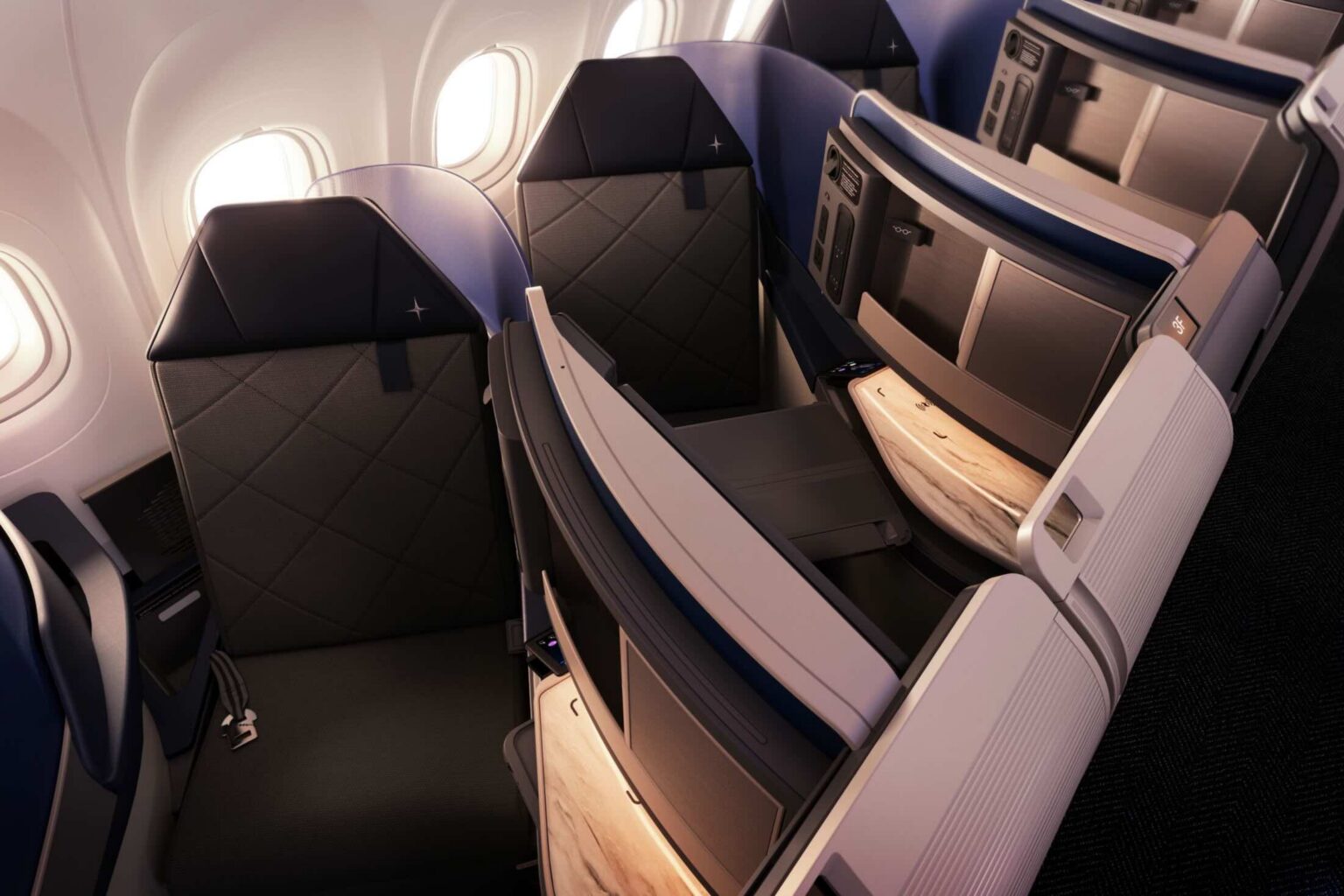
The plane will have direct aisle access lie flat seats, but like with other airlines operating this variant we’ll see herringbone seats where passengers are angled away from the window. (United threw shade at American in their press release: “This new suite is wider at the shoulder and elbow than similar competitor products”).
On these flights, premium economy becomes a real sweet spot because Northeast – nearer Europe flights aren’t that long, and there’s limited opportunity for true sleep. This is the same new seat as United will fly on their A321neo ‘Coastliner’ on cross-country routes.
One more thing to note about these business class seats – doors will initially be locked open ebcause they aren’t yet FAA certified.
Overall, ditching the old 757s is good. Coach gets better screens and overhead bins. To the extent that it replaces that aging aircraft and operates on new routes, this plane is likely an upgrade. Where it swaps out for a widebody as the airline downsizes on a route that’s going to be less desireable in business class for sure.
Those 757s are cheap, though, and this new plane will need to be filled with high fare paying premium passengers to work. Long haul narrowbody has always been niche. Increasingly airlines are betting on it, but it remains to be proven out.



I think 20 J is for a321neo/Coastliner? 321XLR has 32 J
Now if ONLY SWA can get with the program and make their first 5 to 8 rows – FIRST class – and ensure those seats also have RESERVED overhead bin space! Have any of you tried those extra leg room – UGH – not for someone who is 6’2″!!!!
As long as the XLR has lie-flat, this is a welcome upgrade for United; Delta really dropping the ball by keeping their ancient 757s, and giving up on lie-flat for their own XLR.
1989
DL is planning to put a lie flat seat on its trancson NEOs. They just happened to choose a seat vendor which couldn’t get the new D1 seat certified so are turning them into aircraft with a 44 seat domestic FC cabin in the interim.
and the DL 757s will leave as well – they are similar in configuration but are newer so have a few more years left in them. DL has already converted some of the transcon 757s into domestic config but has to hold onto the rest of the international 757 fleet until they get the transcon 321NEOs and their seats certified.
UA basically intended to do this coastliner concept on MAX10s but switched to 321NEOs to have a non-XLR version of the 321NEO which is to be used only on domestic transcons.
That looks even tighter than AA’s, and that’s saying something.
I have never understood why airlines angle premium seats away from the window. I love to look out the window.
Westbound winds flow from the east and are bound for the west thus would help airplanes fly from Europe to North America. They would be Easterlies since that form of description uses where the winds originate from. Unfortunately for flying from Europe to North America, the winds at those latitudes are Westerlies. Westerlies are eastbound winds that slow down the ground speed of airplanes flying west through them thus causing more fuel burn for a given distance compared to a no wind situation. In the wintertime, the Jetstream shifts to a location that impacts more of westbound flying. The options are to fly through it or to divert around it. Diverting creates a longer path but it is done to a degree that minimizes fuel burn while still arriving at the designated time. On the other hand, flying from North America to Europe is aided by the wintertime Jetstream the same as flying from eastern Asia to the North America is.