
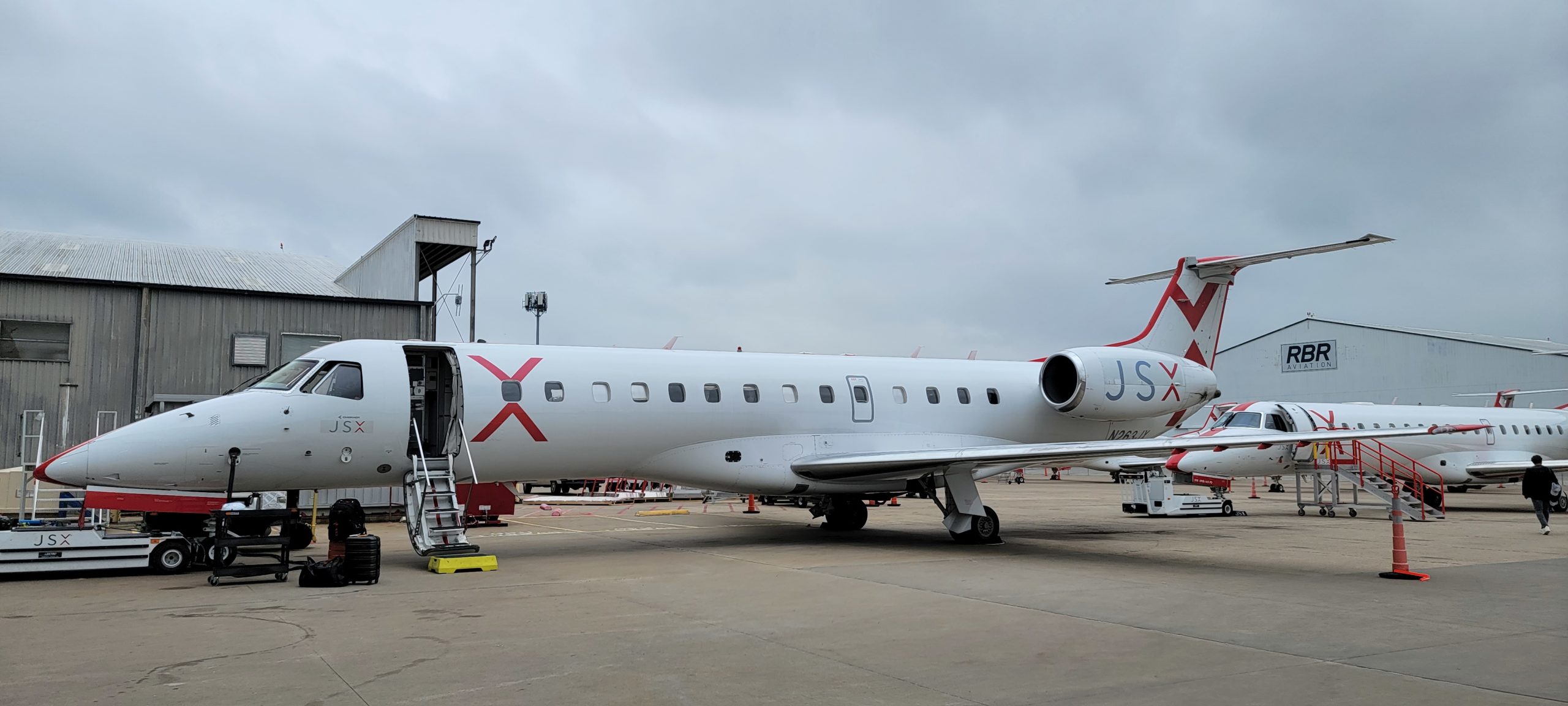
Patent Armory Inc. has to be my favorite name for a lawsuit plaintiff ever. They’re basically announcing themselves as patent trolls. They sued Dallas-based air carrier JSX on Thursday, accusing the public charter operator of infringing two patents for the way its customer service routes calls., covering the idea of using software to match demand and supposedly optimizes outcome.
- Patent No. 7,023,979 “Telephony control system with intelligent call routing” for classifying incoming calls, comparing them to call center agent characteristics, and selecting an optimal agent to route the call to.
- Patent No. 9,456,086 “Method and system for matching entities in an auction” for automating matching based on things like economic surplus and opportunity cost.
That first patent actually expired on November 13, 2023, so they can only sue for past infringement and there’s no compounding damages for future infringement. The second patent will be active through August 26, 2027.
Patent Armory has appeared to sue more than 90 times since acquiring the patents three years ago. They sued Delta a year and a half ago, and that suit lasted only about three months before being voluntarily dismissed.
The lawsuit claims JSX infringed the patents through its call center routing, and continued to do so after receiving notice of the infringment (and therefore the infringement was willful). But it doesn’t appear to really explain what JSX actually does and how it maps onto JSX’s call center activity for. In other words, there doesn’t seem to have been much pre-suit discovery to identify if there’s actually infringing activity, or a clean explanation of the exact product or vendor being used and how that infringes.
Hertz successfully attacked a similar suit as just an abstract notion of “evaluating communications data to make a routing decision”. One analysis concluded that,
Patent Armory has proceeded in a file-and-settle fashion, with a majority of complaints having been dismissed at the early pleading stages.
A classic patent troll is suing American Airlines and Southwest over their free wifi setup. Another patent troll successfully sued TSA for sending trays through its checkpoints and using carts to move the trays back and forth from one end of the checkpoint to another.



These low life’s even make ambulance chasers look good. What losers
A “Voluntary Dismissal” on the docket often indicates a settlement.
We need to adopt the English system, so that losing plaintiffs pay defendants costs. Many, if not all, of these frivolous suits would disappear overnight
”’Telephony control system with intelligent call routing’ for classifying incoming calls, comparing them to call center agent characteristics, and selecting an optimal agent to route the call to.” Amongst the features needed in patent reform is not to give patents to ideas that are intuitive and probably considered by people at happy hour now. Nothing patentable IMHO there.
@This comes to mind – there is a lot of controversy in the IP space about so-called “process patents”. There are many which are simply description of a process (often widely used but not directly copied since often intuitive) then you have scum like this trying to sue. There are numerous examples (like the mouse on a screen, placement of icons on a computer home page, etc). They almost always get thrown out or quickly settled for a very small amount (to avoid paying attorneys to win the case which is often what would happen). Unfortunately, you have low lifes attorneys that know they will get some settlement to make it go away and continue to press these cases. I agree making the losing party pay (often you can’t even sue them for damages after a case is thrown out) is the only way to make it not worth their time.
@This comes to mind: Patents should not be given for ideas for processes that have not been actually developed. I can think of 1000 things we could do, but I have neither the time nor capability to actually develop them. USPO is allowing patents to be issued for dreams, not products or processes. Imagine if someone had obtained a patent for “a device using electricity to produce artificial light” but had never actually designed or developed a light bulb, nor explained the process by which light would be produced and then sued the hell out of Edison. Yet, that is exactly what is happening today.
@ Gary — This is our patent system working as intended.
This comes to mind has a good point. This is similar to patenting the wheel.