
United Airlines Scott Kirby has made various claims about how much money American Airlines is already losing at Chicago O’Hare as he’s sought to grow his own schedule in a money-losing way, figuring he could bleed American even more – and in classic antitrust dumping fashion push out competition and eventually raise his own prices.
- About $800 million a year on a run-rate basis in September 2025.
- About $500 million lost at O’Hare in 2025 which he contrasted with United making about $500 million there.
- Potentially $1 billion in 2026 as he sought to bury them.


I’ve cast significant doubt on the magnitude of these losses, while suggesting that American does lose money in Chicago today. My core point has been that (1) how you do the math, allocating costs to hub and credit card revenue, changes the picture significantly, while (2) Chicago relevance is critical for the success of American’s cobrand credit card which is how the airline actually makes its money.
American has been pretty quiet on the actual performance of the hub from their perspective, although at the end of January Chief Commercial Officer Nat Pieper elaborated on this point about the credit card.
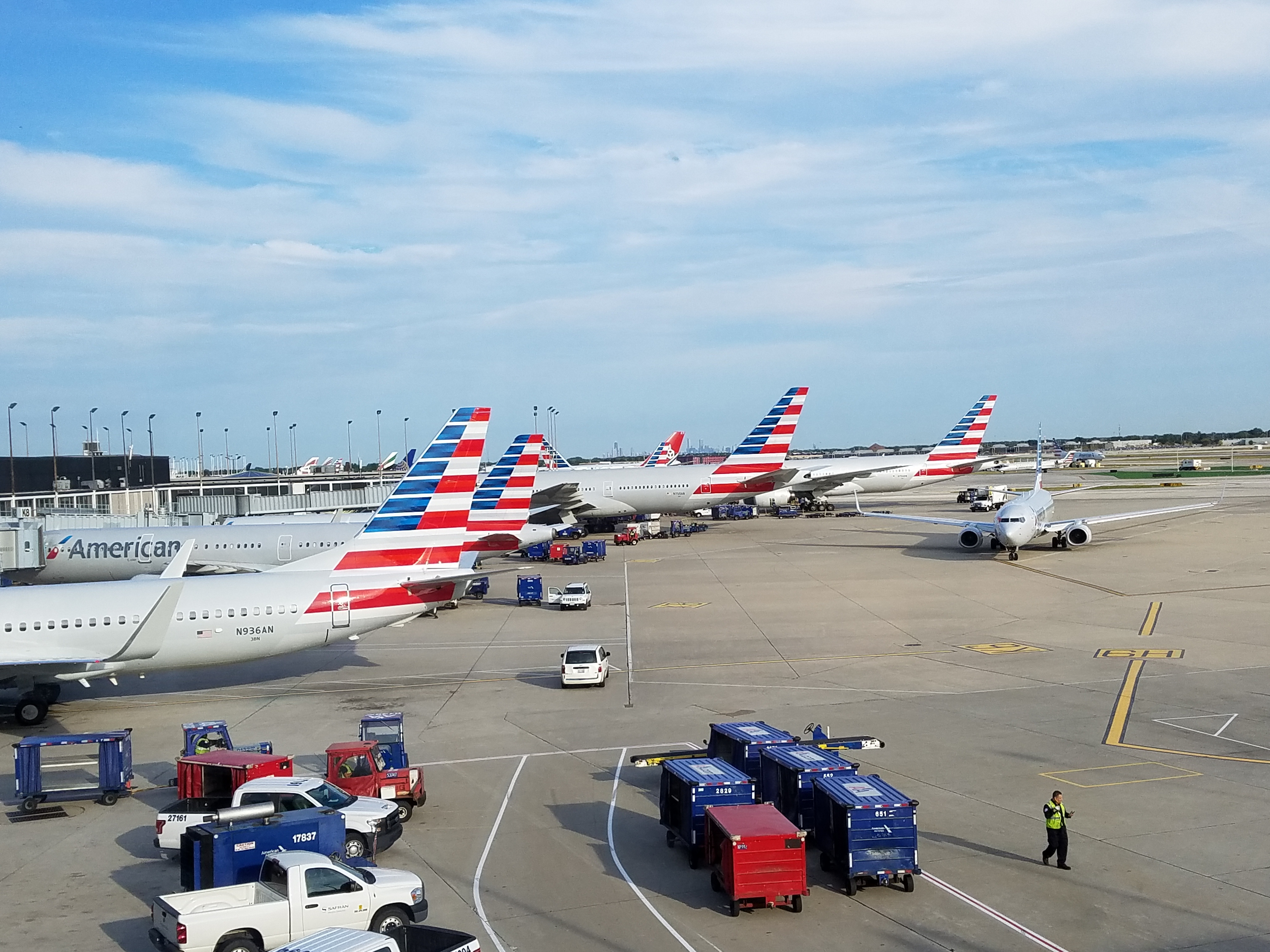
At the J.P. Morgan Industrials Conference on Tuesday, American’s CFO Devon May finally answered the charges that they’re losing significant money at Chicago O’hare. He gives something of a technical answer, claiming that in the ways that matter for decision-making, Chicago O’Hare actually makes money. I’ll explain.
Sure. I’ll maybe take you back to some old managerial accounting and activity-based cost and systems. But American Airlines, along with every other airline and probably most companies when they’re looking at the profitability of a different product or a different factory, whatever it might be, it’s going to be looked at a handful of different levels. The first is how is your profitability against the direct operating costs associated with operating for us that hub or that flight. All of our hubs are profitable at that level. That’s a decision-making level.
Next is it covering the actual assets that are allocated to that hub. So in our case, it’s largely is it covering the cost of ownership. Not really a pure ROIC type review, but like a P&L type review inclusive of ownership. It does include costs that maybe are fixed or a little bit more fixed in the near term. So things like calendar-based maintenance expense, sorry, airport rent expense, which, in many cases, is fixed over a longer term. So you slide some of that into a fixed category. But in our case, when you account for some of these fixed costs, all of our hubs are profitable on an after ownership basis. That’s another decision-making tool.
The last one isn’t a decision-making metric at all, but it’s just there for interest. It’s there because people understand what pretax margin looks like. The way we run an activity-based costing system is effectively, it takes it down to a pretax level. And it’s because that’s a metric that people understand. Some companies might use more of an EBIT level for us, it’s a pretax level. All of that does, it allocates overhead. So it’s not necessarily that a hub or a market is driving overhead. It’s an overhead allocation. You can use it to rank hubs. You can use it because people understand the metric, but it’s not a decision-making tool.
So in a year like 2025, we have some hubs that don’t make money on a pretax basis. We have some hubs that make money on a pretax basis. But it’s not something that we’re basing or making decisions on because when we look at it on versus direct operating costs or direct operating costs, inclusive of ownership, everything contributes positively to the system.
Just one other note that flight profitability systems don’t take into account is the entire network effect. If you cancel a flight out of a spoke station or if you shrink a hub, in our case, we had a smaller hub in Chicago for many years, you have less of a customer proposition in the spoke station. As you grow it back, your customer proposition in that spoke station becomes better. That’s what we’re seeing in Chicago right now.
The last thing that these profitability systems don’t include is the impact to your co-brand program. If you’re much smaller in a city, it’s not necessarily a good thing for your co-brand program. It’s not reflective directly in most of your hub profitability. But it’s something that we look at when we’re looking through just at a really detailed level, what does a hub or what does a flight do for the profitability of the network. So we look at it at a lot of different levels. Every company does the same thing. All of our hubs contribute positively to our system profitability right now. But that’s the way we look at flight profit, and that’s how we think about it at a flight level or a hub level.
May argues that you’re using the wrong profit measure if you think O’Hare is a money loser. There are different ways to measure whether a hub makes money.
- Does flying at O’Hare cover the direct costs of operating there, including crews, fuel, airport handling, etc? He says Chicago covers those costs.
- Does it also cover the costs of the assets tied to that hub? That includes things like airport rent and ownership-related costs. He says yes, even after including those more fixed costs, Chicago is still profitable.
- Finally, after allocating corporate overhead, does it still show a pretax profit? Here you’d include a share of companywide overhead like headquarters expense and all central costs. Since American was basically break-even in 2025, it’s not surprising that not every hub passes this test.
May explains that fully allocated overhead isn’t how they make decisions. It’s somewhat artificial, getting assigned a bunch of costs it doesn’t really cause. So “losing money” depends on what you include.
If you look incrementally, “If we operate this hub, is it adding positive value?” Chicago O’Hare passes that test. If you look at fully allocated accounting profitability – “After assigning a slice of all corporate overhead to it, does it still show a pretax margin?” – then it does not.
Chicago covers its direct costs plus asset ownership costs, therefore it is economically helping the airline, even if a fully allocated pretax view might make it look weak. That’s all pretty standard. And once you allocate overhead, you can make almost anything look worse.
If Chicago generated $100 of contribution after local costs, then corporate accounting assigned it $120 of headquarters overhead, it “loses” $20 pretax. But shrinking Chicago wouldn’t actually eliminate that $120 of overhead. So the business wouldn’t be better off shrinking Chicago. Allocated overhead isn’t the same thing as profitability drag.
Then he adds two important points about hub profit metrics: network effects and credit card effects. If American shrinks Chicago, then passengers in smaller spoke cities have fewer useful connections. That weakens the whole network. That Chicago flight supports itinerary options, customer loyalty, and relevance in surrounding markets. And related to that, a smaller American in Chicago means fewer people there are likely to care about AAdvantage and its cobrand credit cards. Investing in Chicago means more cobrand card acquisition and spend.
That is an important point. It’s why the JetBlue partnership in New York mattered so much (relevance in the most important spend market in the country). It’s why their Alaska partnership was supposed to be so important, because American is weak in the Bay Area and Pacific Northwest. And it’s why American’s relative decline in New York and Los Angeles was such a mistake.
May is correct that in capital-intensive network businesses, fully allocated accounting profit is often a poor guide to operational decisions. To the extent that O’Hare covers variable costs, fixed ownership costs, strengthens the network, and supports loyalty revenue, then calling it a “money loser” is sloppy and wrong.
However, it’s also important what he does not say. He doesn’t claim O’Hare is earning an attractive return on capital, or outperforming other places they could invest. He isn’t saying adding flights in Chicago offers better economics than in Dallas, Charlotte, or Miami. O’Hare can be positive, while still an inferior use of aircraft and capital.



Glad you covered this which I saw as well.
The reality is that AA’s network is far better suited for domestic connections than UA’s and ORD is a workable and viable part of AA’s network. UA does not have a DFW size hub, let alone at ATL. And Chicago is sandwiched between DL’s DTW and MSP hubs which give DL the largest position in the Midwest, something UA desperately doesn’t want to admit it can’t break unless it takes out AA at ORD.
It is obvious from UA exec statements that they hold a different standard for profitability of their own hubs than they use for other carrier hubs and credit card revenue is part of it.
As you noted elsewhere, AA’s new credit card deal gives AA a bigger an advantage and, while they don’t have as much strength on the coasts as they did or should, they have alot of strength in small and medium sized markets as well as in the fast-growing south.
It doesn’t really matter how the accounting works because AA was never going to leave ORD as a hub and the FAA simply confirmed that UA will not be allowed to flood ORD w/ a bunch of flights to try to drive AA out.
Another failed UA strategy while AA defies another of the predictions of death from its competitors.
American got unlucky with both losing NEA and having Citi (as opposed to Chase or Amex) as their big-bank sugar-daddy. Is still think this whole ‘scuffle’ at ORD is astro-turf. Until there are actual benefits to consumers, like, more affordable fares due to increased competition, it’s just fodder for blogs. (Not a problem for us, because, after all, we like our hot-goss here; thanks as usual, Gary…)
I’m trying to figure out how any hub is making money for American. They reported a net profit of only $111 million for 2025, which most likely can be all attributed to their credit cards. If a hub is “making money”, I would assume CLT and/or DFW.
Lets analyze Tim’s comment for fun here:
The reality is that AA’s network is far better suited for domestic connections than UA’s (well that’s subjective but sure…) and ORD is a workable and viable part of AA’s network (probably). UA does not have a DFW size hub (irrelevant we are talking about a city thousands of miles away), let alone at ATL (even more irrelevant as it is a different city with an airline not even in this equation). And Chicago is sandwiched between DL’s DTW and MSP hubs (two hubs that people hate and don’t want to fly to) which give DL the largest position in the Midwest (The largest position in the worst market in the US – wow congratulations), something UA desperately doesn’t want to admit it can’t break unless it takes out AA at ORD (United doesn’t even talk about breaking Delta in the midwest because of the points I raised earlier, United also doesn’t admit it can’t beat Hawaiian in Hawaii either – this is really just another irrelevant conversation).
It is obvious from UA exec statements that they hold a different standard for profitability of their own hubs than they use for other carrier hubs and credit card revenue is part of it (United execs don’t make claims like this to be factual, they do it to drive media hype, like this post from Gary that American is losing, there is no way under the sun that AA will dehub ORD in the next 10 years, but if Kirby says stuff like this it drives media asking the question on what the basis for his claim is).
As you noted elsewhere, AA’s new credit card deal gives AA a bigger an advantage (Sure in terms of economics it is better but Citi is a weaker bank than JPM in terms of distribution) and, while they don’t have as much strength on the coasts as they did or should, they have alot of strength in small and medium sized markets as well as in the fast-growing south (“The fast growing South” – I agree faster growing than other US sates, but no state is growing quickly – the difference between 1.5% growth in the South vs 1% growth elsewhere is not really a big driver)
It doesn’t really matter how the accounting works because AA was never going to leave ORD as a hub (agreed) and the FAA simply confirmed that UA will not be allowed to flood ORD w/ a bunch of flights to try to drive AA out (also true).
Another failed UA strategy (not necessarily they have driven a huge amount of media while literally not having to fly an empty plane this Summer to show that AA has been flailing in ORD and have driven business to themselves) while AA defies another of the predictions of death from its competitors (I wouldn’t call it a prediction, more media hype).
This whole thing reminds me of a West Wing Episode where Bartlet calls his rival a .22 in a .357 magnum world. He says it was a mistake and it drives a huge amount of media spin questioning the intelligence of his rival and then you realise at the end that it was never a mistake. Kirby is wrong here and he knows it, but thats the point – people in Chicago now think American is struggling there – whether they are or not.
“A Deutsche Bank analysis this week estimated United generates about $10 billion of annual revenue tied to Chicago, compared with just over $5 billion for American, and put United’s 2025 operating margin in the market at about 5% versus an estimated negative 9%-10% for American.”
https://www.reuters.com/business/americans-chicago-showdown-with-united-airlines-becomes-key-test-turnaround-2026-02-05/#:~:text=A%20Deutsche%20Bank%20analysis%20this,9%25%2D10%25%20for%20American.
so the summary of what you said is that my assessment of UA’s strategies is correct.
UA is a smaller domestic airline and hoped to get closer to AA and DL’s mega southern hubs with dominance that UA only enjoys in EWR, IAD and SFO – coastal hubs – but the only mid-continent hub where UA has dominance is IAH – and THAT is why UA needed to get AA to fold even if it meant trash talking them out of existence.
UA was counting on trash talking itself into a bigger role while trash talking AA into a smaller position – and it was all shot down by the feds that aren’t the least bit impressed by the suck up language.
Got it.
@Tim Dunn — ‘For fun’ (as @Andy says), how about another detailed CASM/RASM analysis, sir?
A Deutsche Bank analysis this week estimated United generates about $10 billion of annual revenue tied to Chicago, compared with just over $5 billion for American, and put United’s 2025 operating margin in the market at about 5% versus an estimated negative 9%-10% for American.
@1990 – I don’t think AA got unlucky with Citi. I think that unlike JPM (who is the largest domestic bank and until the C1/Discover deal was also the largest CC issuer) Citi actually is looking to grow market share. Citi also values AA cards (just check the Citi securitization trust SEC filings – AA card members have much better payment rates than the other junk Citi threw in those tranched offerings, and there are risk factors about what it would mean if AA cards were not included in the portfolio). Barclays is a big player in aviation debt finance markets (they lend to AA/Delta among others) and AA for awhile was trying to please everyone by having a split program with Barclays/Citi. I think unlike United-Chase (United can grumble all they want but it’s going to be really, really hard for them to leave Chase), AA actually successfully played the game with Barclays/Citi over the long term and ultimately got a good deal out of Citi for consolidating the business. And as the number of Citi Strata Elite posts indicate, Citi is trying to expand its market share…
Despite poor prior decisions with NYC, NEA, etc., AA isn’t leaving ORD, and now has Citi fully backing them up with a good co-brand deal. But can’t fault United for being bombastic I suppose – that’s a language the current administration speaks.
Interesting that Devon felt compelled to speak to it at all.
I’d guess UA’s pressure campaign may not be entirely successful, but it is taking away cycles AA execs could be using to think about future strategy instead of defending an existing one.
@Evan – It could be that the business is operationally profitable (flying, hubs, etc all make money) but corporate overhead eats literally all of that.
It’s basically making an argument to gut HQ significantly, while HQ tries desperately to instead push cuts to frontline employees. It’s why we have only 1 agent for boarding now, or the baggage system remains the worst in the domestic industry, for example.
it is non-sense to think that AA execs can’t focus on multiple issues at a time.
It is even more nonsensical to frame this whole Chicago issue as anything other than a loss for UA but UA execs all the way down to the UA internet warrior brigade will try to say it is everyone else’s fault – except for the DOT/FAA who they will suck up to even though everyone else can see through it.
AA’s problem is low profitability across its entire network. If they can get their system profitability high enough at DFW, DCA and CLT, it really doesn’t matter what they lose or make at ORD so long as the bottom line works.
“And Chicago is sandwiched between DL’s DTW and MSP hubs which give DL the largest position in the Midwest, ”
You can keep saying this, Tim. But it’s still wrong.
Delta is the smallest of the US3 in the midwest when you take out the hub states — aka. Obviously DL is going to be the biggest carrier in Minnesota and Michigan — duh. They have hubs there. Combined, those two hubs are bigger than ORD.
Obviously, UA and AA will be bigger than Delta in Illinois — duh.
So you take out the hub states to actually consider whether having two hubs is better than one as you claim. Your claim that Delta’s two midwest hubs makes them superior? Data doesn’t support that. Absent the hub states, Delta is the smallest of the US3 in the midwest. I realize you absolutely hate data that doesn’t support your assumptions that you never bother to look up but stop repeating this nonsense about Delta’s two hubs being superior for DL in the Midwest in terms of size.
Seriously. How many times do you just repeat the same tired talking points hoping you can say whatever you want? It isn’t true. Delta’s dual-hub position at two weaker cities vs Chicago has made them the smallest vs AA and UA — or rather, it has not made them the biggest in the other midwest hubs where those hubs feed into. Which… is what you’re trying to suggest — that delta’s hubs have made them the biggest doing what a hub should do — bring in traffic from nearby. It has not done that.
Delta is the smallest carrier in the Midwest by every metric vs AA and UA. Southwest is also about 50% bigger than DL for seats in those states.
“Obviously DL is going to be the biggest carrier in Minnesota and Michigan — duh. They have hubs there. Combined, those two hubs are bigger than ORD.”
To be clear, combined those two DL hubs are bigger than either AA or UA’s hub at ORD. Those two hubs are not bigger than ORD overall.
And here I thought that airlines didn’t make ANY money flying people, but that their only profits came from credit cards. Apparently that theory is wrong?
quit smoking dope, Max.
You and you alone are the only person that thinks that analysis of regional strength involves removing market share in the entire state where the hub exists
You do realize that makes the largest carrier in Texas by your definition?
See how a78backwards it is?
You can’t admit that DL is indeed #1 in the Midwest so you lie and distort facts.
and to your last point, UA doesn’t and won’t ever have even 75% of ORD traffic – as DL has in at least 4 of its hubs and AA has in multiple hubs as well.
@Peter — As always, you’re onto something. American did get better terms with Citi since they basically threatened to move their entire portfolio to one or the other (and ultimately exited the Barclays co-branded relationship). That’s an interesting angle with Barclays being one of the major banks providing the actual loans for aircraft (hopefully, AA didn’t upset them too badly). I’m still a little skeptical on the Strata Elite long-term (happy for now using year 1 credits + SUB); and I’d imagine other consumers are making similar calculations. I still think the order is Platinum, CSR, Strata. (Must we discuss BILT, or still waitin’ on the Guinea pigs? Bah!)
@Tim Dunn — Could you emphasize ‘load factor’ a bit more? Would amplify your case, sir.
@Max Power — I must respectfully disagree with our esteemed colleague… I say, you two should smoke MORE dope.
@rebel – i’ve addressed the analysis, which is fully loaded (see devon may’s remarks) and doesn’t properly factor loyalty revenue. american is certainly losing money at o’hare. they lose money on most of their flying ex-loyalty revenue, and barely break even with it! but those numbers are likely high and in some sense it’s surprising their lossesa aren’t greater.
LTD says, “it really doesn’t matter what they lose or make at ORD so long as the bottom line works.”
Almost as entertaining as listening to the AAL CFO torture logic dancing around hub profitability. UA: +36 ORD gates, +14% PRASM, +22% share, +38% corporate share, +40% premium seats, +59% seats, 2x the int’l destinations and 130 new up-gauged aircraft in 2026.
A Deutsche Bank analysis estimated United generates about $10 billion of annual revenue tied to Chicago, compared with just over $5 billion for American, and put United’s 2025 operating margin in the market at about 5% versus an estimated negative 9%-10% for American.
@Gary Leff – As others have pointed out if all the AA hubs were “profitable” as the AAL CFO claims then AAL would be enormously profitable given DFW, MIA & CLT, obviously fare far better than ORD, but they are not. DB did an apples to apples comparison and they estimate UA has an operating margin of 5% and AA -9-10%. It is funny you were taking Devon May’s word for it.
P.S. Why doesn’t your site allow links that can enlighten your readers?
rebel,
if UA was as profitable as the numbers you throw around, UA would have margins and absolute profits higher than DL’s AND YET
Everyone knows that UA execs and its fan club exaggerate everything positive about UA and everythinig negative about everything else.
Jamie Baker was right.
Ed has no reason to worry that UA will come anywhere close to taking the first spot at JPM’s conference because it is reserved for the airline with the highest percentage of US airline profits (55% for DL) and highest profit sharing (DL’s pays more than the entire rest of the industry combined)
UA is #2 and its profits will sink relative to the industry as UA has to spend a lot more money on labor costs and pay more for fuel by virtue of being so west coast heavy.
AA will be just fine.
UA has failed once again at another strategy.
No one other than you is surprised
Nice analysis, Gary.
@Rebel
“As others have pointed out if all the AA hubs were “profitable” as the AAL CFO claims then AAL would be enormously profitable given DFW, MIA & CLT, obviously fare far better than ORD, ”
You’re usually a fun one to read, but lay off the UA kool aid. You sound as deranged as the UA execs and just parroting United Investor Relations. And to be honest, you’re starting to become as crazy a United fanboy as Tim is for Delta.
I think the AA CFO knows a bit more than you about their hubs and more than Scott Kirby. It’s pretty stupid to assume otherwise.
@MaxPower – It’s a Deutsche Bank analyst and it makes sense given AAL’s financial results and their hubs’ relative performance.
Like Hollywood movie accounting, it is in American’s best interest accounting wise to not show a lot of profit since that will trigger profit sharing.
The whole accounting picture about if Chicago is profitable for American Airlines would assign airports for all revenues coming from the credit card operations.
Even if Chicago is not profitable, it can still be necessary for a large part of American Airlines to work profitably.
@1990 – Agree with your order, but have to account for C1 as well. For the luxury cards it’s-
1. Amex Plat (clear market leader – the king!)
2. CSR (so many bad changes, but lounges are good and can still make this card profitable)
3. C1 (bottom line is it’s $395 minus $300 for access to C1 lounges that are new and nice)
4. Strata Elite (other than 6x citi nights, doesn’t offer me anything as an AA Exec card holder, and offers little to most others, but Citi has best ecosystem with Strata Premier / DoubleCash / CustomCash)
5. Bilt (completely awesome, other than the complete lack of confidence in the product and team behind it).
@Peter — C1 is my blind spot. Working on getting VX. Gonna take me a year. @L737 this is the plan!
@rebel
if your position is that AA’s CFO is lying to investors, great. Otherwise it’s pretty clear the Deutsche Bank is, as usual, wrong.
They aren’t really known for being at the top of the analyst group but… they are known for just publishing data like you mention provided to them by companies like… United
You’re betraying a bit where you work, Rebel.
@MaxPower – Sorry, but AAL only made $111M in 2025. The CFO is using accounting games to hide the obvious that DB highlighted. You might want to check out the latest episode of Airlines Confidential. Doug Parker of all people explained how the game works.
@Rebel
If you want to talk about accounting games, try Scott Kirby claiming all United hubs are profitable if you include credit card revenue then talking about rival hub profitability absent that revenue.
That’s about the only game being played.
And again. Unless you’re claiming the AA CFO is lying, this seems like a very clear and obvious story plant to Deutsche Bank by United and very in keeping with the coordinated public statements about AA @ ORD by UA execs.
Given how much United execs have gone off about AA in ORD — a concern they seem to really NEED the street to agree with them on since they can’t push AA out of ORD on their own clearly, a story plant to DB would be very in keeping with United and Kirby.
Even getting the corrupt city of Chicago on their side for gate reallocation hasn’t been able to push AA out of ORD so now United is resorting to other tactics. Making up their own P&L for American at ORD and providing it to DB, it seems
@MaxPower – To believe AAL’s ORD hub was profitable when the airline only made $111M over all their hubs defies basic arithmetic & logic, but knock yourself out.
@Rebel
To think the AA cfo knows less about his own hubs than Scott Kirby? That defies a lot more than your elementary arithmetic or a story plant by UA. Knock yourself out.
@MaxPower – LTD couldn’t build a better straw man. The AA CFO knows what he is doing and AA’s #s.
@Rebel
To think the AA cfo knows less about his own hubs than Scott Kirby? That defies a lot more than your elementary arithmetic or a story plant by UA. Knock yourself out.
too bad VWTW doesn’t have upvotes. This one and the last several exchanges would earn Max a bunch of thumbs up.
Rebel
get your head out from under Scotty’s desk and smell the fresh air.
@1990 @Peter — Woohoo! Let’s hope that new Hyatt Premium card isn’t too enticing…
Wow, MaxPower & LTD built identical straw men. Pretty funny.
You might want to check out the latest episode of Airlines Confidential.
Kirby needs to shut up he don’t work for us he doesn’t know anything about us anymore he needs to worry about his Airline and act professionally and stop whining like a little girl because Isom was selected over him when he was our President but he was so lucky that UAL needed a President and you got what you wanted not where you wanted but you got it and you are doing very well but stop the whining its enough get AA out of your mouth dude.
I live by IAH and in my little world, UA dominates, and I fly between IAH and ORD and DEN fairly often, so UA is a great fit for me. But by no means do I consider them the largest carrier in the Midwest. I’d put money on Delta, with AA in last place of the legacy carriers.
Purely anecdotal on my end though, as both Delta and AA have a miniscule presence at IAH in terminal A, and I never go to HOU other than to pick up friends that travel there.
Scott Kirby was shown the door at AA, because he asked too many times when Doug Parker was going to retire or relinquish the CEO position.
So, his attempt to portray AA as a failing carrier is sour grapes on his part.
Is he hoping that AA will fire Robert Isom and do whatever it takes to get him to move back to the Metroplex?
Or is he like Steve Wolf. Wolf was VP of the Western Division at AA. CEO Bob Crandall told Wolf that he did not foresee Wolf moving up on AA’s org. chart.
Wolf had stints at four different carriers (Flying Tigers, the original Republic, United, and US Air). None of his stints were particularly successful (especially if you compare Wolf to Crandall or Herb Kelleher at Southwest).
So, I think Kirby is trying to prove to AA that it was a major mistake to fire him.
However, if Kirby had succeeded Parker as CEO, would American look like United, or like the same tired AA that Parker created and Isom can’t figure how to fix?
All this is a fancy way of saying that American needs to remain relevant in major cities and hubs like ORD, NYC and LAX to remain a viable big 3 carrier – which is absolutely true. I’m glad Devon May realizes this.